


Zoological Survey of India has launched a three-year conservation project in Nagaland to assess and monitor Himalayan wild pollinators, with a focus on bumblebees, biodiversity and long-term conservation.
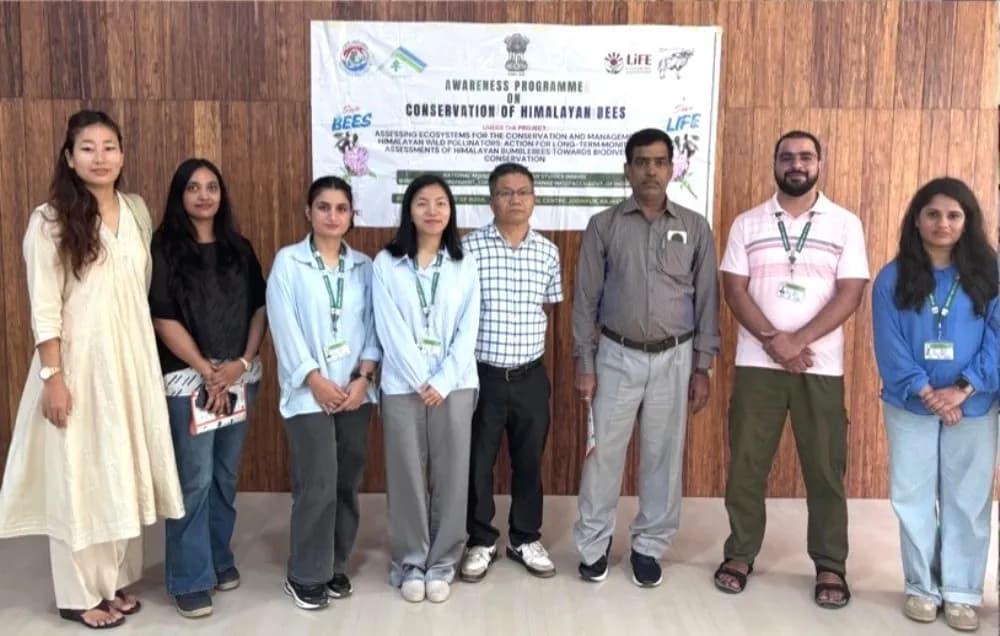
DIMAPUR — The Zoological Survey of India (ZSI) has launched a major conservation research initiative in Nagaland to assess and monitor Himalayan wild pollinators, with a particular focus on bumblebees.
According to a ZSI press release, the three-year project, titled "Assessing ecosystems for the conservation and management of Himalayan wild pollinators – action for long-term monitoring assessments of Himalayan bumblebees towards biodiversity conservation," is being implemented from 2026 to 2029 with financial support from the National Mission on Himalayan Studies (NMHS) under the Ministry of Environment, Forest and Climate Change.
The project aims to document the diversity, distribution and ecological role of wild pollinators while establishing long-term monitoring protocols to support evidence-based conservation strategies.
Field surveys are being carried out by a multidisciplinary team from the Desert Regional Centre (DRC) of ZSI, Jodhpur.
The team is led by Research Associate Dr. Muzafar Riyaz and includes Research Associate Purnima Pathak, Junior Project Fellow Aimen Rafiq and Project Associate Habung Elsa.
The project is being supervised by Dr. Rifat H Raina, Scientist-E and Principal Investigator at DRC-ZSI.
Also read: Nagaland: Researchers discover India's largest stingless bee in Wokha
Over the past week, the research team held a series of consultative meetings with the Nagaland State Biodiversity Board to coordinate field surveys across the state.
The survey will cover more than 20 villages across six districts to generate baseline data on pollinator diversity and distribution.
Alongside fieldwork, the team has launched capacity-building and awareness programmes for Forest department personnel and local communities, highlighting the importance of pollinator conservation for biodiversity, agriculture and forest ecosystems.
As part of the outreach programme, a knowledge-sharing session was held at the Divisional Forest Office, Zunheboto, on June 20. The programme focused on sustainable forest management and pollinator-friendly forestry practices.
On July 21, the team also visited the Department of Zoology at Nagaland University, Lumami, to strengthen academic collaboration. During the visit, Dr. Riyaz presented the project's objectives, research methodology and preliminary observations. An interactive workshop was also conducted for postgraduate students, providing hands-on training in pollinator collection techniques, museum specimen preparation, and morphometric and molecular identification methods.
The research team acknowledged the financial support provided by the National Mission on Himalayan Studies and thanked the Zoological Survey of India, the Department of Environment, Forests and Climate Change, Government of Nagaland, the Nagaland State Biodiversity Board, the Forest Department and Nagaland University for their administrative, logistical and academic support.
The project is expected to conclude in 2029 and is anticipated to produce a comprehensive inventory of pollinator species, a regional DNA barcode reference library for bumblebees, and detailed assessments of threats and vulnerabilities.
These findings are expected to strengthen scientific understanding and support future conservation policies for Himalayan pollinators.