


White Owl Literature Festival and Book Fair features discourse on podcasting as a means of storytelling.
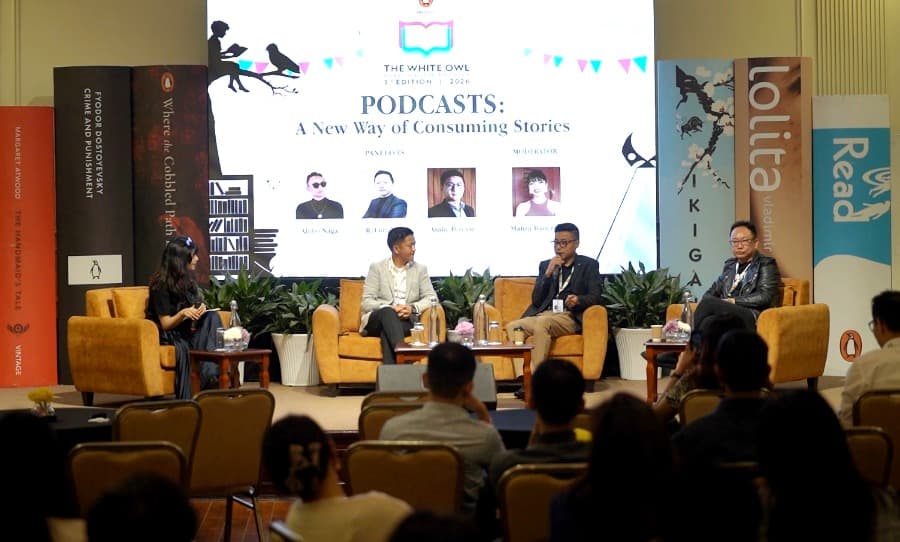
DIMAPUR — A discourse centred on podcasting as a means of storytelling, preserving oral traditions and amplifying voices on social issues took place on Saturday at the third edition of White Owl Literature Festival and Book Fair, presented by Penguin, at Zone Niathu by The Park, Chümoukedima.
The panel discussion “Podcast: A new way of consuming content” featured Alobo Naga, singer-songwriter and host of The Alobo Naga Show; political commentator and host of The Lungleng Show, R Lungleng; and host of Shout Out Media Asalie Peseyie, in conversation with Malini Banerjee, a media professional turned singer-songwriter.
Lungleng shared that he was inspired to start his podcast The Lungleng Show after noticing the stark contrast in development between Europe, where he studied, and his home region, which lagged behind in growth and development.
He realised that there was no effective way to convey these concerns to politicians, prompting him to create a platform for meaningful conversations.
When asked if politicians were tuning in, he replied, “They are listening.” He added that their familiarity with his podcast when he reaches out shows they are paying attention.
Also read: From books to bytes: White Owl LitFest on the creator economy
Lungleng highlighted how podcasts help preserve Naga histories and culture by reviving the traditional practice of oral storytelling, likening it to sharing stories by the bonfire, now amplified through tech — a “digital bonfire” reaching thousands.
He was of the opinion that while conventional news focuses on headlines, podcasts create a personal connection with the audience.
“It makes them feel like they hit home,” he said, adding that podcasts foster an emotional bond with the storyteller, making listeners invest in the narrative. The unfiltered, personalised nature of podcasts makes them uniquely engaging, he said.
Lungleng also sees podcasters like himself as a mix of influencers and journalists, filling a gap left by mainstream media. Podcasts are the new media trend, especially among youth, sharing news and stories uniquely, he said.
Peseyie sees podcasts as a revival of Naga oral storytelling traditions, where elders shared information and awareness with younger generations.
He believes that podcasts are a powerful tool for sharing stories and spreading awareness, acting as a new, organic form of journalism where voices are respected and heard authentically, without manipulation.
Podcast, he said, brings organic and authentic content that it respects even the listeners.
“We will serve you as it is and we trust your judgment. And we believe that you have the brain to accept to take what is good for you, what is true, what is not true,” he asserted, while saying that the conventional media will normally select what is good for the public.
According to Alobo Naga, he had always been a storyteller through his music and now exploring a new way to share stories, through podcasting. “I am taking a new identity of telling stories,” he said.
He admitted that as an artist, it is tough to listen to others as they are used to being the centre of attention.
But podcasting helped him understand different perspectives, enhancing his artistry perspective and changing his opinions and ideas.
“I go in with one view, but come out with a different one,” he said, appreciating the growth it brings to his artistry.
He highlighted the challenge of combating gossip and fake news, saying it is tough to change people's opinions once they're influenced by initial misinformation.
“The first gossip, the first fake news is always very strong,” he noted.
Cautious of the impact of spreading information, he noted that it is scary on how opinions can escalate. “We do influence people, sometimes even in a negative way,” he said while remarking that he would prefer not to be called an “influencer.”