


Journalists at White Owl Literature Festival warn that fake news and cyber scams are growing more sophisticated, threatening public trust and democracy.
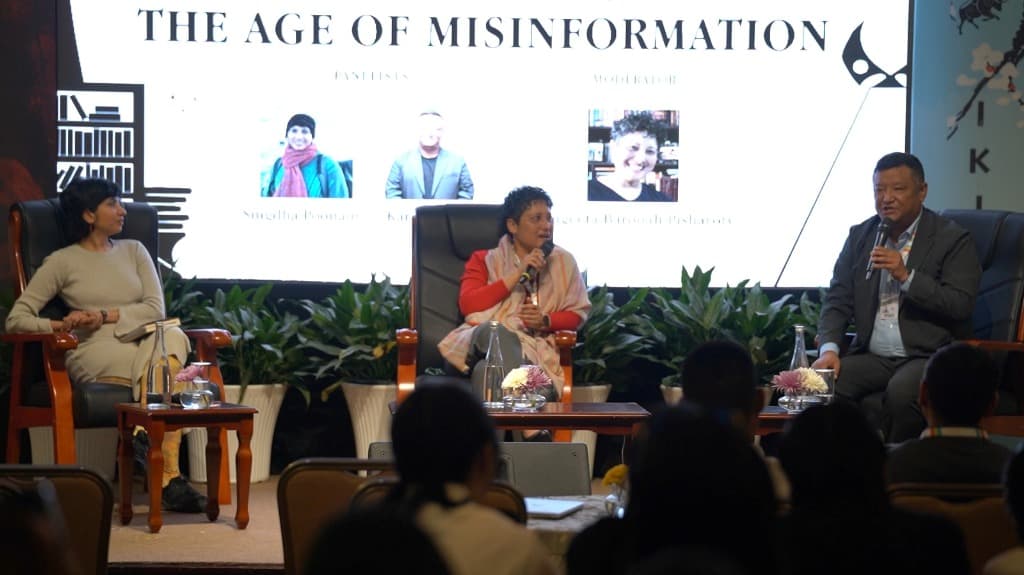
DIMAPUR — Journalists at the White Owl Literature Festival on Friday warned that misinformation and cyber fraud have become increasingly sophisticated and dangerous, with fabricated content, counterfeit news sites and organised scam networks now posing serious risks to the public and to democratic discourse.
The issue was discussed on day two of the festival’s 3rd edition during a panel titled ‘Fake News and the Age of Misinformation,’ moderated by journalist Sangeeta Barooah Pisharoty and featuring Karma Paljor, Editor-in-Chief and co-founder of EastMojo, and journalist-author Snigdha Poonam.
Opening the session, Pisharoty flagged how misinformation is often packaged to look like legitimate journalism and is increasingly finding space even in mainstream media. Responding, Paljor recalled his first encounter with fake news while covering the Sikkim earthquake, when a national television channel aired a video of a bus falling into a gorge and falsely claimed it was from the Northeast. He later found that the footage was from Colombia, identifiable from the Spanish language in the clip.
Paljor said misinformation has since become far more complex, citing fake death rumours on social media and counterfeit news websites designed to mimic national dailies by altering only a few letters in their web addresses. He warned that such content is frequently created to target specific communities and stoke violence, contributing to communal tensions.
Also read: From anime to oral storytelling, White Owl Lit Fest opens in Nagaland
Referring to the Manipur crisis, he said EastMojo chose not to publish disturbing, unverified videos despite online pressure and trolling, stressing that journalistic responsibility must prevail when content could harm communities or incite violence.
When asked how audiences, especially young people, can identify credible journalism, Paljor advised viewers to avoid channels driven by shouting and sensationalism and to seek out independent platforms, cautioning that stories which appear “too good to be true” often are.
Turning to cyber fraud, Poonam said India’s digital expansion has exposed people to both misinformation and financial scams, many of which begin with convincing falsehoods that can wipe out life savings. She recalled encountering a fake lottery scam that used forged images of national figures, noting that even educated individuals can be deceived.
Asked about Jamtara in Jharkhand, Poonam described it as one of the most compelling and alarming stories she has reported. She said organised fraud networks operate across villages, recruiting youths as young as 14 and training them with scripted calls and evolving techniques that track India’s digital growth from ATMs to mobile wallets. She warned that technologies designed for convenience often make scams easier as well.
Pisharoty also questioned Paljor on editorial standards at EastMojo, particularly amid concerns about government-led fact-checking mechanisms and the circulation of unverified reports by mainstream media.
Paljor said verification begins with firsthand reporting, including sending journalists to the ground to confirm facts. He lamented that journalism is becoming a “dying breed,” with many forgetting how to report real stories. He argued that educating the public about scams and digital privacy should be a core journalistic responsibility, adding that law enforcement alone cannot prevent fraud.
Responding to a question about the social realities behind scam calls, Poonam said her book Scam Land is grounded in field reporting and shows how scams thrive in the deep structural cracks of Indian society. She pointed to inequalities rooted in caste, religion, gender and political discrimination as factors that create environments where such frauds flourish. Highlighting villages that have seen little development for generations, she said scamming often emerges as a perceived route to social mobility and warned that unless these systemic inequalities are addressed, such crimes will continue.