


Creators at White Owl Literature Festival discuss authenticity, algorithms, online influence, and the evolving realities of India’s growing creator economy.
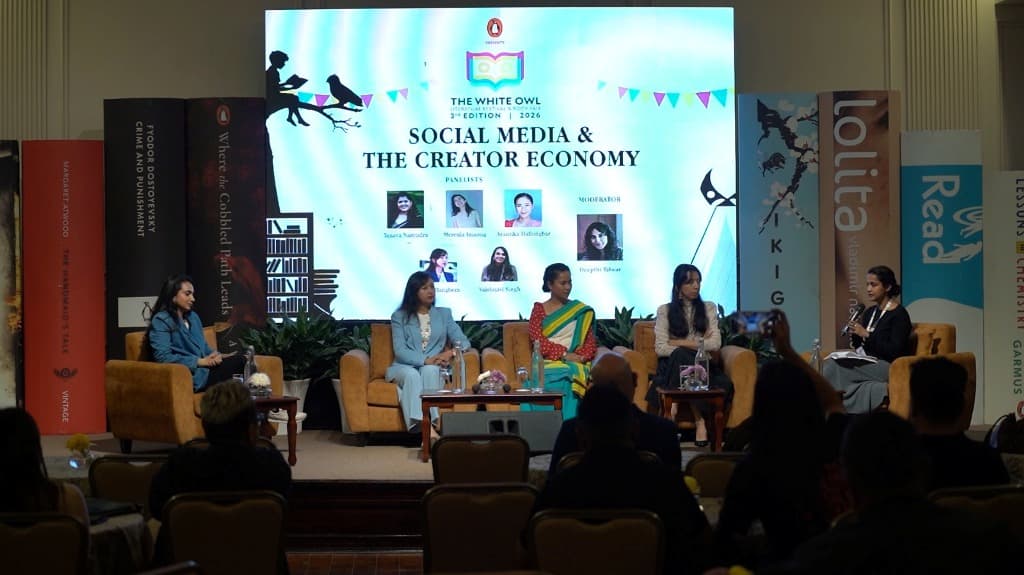
DIMAPUR — Three social media creators’ journeys—from quitting a corporate job to documenting indigenous culture and building communities online—took centre stage at the third edition of White Owl Literature Festival and Book Fair, presented by Penguin, on Friday, February 6, at Zone Niathu by The Park, Chümoukedima.
The panel discussion titled ‘Social Media & the Creator Economy’ featured Pooja Elangbam, a 2018-batch IAS officer from Manipur; Assam-based social entrepreneur Avantika Haflongbar; actor Merenla Imsong; and networking professional Vaishnavi Singh. The session was moderated by journalist Deepthi Talwar.
Sharing their experiences, the speakers said that they began creating content casually, without specific goals, but gradually discovered the power of social media as a tool for storytelling, awareness and community-building.
Haflongbar recounted how she initially began documenting her late mother’s traditional Dimasa attire on Instagram, sharing the stories and meanings behind the garments before eventually expanding into food content. The posts resonated widely and gained traction within days.
She shared that the pressure to remain consistent and constantly produce content eventually took a toll on her well-being. Haflongbar also flagged pay disparities faced by content creators from the Northeast, noting that brands often offer lower compensation compared to creators from mainland India.
“Everyone talks about the creator economy, but we do not really have a sustainable creator economy here,” she observed.
She cautioned young creators against expecting instant success. “Making reels will not make you rich overnight. Make content consciously, not just in the hope of going viral. You can’t buy an iPhone with Facebook money,” she said.
Haflongbar also highlighted how states like Nagaland and Mizoram are leveraging local economies, with content creators collaborating with local businesses to promote shops and services. She felt this model could strengthen local economies if adopted more widely.
Pooja Elangbam said that her Instagram account gained popularity after she began sharing her reading journey, particularly following her success in the UPSC examination. Responding to followers’ interest, she later launched a book club, transforming a personal habit into a community-driven space for discussions, book swaps and recommendations.
“I felt it gave exposure to voices from the Northeast. We often look up to national or international figures, but we don’t always recognise role models who look like us, dress like us and eat like us. I wanted to change that,” she said.
Elangbam also spoke about online trolling, especially faced by women, describing it as often petty but sometimes threatening. “Even for innocuous opinions, people can get very angry. It can be overwhelming,” she said.
Actor Merenla Imsong said that she does not approach content creation with the intention of being a spokesperson, but rather shares lived experiences as a woman. “I am conscious that my content reaches young girls. I want to make content for women,” she said.
Vaishnavi Singh spoke about credibility in digital spaces, using Reddit as an example. Quoting Reddit CEO Steve Huffman, she said that the platform functions differently from mainstream social media because content visibility is decided collectively by users.
“The upvote-downvote system lets people decide what resonates. You get the good, the bad and the ugly, but that’s what makes the discourse real and democratic,” she said.