


Thanamir village made its first appearance at the Hornbill Festival by launching a community-led bird guide from Meramkhanvong.
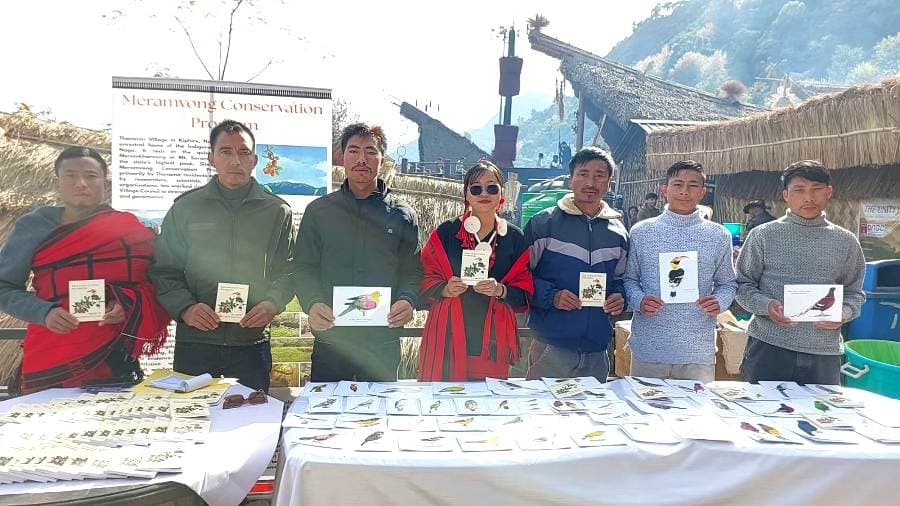
KISAMA — Thanamir village made its debut this year as the Yimkhiung representative at the Hornbill Festival, using the platform not only to share their culture but also to highlight the community-led conservation work taking place in the forests beneath Nagaland’s highest peak—Meramkhanvong or Mt. Saramati.
At the Yimkhiung morung on Tuesday, the Meramvong Conservation Programne released Meramkhanvong Wuhnupo (Birds of Meramkhanvong), a pocket guide featuring 150 species commonly found in the region. The book is the result of community-led research in Thanamir, a village that has emerged as one of the state’s most active sites for Indigenous conservation and biodiversity documentation.
The guide was formally launched by S Kiusumew, Advisor for Home Guard and Civil Defence, Fire and Emergency Services, and Relief. Postcards featuring bird illustrations were also released.
Speaking to Eastern Mirror, Sophia Yimchunger, Project Assistant with the Meramvong Conservation Programme, said the initiative is rooted in the community’s desire to “give back” to the land and safeguard a forest that sustains both livelihoods and cultural identity. Thanamir, tucked against the slopes of Meramkhanvong, has long relied on customary law to regulate hunting and resource use.
“Village communities in Nagaland have constitutional rights to own and manage their forests,” she said, noting that customary law and local governance plays an essential role in protecting biodiversity. “We are building on this foundation. Our work supports the village council’s aspirations through research, monitoring, and careful planning.”
Also read: Solar morungs bring clean energy to Hornbill Festival
Across Nagaland, more than 800 Community Conserved Areas (CCAs) exist today, each shaped by locally relevant rules and community leadership.
She said the conservation taking place in the Meramkhanvong landscape is grounded in this wider framework of strong local governance and ecological knowledge.
A growing body of local research
Since 2021, the programme’s community-led bird monitoring has recorded more than 300 species, a significant figure for a single village and nearly half of Nagaland’s known bird species. The new guide features 150 of these, chosen for their visibility and cultural relevance.
Sophia said the team aims to bring scientific knowledge home to residents. “We have created this pocket guide so that our community and the wider Naga society can learn from what we have documented. It is not just a catalogue; it is a way to foster curiosity and a connection to the land,” she said.
The guide includes hand-drawn illustrations by self-taught youth artists from the Yimkhiung community. Their artwork, combined with oral histories and traditional knowledge recorded during the research process, anchors the book in local identity.
Sale proceeds from the book and postcards will go toward the construction of the village church in Thanamir. “This is how we give back, by sharing what we have learned and supporting the community,” Sophia said.
Beyond birds, the team has recorded more than 28 species of mammals. A notable finding was the sighting of a clouded leopard at 3,842 metres above sea level, near the summit of Meramkhanvong.
Community engagement
Conservation in a region where hunting is culturally rooted brings challenges, but Sophia said engagement across age groups has been important.
“We take residents on birding walks, tell stories, and share knowledge. That is how we build the connection between people and nature,” she said. The team covers nine transects each month, sometimes accompanied by villagers.
The Meramvong Conservation Programme now consists of six local researchers, a project coordinator and a programme assistant. Partner organisations such as the Nature Conservation Foundation (NCF) and Wildlife Protection Society of India (WPSI) support research and capacity building, but the core remains community-led.
A press release issued for the launch described the guide as a milestone in Indigenous-led documentation emerging from one of Nagaland’s remote mountain areas. It also noted that this is the first time Thanamir has represented the Yimkhiung Naga community at the Hornbill Festival.
During the programme, advisor Kiusumew encouraged the community-based researchers to “go beyond boundaries” in raising awareness about conservation and praised them for creating a source of knowledge for young people.
Governance rooted in custom
Sophia said Thanamir’s approach reflects Nagaland’s unique governance system, where villages retain constitutional rights over land and forests.
Customary law shapes restrictions on hunting, regulates forest use and empowers youth and elders to protect their homelands.
“Within this system, our conservation landscape takes shape,” she said, adding that the programme aims to strengthen long-term forest governance rather than focus only on wildlife research.
The work includes documentation of oral histories, cultural knowledge and traditional livelihoods, acknowledging that conservation cannot be separated from the lived realities of the people who depend on the land. She said the team hopes Nagas will take a more active role in safeguarding species such as the hornbill. “Maintaining tree hollows for nesting and protecting hornbill-preferred trees is crucial,” she said.