


Cleanup workers at Hornbill Festival battle constant littering, managing 29 tonnes of waste while urging visitors to act responsibly.
-1765207358235.jpg&w=1200&q=75)
KOHIMA — For Nokeduto Thao and his team, waste management at the Hornbill Festival is a Sisyphean task. They pick up trash, collect waste and clear corners of Kisama only to find the same stretch littered minutes later.
“We clean the same place four to five times a day. Whenever we take a tea break, the stretches we cleaned some minutes earlier would be filled with waste again, and it is disheartening,” Thao said as he boarded the vehicle going back to the segregation site with another load of collected trash.
Some of the items he routinely picked up were gutkha (smokeless-tobacco) packaging and plastic water bottles. The most unpleasant waste he encountered were sanitary pads often discarded in corners. He said the area near Gate-2 was among the worst affected, where they frequently came across large amounts of litter.
The team
Thao is one of nearly 100 workers engaged by the Sanitation Support Team, a group of youths and mothers from villages around Kisama who have taken up the responsibility of managing waste at the festival.
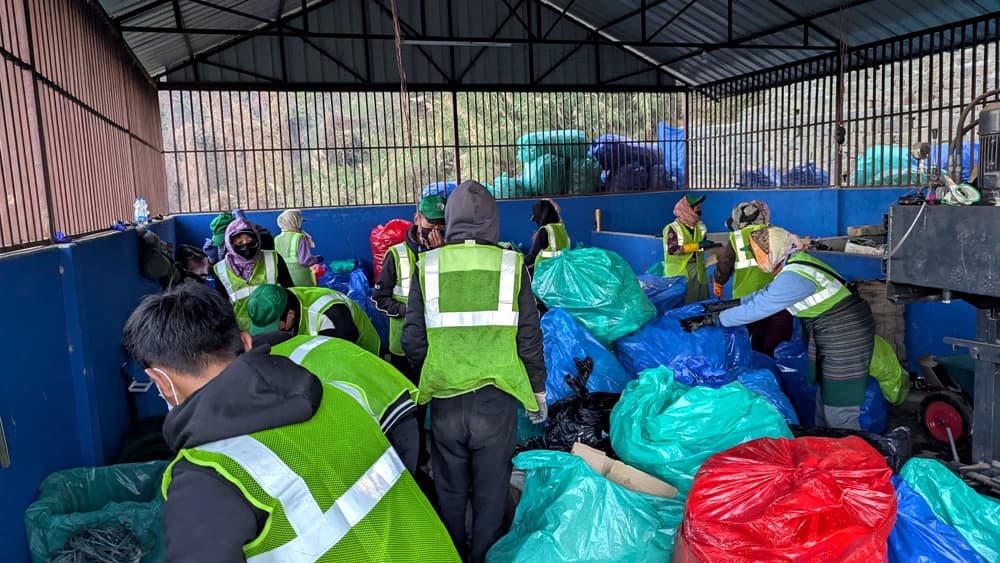
Their work begins before sunrise. Every day, around 80 to 100 workers gather at the segregation site as early as 5.30 am, receiving instructions from their team leaders before dispersing to stalls, morungs, roadside stretches and public areas. By 6 am, they are already on their feet, carrying sacks, gloves and tools as the arena slowly comes alive.
Yashiwapang, one of the two team leaders, said this year’s effort feels different because the group chose to work together as individuals rather than through a company. This led to the formation of the Sanitation Support Team which is led core members Yashiwapang and Niketou Theyo.
They invited interested youths and mothers from nearby villages to join, believing that the experience would serve as both employment and an educational opportunity. “The idea of inviting mothers was to educate them on the importance of sanitation and waste segregation,” Yashiwapang said. Around 12 to 15 mothers joined the team, with the rest being young people.
Waste collection happens continuously throughout the day, from stalls, roadsides, morungs and other activity areas. The team uses two pickup trucks and a Maruti Gypsy to gather waste from the source and transport it to the segregation site. Once there, everything is emptied and opened manually. Without any machines, workers separate each item by hand—protected by five layers of gloves and reflective vests.
-1765207362140.jpg&w=1200&q=75)
The site is sanitised twice daily, once before work begins and again after dispersal. So far, they have not encountered medical waste, but they have found deeply unhygienic items. One discovery left workers shaken: human waste wrapped inside a plastic container, abandoned along a walkway. They removed it for safe disposal.
Despite Kisama’s “eco-friendly” branding, Yashiwapang admitted that eliminating plastics altogether is unrealistic. “We keep saying eco-friendly, but that is not possible to materialise,” he said, adding that without plastic bags for stall-side waste or liners for bins, the entire system would collapse.
Growing mountain of waste
The volume of waste generated in the first week of the festival reflects both the crowd size and the public’s poor habits. Between December 1 and the 7th, Kisama generated more than 29 tonnes of waste—21,164 kilograms of biodegradable waste and 8,703 kilograms of non-biodegradable waste. Food scraps, garden waste, wood and paper made up the largest share of biodegradable materials.
Non-biodegradable items included plastic products, rubber, e-waste, synthetic fibres and Styrofoam. The team also recorded large quantities of recyclables during the week: 852.86 kilograms of plastic bottles, 728.4 kilograms of glass bottles, 207.7 kilograms of aluminium cans and 19.2 kilograms of tin and assorted materials. Cardboard waste collected between December 1 and the 5th totalled 248 kilograms.
Read more: Buyers-suppliers meet connects 22 Nagaland MSMEs with national firms at Hornbill Festival
After segregation, the Kohima Municipal Council collects wet waste, cardboards and plastics for disposal. Recyclables such as bottles and cans are sent onward for processing. The system functions smoothly for now, but the workers shared that public behaviour often undermines their efforts.
The lack of waste-management awareness has been frustrating for the team. Bins are placed throughout the festival grounds—around 100 in total, including green bins for biodegradable waste and blue bins for non-biodegradables—but many visitors ignore them entirely.
On his experience at Kisama, Thao said that while management is not easy, the labour has been worth it. The 26-year-old from Jakhama said the experience has changed him: “Now that we’ve learnt segregation, we will practice it at home too.”
Stall owners also need constant reminders to keep plastic bags handy so that waste can be collected efficiently. Even uniformed personnel on duty near Gate-2 often fail to use the bins, Theyo, the other team leader, said.
“We want people to understand that someone has to pick up what they throw,” Yashiwapang said. “If we all take responsibility, waste will not be a problem.”