


Patkai Christian College in Chümoukedima organised a lecture examining the shifting politics of the Inner Line Regulation.
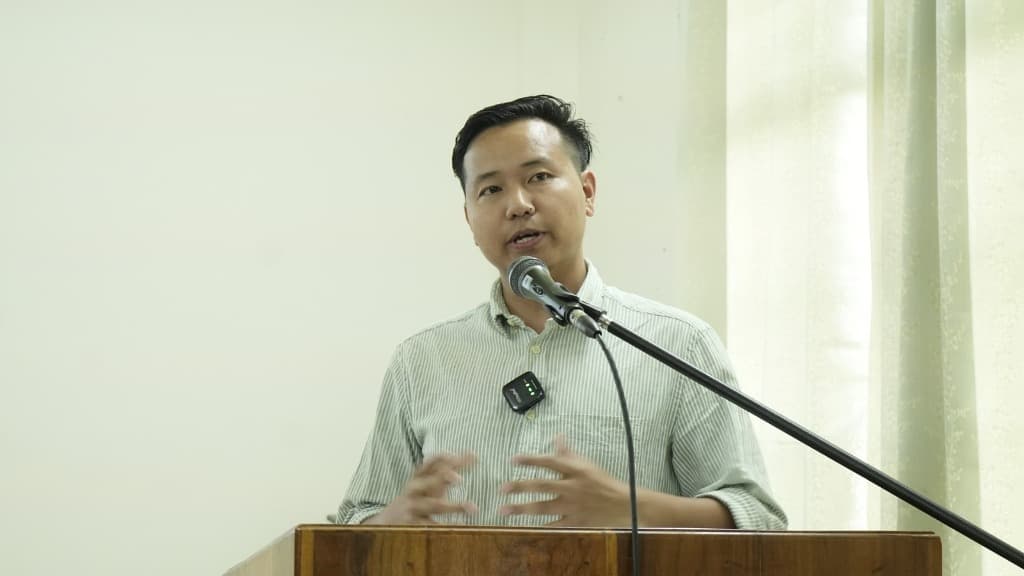
DIMAPUR — The Patkai Reading and Writing Club of Patkai Christian College (PCC) (Autonomous), Chümoukedima, organised a lecture on “Postcolonial entanglements: Reading the shifting politics of the Inner Line Regulation in Northeast India” as part of its Academic Engagement Series on Wednesday.
The lecture was delivered by Dr. Thejalhoukho Casavi, Assistant Professor in the Department of History, who presented a critical examination of the Inner Line Regulation (ILR).
According to a press release from the college, he traced its origins to the Bengal Eastern Frontier Regulation of 1873 and analysed its evolving role in postcolonial Northeast India.
In his address, Dr. Casavi highlighted that while the legal framework of the ILR has largely remained intact since the colonial period, its interpretation and political significance have undergone substantial transformation.
He observed that the regulation was originally conceived as a policy to define the jurisdictional limits of the British administration during a period when expanding commercial interests in rubber and tea threatened the stability of the Northeast frontier. He further emphasised that the discourse of 'protection of tribes' was never a consideration in any of the official correspondence relating to the inner line in the 19th and early 20th centuries.
Also read: ICSSR sanctions INR 20 lakh grant to Tetso College faculty
The radical shift in understanding the inner line as a policy to protect the tribes occurred in the late 1920s with the institution of the Naga Hills and Lushai Hills inner line, when the inner line was given a new interpretation aligned with anthropological discourse on protection through exclusion.
Dr. Casavi also noted that this new interpretation was intended to preserve the British Empire by preventing the spread of the Indian independence movement into the hill districts of Assam. Further highlighting the contested nature of the inner line in post-colonial Northeast India, he cited instances from the 1950s in which restrictions on the movement of activists and journalists in the Naga Hills were imposed under the pretext of security.
At the same time, he noted that in contemporary discourse, the ILR is widely regarded as a protective mechanism safeguarding indigenous identity and regulating migration. He further underscored the persistence of colonial continuities within the regulation, particularly in its role in constructing distinctions between “insiders” and "outsiders" and in shaping access to land and economic spaces, including debates over its extension to urban centres such as Dimapur.
Dr. Casavi also drew attention to the conceptual and political challenges associated with the notion of indigeneity, arguing that the inner line framework remains inadequate to address these complexities. He maintained that the regulation is intrinsically linked to existing administrative and political arrangements, which may themselves be historically contingent and contested.
The lecture was followed by an interactive session during which participants raised questions regarding the criteria for defining “indigenous” communities. Responding to these concerns, Dr. Casavi noted that prevailing definitions are largely based on state-determined benchmarks, including specific cut-off years such as 1963 and 1979, which are still debated.
He stressed that implementing the Inner Line Regulation requires a clear definition of indigeneity; however, entrusting this responsibility solely to the state raises serious concerns. He argued that such an approach may undermine the principles of self-determination, as the authority to define indigenous identity ideally rests with the communities themselves rather than administrative institutions.
Dr. Casavi further observed that attempts to formalise indigeneity within the framework of the ILR risk reinforcing existing political boundaries and exclusions, thereby limiting its ability to address the broader and more nuanced realities of identity and belonging in the region.
Wednesday's talk marked the commencement of the 'Academic Engagement Series', which is aimed at fostering critical inquiry, meaningful dialogue, and scholarly engagement among the campus community.