


NBSE and PARAKH-NCERT are conducting a four-day workshop in Kohima to strengthen competency-based assessment reforms.
Share


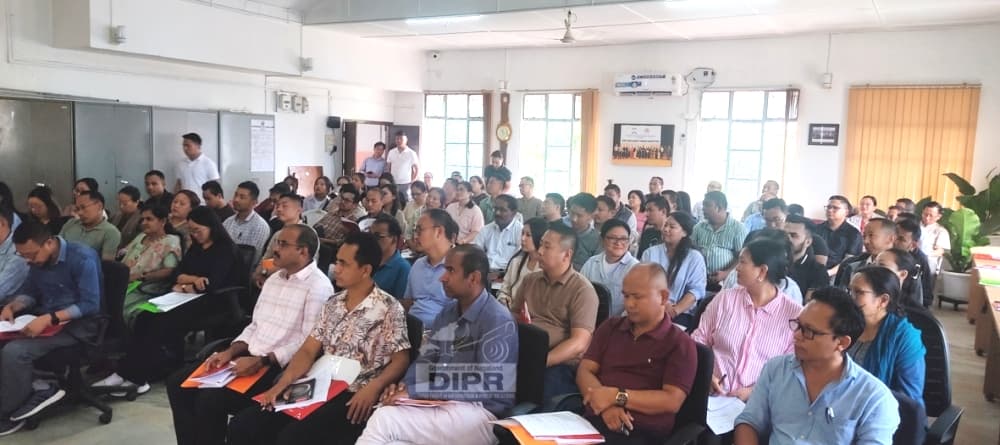
DIMAPUR — The Nagaland Board of School Education (NBSE), in collaboration with PARAKH-NCERT, New Delhi, is organising a four-day workshop on “PARAKH Taxonomy and Development of Competency-Based Question Bank for ITMS” from June 2 to the 5th at the NBSE office in Kohima.
Delivering the welcome address during the inaugural session, Rangumbuing Nsarangbe, Secretary and Chairperson (Additional Charge), NBSE, outlined the purpose of the workshop.
He said that the National Education Policy (NEP) 2020 has set the direction for transforming the education system, while the National Curriculum Framework (NCF) 2023 has begun translating that vision into practice.
Nsarangbe noted that PARAKH under NCERT has provided two key instruments to support this transformation—the Holistic Progress Card and the taxonomy and guidelines for developing balanced question papers.
He stated that the workshop would focus primarily on the latter.
Appreciating PARAKH-NCERT for its guidance, he said the partnership built over the past two years has helped shape the way forward for assessment reforms in the state. He also thanked the participating teachers for their continued support and contributions to the examination process.
Expressing confidence in the workshop’s outcomes, Nsarangbe said the deliberations and recommendations emerging from the four-day programme would help strengthen the fundamentals of examination question paper design.
Read more local news: Nagaland University Medziphema hosts 5-day poultry farming training
A keynote address and programme introduction were delivered virtually by Prof. Indrani Bhaduri, CEO and Head of PARAKH.
Speaking on the structured assessment taxonomy, she described it as a significant shift in India’s school education system, aligned with the vision of NEP 2020.
According to Bhaduri, PARAKH’s taxonomy provides a coherent framework for aligning curriculum, pedagogy and assessment with competency-based education. She explained that its conceptual foundation moves beyond traditional content-recall approaches by organising learning across progressive domains, ranging from foundational understanding to higher-order thinking skills such as analysis, evaluation and creation.
She further noted that the taxonomy supports the development of competency-based question papers by guiding item writers to design questions that are explicitly linked to defined competencies and cognitive levels, rather than relying on rote-learning-based assessment.
Bhaduri also highlighted the taxonomy’s integration with classroom-level formative assessment through the Holistic Progress Card, stating that it serves as a key mechanism for linking assessment practices with student learning outcomes.
She said PARAKH’s taxonomy forms the backbone of India’s transition to competency-based education by bridging classroom practice and board examinations through a unified, evidence-based framework.
The inaugural programme was chaired by Siduniu Rentta, Assistant Academic Officer, NBSE.
Altogether, 73 teachers from across Nagaland are participating in the workshop.