


Residents of three Kohima wards face a prolonged water crisis as disrupted PHED supply forces reliance on costly private tankers.
KOHIMA — Water, often described as the essence of life, is a basic necessity for human survival, and the World Health Organisation (WHO) recommends a minimum of 50 to 100 litres of water per person per day to meet essential Water, Sanitation and Hygiene (WASH) needs.
However, residents of three wards in Kohima have reportedly been grappling with prolonged disruption in water supply.
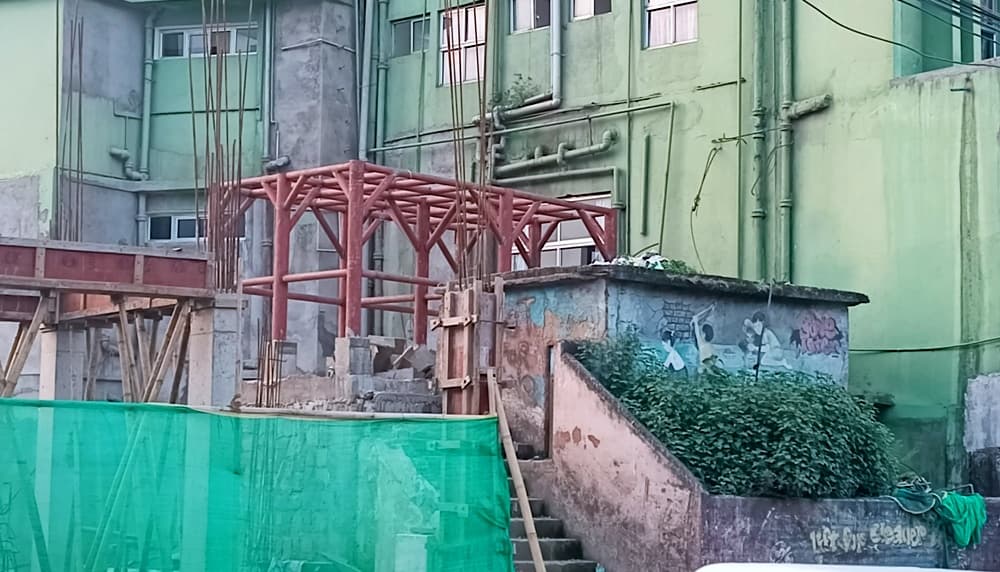
Sources informed Eastern Mirror that residents of Daklane (Ward No. 7), New Market (Ward No. 8) and Midland (Ward No. 9) have been affected by the interruption in water supply provided by the PHED, following the demolition and reconstruction of the erstwhile Tibetan Market building, where a key water distribution point is located between the building site and Oking Hospital.
It was learnt that earlier this year, the chairpersons of the three wards submitted a joint representation to the executive engineer, PHED, Kohima, seeking immediate restoration of drinking water supply from the Phoolbari distribution point near Oking Hospital.
In the representation, the ward authorities stated that the Phoolbari water distribution tank caters to the basic water requirements of the three wards. However, the supply was reportedly disrupted following private construction activity adjacent to the distribution point in September 2025.
Also read: Kohima pushes ahead with Teupuiki water project, Khonoma treatment plant plan reviewed
The representation stated that the disruption had affected several hundred households, forcing residents to depend on private water suppliers at considerable expense, particularly during the dry season.
The ward authorities further expressed concern that despite the issue being known to the department for several months, no remedial measures had been taken to restore the supply.
Appealing for urgent intervention, the wards urged the department to reinstall the affected pipelines and restore water supply at the earliest.
Meanwhile, a resident of the affected locality told this newspaper that the water supply has been disrupted since last year, yet the issue has not been addressed to date, and alleged negligence on the part of the department's engineers and officials in resolving the disruption and restoring the water supply.
Despite not supplying water through the pipeline, the department is reportedly still dispatching monthly bills to consumers.
The source also alleged that despite not increasing the source capacity, the department had enormously increased pipeline connections, resulting in a lower quantity of water supply.
It added that prior to the disruption of the distribution point, which has been ongoing for several months now, the water supply came only about four times a month (once a week), and that too for approximately 30 minutes, causing considerable inconvenience to consumers.
Another resident said the shortage has placed an additional burden on households, many of which are now dependent on purchased water and rainwater harvesting to meet their daily needs.
According to sources, a 2,000-litre water tanker supplied by private operators (Tata Mobile) comes at a significant cost, ranging from INR 1200 to 1500, adding to the hardship faced by families.
When this newspaper visited the affected area on Thursday afternoon, an iron structure reportedly meant to restore the affected water distribution point was seen under construction. However, restoration appeared to be far from complete, with no workers present at the site.