


Joel Richard Williams has become the voice of Nagaland football, winning fans with his energetic commentary and deep connection to the Dr. T Ao Trophy and local game.
Share


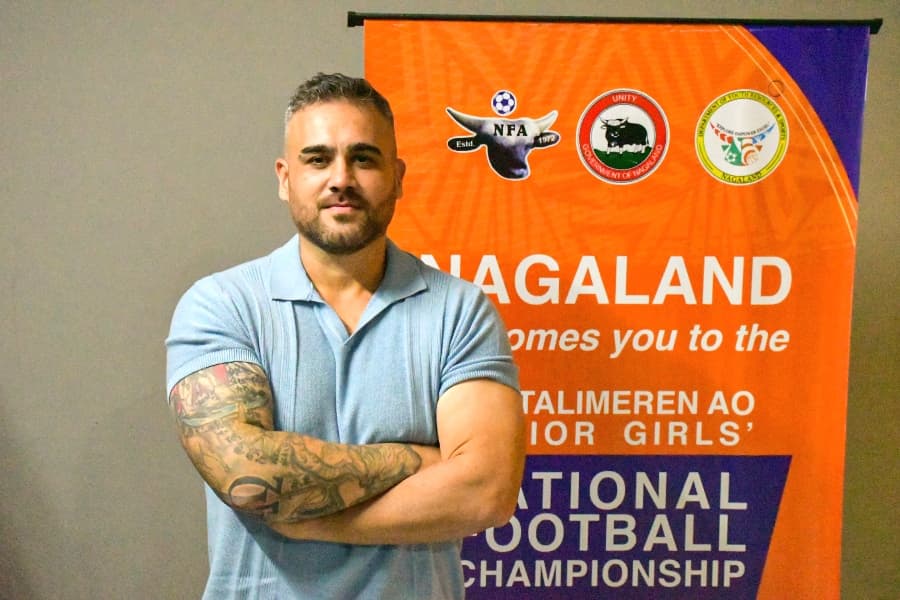
DIMAPUR — Nagaland’s football scene has found an unlikely internet sensation in Joel Richard Williams, whose high-energy and often hilarious commentary has propelled him to viral popularity across the state.
Joel’s connection with Nagaland began in 2022 during the 22nd Dr. T Ao Trophy in Mokokchung district, which was livestreamed on YouTube by SportsCast India.
Since then, he has become a familiar and much-loved voice in Nagaland football. His fondness for the state, its people and the easy rapport he shares with viewers has ensured his return season after season.
His commentary career, however, started far from Nagaland. In 2016, Joel was unexpectedly thrown into the I-League with no prior experience.
He has since spoken openly about overcoming a teenage stutter that once made public speaking a struggle. After three-and-a-half years of speech therapy, he turned that challenge into a strength.
Today, he speaks fluently on air, often sharing a simple message: no matter what blocks you, there is always a way forward.
At the recently concluded Dr. T Ao Junior Girls National Football Championship 2025–26 (Tier-2) in Chümoukedima, Joel, who handled commentary and was present for the finals, spoke about his journey to Nagaland and his growing attachment to the state’s football culture.
Read more: Maharashtra win Dr. T Ao Junior Girls National Football Championship
Joel, who also coaches for Gokulam Kerala FC, recalled that before 2022 he barely knew where Nagaland was when he first heard about the Dr. T Ao Trophy.
SportsCast India had offered him a choice—broadcast an India SAFF U-20 match or cover a local tournament in Nagaland. While the international assignment paid more, curiosity led him to choose the unfamiliar.
“Why not try something new?” he thought. He arrived in Nagaland with little knowledge of its culture, cuisine or tribes, but was met with a warm reception. “The rest,” he said, “is history.”
Asked whether he prefers commentary or coaching, Joel said that the two roles are entirely different. As a coach, his responsibility is to teach rather than entertain. As a commentator, his job is to keep audiences engaged.
Referring to the Dr. T Ao Trophy final between Mon and Niuland, Joel explained that his commentary style is flexible. He can switch from formal narration to banter-heavy, podcast-style punditry that Nagaland fans enjoy, even slipping in local songs such as “Kenlak Nang O Ute” by Hentok Konyak.
Giving viewers exactly what they want, he believes, is what makes his commentary resonate.
Commentating in Nagaland, he added, often leaves him “dying of laughter”, sometimes forcing him to mute his microphone mid-broadcast. “It’s the vibe we share, the back-and-forth banter that keeps me coming back,” he said.
When the final whistle blew on the 23rd Dr. T Ao Trophy 2024 in Tuensang, Joel became visibly emotional on live broadcast. Wrapping up a tournament feels like a goodbye, he said, adding that even early 8 am matches excite him, while the wait for the next season feels far too long.
Asked who enjoys greater popularity—himself or cameraman ‘Binod’, a familiar name in Nagaland football comment sections—Joel laughed and replied, “Binod, 100%. I’m just the voice.”
Joel observed that football in Nagaland has grown significantly since he began commentating in the state in 2022, progressing from local tournaments to national-level events. The newly launched Nagaland Super League, he said, feels like a breath of fresh air.
Despite this, the Dr. T Ao Trophy remains the highlight of the year for him. Unlike other tournaments, it pits districts against one another—Konyaks versus Yimkhiungs, Changs versus Aos—fueling inter-district pride and giving the competition a uniquely Nagaland character.
While acknowledging the sport’s progress and the All India Football Federation’s growing interest in Nagaland as a potential host state, Joel stressed that sustainable growth requires proper infrastructure, visionary leadership and the right mindset.
For football to truly thrive, he said, politics must stay out of the game. “Those in power often lack a real understanding of the sport and are there simply because that’s how it is,” he remarked, adding that administrators should be people who genuinely understand football rather than political appointees.
He pointed to Mokokchung’s Rempukong ground and its new gallery as positive steps in improving infrastructure. However, he identified three pillars essential for long-term growth: adequate playing and training spaces; qualified coaches with at least a D-licence; and leadership driven by passion rather than short-term financial gain.
“Without proper leadership and organisation, even the best infrastructure will fail,” he said, likening poor governance to “a ship without a captain”.
According to him, Nagaland’s football future lies in locally groomed talent—players raised and trained within the state. While players who leave early and succeed elsewhere remain Naga, he said that those who rise through the ranks at home would be a special source of pride.
He also cautioned against congested match schedules, noting that back-to-back fixtures exhaust young players and lower tournament quality. At least two days’ rest between matches, he said, is essential for performance—an issue not unique to Nagaland but prevalent across Indian football.
Beyond commentary, Joel plans to deepen his involvement in the state by establishing football academies, particularly in Chümoukedima and Dimapur.
Revealing his next step, Joel said that he will take on the role of head coach for a Dr. T Ao Trophy side next year. “It’s not just commentary anymore,” he said. “I’ll be on the sidelines as well.”