


Akok Tally recalls the life and legacy of his father Dr. Talimeren Ao as the junior girls’ national football championship unfolds in Nagaland.
Share


DIMAPUR — “An American sports teacher once told my father, the late Dr. Talimeren Ao, ‘If you were in America, you’d have earned a volleyball scholarship, not a football one.’”
That, says his eldest son Akok Tally, was because his father was an all-rounder who excelled in football, volleyball and even carrom during his college days.
The Dr. Talimeren Ao Junior Girls’ National Football Championship—formerly the Junior Girls’ National Football Championship—is currently underway at the Chümoukedima Sports Complex.
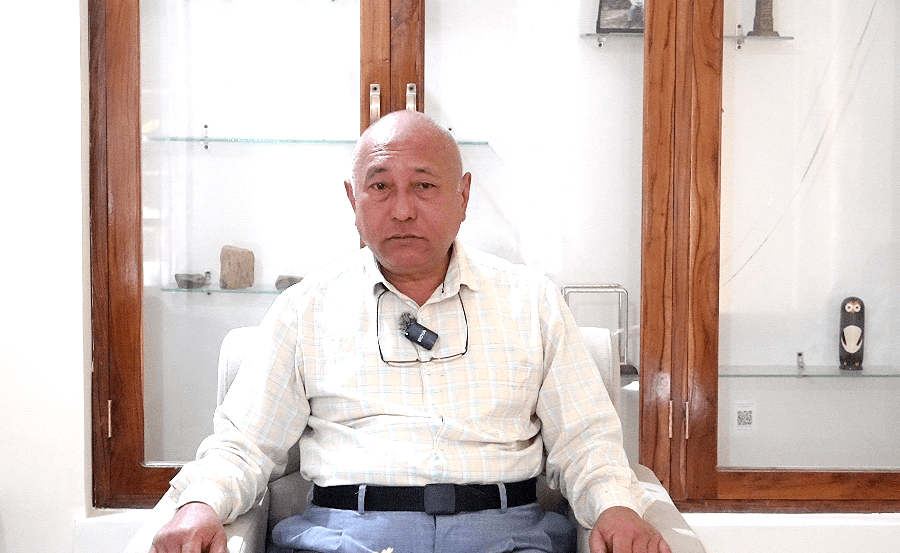
On Sunday afternoon, members of the media met Akok at his residence in Dimapur, where he reflected on the life of his legendary father, whom he described as “very athletic and sports-minded, yet always diligent about his studies.”
According to the son, renaming the championship after his father, a joint initiative of Nagaland government and All India Football Federation, filled him with pride.
His father, he said, would have been “immensely proud—thrilled that his legacy could inspire and help raise the next generation of girls.”
Also read: Nagaland steps into the national football arena with Dr. T Ao girls championship
“As his son, I’m deeply proud. I believe all Nagas would feel the same. My father left a lasting legacy, one that will inspire generations. It’s wonderful to see girls encouraged and supported in this way—especially when we’re still striving to improve our standing internationally,” he said.
Akok acknowledged that Indian women’s football still had “a long way to go” when compared to international teams, but added: “A thousand-mile journey starts with a single step. They’re taking that first step, and I’m proud that the Nagaland government is doing so much. There’s no other institution that can truly lift his name and image.”
He shared that his father’s accomplishments were not fully acknowledged during his lifetime, calling it “a matter of discussion.”
“We all feel he should have received the Arjuna Award,” he said, adding that a misconception persists that the award must be conferred only while the recipient is alive. “I discovered it can be conferred posthumously. If he meets the criteria—leadership, sporting excellence—there’s no reason he shouldn’t be honoured.”
Akok said that while women’s football in India showed promise, the momentum across both men’s and women’s football often “dies down” when players retire or when tournaments end, which he feels discourages emerging talent.
He praised the Nagaland Super League, stating that the relatively higher salaries offered to players were “a real boost.” But he pointed out that while top international players can become millionaires, “most local players here barely scrape by.”
“If a sport reaches a point where athletes can actually make a living, that’s ideal. Everyone knows even the biggest stars hit a peak and then naturally decline with age. So what happens after that peak?” he said.
According to him, his father was fortunate to balance his medical career with sports. “After hitting his athletic peak, my father switched to medicine, which enabled him to support his family and maintain a stable life,” he shared.
Speaking about his father’s discipline, Akok highlighted one principle passed down: “You have to maintain a tunnel vision.” He said that his father believed in deep focus—whether in studies or in sport.
He recalled how Dr. T Ao and his contemporaries trained without tribal or caste concessions. “They were called pioneers because they simply made their own way,” he said.
With no formal coaching, the young Talimeren learned by observing and imitating players, sharpening his skills while excelling academically.
From dribbling football to stethoscope
According to the son, his father’s decision to pursue medicine was influenced by Akok’s grandfather, a reverend who urged him to serve his people.
Two key incidents shaped that choice—guests falling ill at his sister’s wedding feast and his own father becoming seriously ill when medicines were scarce.
At Impur in Mokokchung, where they grew up, the children played football with handmade balls. Dribbling became essential because the balls did not bounce. “He was ambidextrous—he could play with both feet,” said Akok.
The only bouncing ball they ever saw was a tennis ball brought from Mariani in Assam. “It bounced, but it was hardly fit for football. Yet they used it anyway. That’s where he sharpened his dribbling and shooting abilities,” he recalled.
1948 Olympics: a defining moment
Akok also recounted the dilemma his father faced in 1948 when his medical final exams clashed with an invitation from the IOC to captain the Indian football team at the London Olympics.
His principal encouraged him to seize the Olympic opportunity, reminding him that exams could be retaken but such a moment would never return.
“That Olympic appearance became a landmark chapter for the Nagas and the whole Northeast,” Akok said. “You have to be in the right place at the right time.”
India returned without a medal, but the barefoot Indian team—captained by Dr. T. Ao—captured the world’s attention.