


S Supongmeren Jamir chaired the DISHA Dimapur meeting to review urban development, agriculture, and livestock schemes.
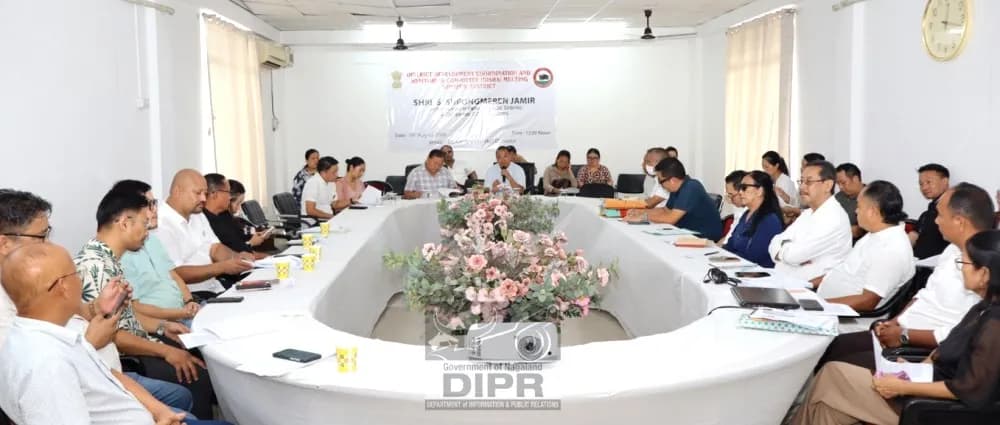
DIMAPUR — The District Development Coordination and Monitoring Committee (DISHA) meeting for the Dimapur district was held at the deputy commissioner’s (DC) conference hall in Dimapur on Wednesday under the chairmanship of Member of Parliament S Supongmeren Jamir.
According to a DIPR report, the meeting reviewed the progress of the Urban Development department and assessed the implementation of various flagship programmes in the district. The committee also discussed measures for the effective execution of schemes.
During the review, the Public Health Engineering Department (PHED) reported that toilets were being constructed under relevant programmes. The department has also conducted awareness activities and created Information, Education, and Communication (IEC) assets to promote sanitation and hygiene.
The Social Welfare department reported that the details of beneficiaries under the old-age pension scheme have been submitted to the government for further action.
The School Education department informed the committee that officials had visited schools to assess requirements and had submitted proposals to the government based on the findings.
The banking sector, represented by the Lead Bank, informed the committee that training programmes for educated unemployed youth would be conducted in the near future to support skill development and employment.
Read more local news: NSRLM staff undergo Knowledge Management and Communication training in Kohima
The Medical department reviewed its ongoing activities and reported that various training programmes and awareness campaigns are being carried out.
The District Rural Development Agency (DRDA) reviewed the status of job cards and reported that awareness, sensitisation, and verification activities are ongoing.
The Department of Animal Husbandry and Veterinary Services presented details on livestock development schemes, highlighting the National Livestock Mission–Entrepreneurship Development Programme (NLM-EDP), which covers piggery, poultry, sheep and goat farming, and feed and fodder development.
In Nagaland, 100 projects have been taken up under the programme, including 79 for piggery, six for poultry, and 15 for sheep and goat projects. Dimapur has 14 projects, comprising 12 piggery, one poultry, and one sheep and goat project. The presentation also covered livestock insurance and health programmes, including disease surveillance and the Rashtriya Gokul Mission.
The Department of Labour presented on welfare schemes for workers, including those under the Nagaland Building and Other Construction Workers’ Welfare Board (NBOCWWB). It highlighted benefits such as annual tool grants, loss-of-earning compensation, children’s education assistance, maternity benefits, and life insurance coverage. A total of 2,431 construction workers are registered under the scheme in the Dimapur district. The department also briefed the gathering on e-SHRAM, the national database for unorganised workers.
The District Agriculture Office (DAO) highlighted programmes including PM-KISAN, National Mission on Natural Farming (NMNF), Sub-Mission on Agricultural Mechanisation (SMAM), National Mission on Edible Oil-Oil Palm (NMEO-OP), National Food Security and Nutrition Mission (NFSNM), Mission for Aatmanirbhar in Pulses, PMKSY, Rainfed Area Development (RAD), and Rashtriya Krishi Vikas Yojana (RKVY).
Under PM-KISAN, 2,928 beneficiaries have been registered in Dimapur and Kuhuboto, and the 23rd instalment has been released. The NMNF achieved 100 per cent in two clusters covering 250 acres, while two new clusters are ongoing.
The NFSNM covered 80 hectares against the 80-hectare target in 2025-26, achieving 100 per cent. Under NMEO-OP, 42 oil palm growers covering 70 hectares have been covered. PMKSY covered 89 farmers in Zani and Shozukhu, achieving 100 per cent, while RAD covered 66 farmers in the Zani cluster, also achieving 100 per cent. RKVY activities included pest management, marketing facilities, and the promotion of traditional crops.
MP Jamir highlighted the importance of regular monitoring, proper coordination among departments, and the timely implementation of schemes to ensure that the benefits of government programmes reach the intended beneficiaries.