


Speaking at the NSF's National Seminar on the BEFR 1873, Nagaland CM Neiphiu Rio called for collective responsibility in implementing ILP
Bhushan advocates cultural protection with greater economic openness
-1788027608091.webp&w=1200&q=75)
DIMAPUR — Nagaland Chief Minister Neiphiu Rio on Saturday stressed the need to protect indigenous interests while welcoming legitimate investors, workers and businesses, saying that the state cannot isolate itself from the rest of the country as economic integration, urbanisation and migration are realities.
He was speaking on second and final day of National Seminar on the Bengal Eastern Frontier Regulation (BEFR) 1873, organised by Naga Students' Federation (NSF) at Town Hall, Dimapur.
Tracing the enactment of the Bengal Eastern Frontier Regulation (BEFR) 1873, Rio said the British framed it to regulate the entry and to protect indigenous communities from external economic and demographic pressures.
He recalled Naga resistance, including the killing of Captain John Butler at Pangti, the battle of Kikrüma, and the Khonoma War of 1879-80, as the British began expanding into the Naga Hills. British later established administrative centres at Asalu, now North Cachar Hills, Samaguting (present-day Chümoukedima), Wokha and Kohima, with the Naga Hills becoming a district of Assam in 1881.
It was during this period that the BEFR came into force, he said.
Also read: BEFR 1873 key to protecting indigenous rights, says Nagaland Home Commissioner
The BEFR provides protection against outsiders purchasing immovable property as well as safeguards traditional artefacts and cultural possessions. The regulation remains necessary in Nagaland but it must be implemented properly and not misused, he added.
Referring to the 16-Point Agreement, he said the continuation of BEFR 1873 in Nagaland was specifically provided for, while Article 371A of the Constitution protects Naga customary laws, land and its resources, religious and social practices.
On the state’s complex demographic situation, Rio highlighted the unique situation along the India-Myanmar border, particularly in Longwa village, where the international boundary runs through the Angh’s house and divides families, villages and agricultural fields.
He said fencing the border would create serious difficulties for communities with close social and economic ties across the boundary.
Highlighting the complexities surrounding the Inner Line Permit (ILP) implementation in Dimapur, Chümoukedima and Niuland districts, he said Dimapur was initially not included in the tribal belt but was declared a tribal area only in 1979, therefore it has to be the cut-off year for non-indigenous settlers in this area, up to Chümoukedima.
WATCH MORE:
The government must, therefore, ensure that Indian citizens who have legally settled in the area are not harassed while taking action against illegal migrants, he said.
‘Indigenous status misused’
Rio acknowledged that indigenous certificates had previously been issued to large numbers of non-Nagas, creating difficulties for the government. To address this, he said, the government has introduced the Registration of Indigenous Inhabitants of Nagaland (RIIN) framework, under which village councils would play a key role in identifying indigenous inhabitants.
He stressed that non-Naga communities from Manipur, Assam and Arunachal Pradesh residing in Nagaland cannot be granted indigenous certificates, as they are indigenous to their respective states.
Being a Naga alone does not entitle a person from another state to claim indigenous status in Nagaland, he added.
He, however, said the government must ensure that genuine Indian citizens are not harassed or displaced, while preventing illegal migration and misuse of indigenous status.
ILP implementation
Rio called for collective responsibility among the government, tribal hohos, civil society organisations, village councils and other stakeholders, saying that the ILP system can’t succeed through government efforts alone.
Nagaland can learn from Mizoram’s ILP success, he said, while pointing out that the state’s social and tribal diversity makes the situation different.
Terming the June 16, 2026 Gauhati High Court judgment upholding the extension of ILP to Dimapur, Chümoukedima and Niuland a “big victory” for Nagaland, he said it also highlighted the constitutional significance of Article 371A and upheld the validity of BEFR 1873.
This seminar on the BEFR should produce practical and forward-looking recommendations, he said, adding that the objective should be a balanced, effective and humane ILP system that protects Naga identity, land, culture and indigenous rights while facilitating legitimate economic activity, investment, employment and development.
Meanwhile, he raised concerns over benami businesses, saying that outsiders should be allowed to invest and conduct business in Nagaland, but must do so transparently and in accordance with the law.
On oil exploration
On economic development, he said Nagaland has significant petroleum, natural gas and mineral resources, including identified deposits of cobalt, nickel and lithium. However, their exploitation has remained stalled due to unresolved political and land-related issues.
On petroleum exploration in the disputed areas, he said Assam has been actively extracting oil while Nagaland had stopped operations on its side, adding that oil had been leaking in areas such as Champang after operations were halted in 1994, forcing the state to engage technical experts to control the leakage.
Stating that Nagaland gets nothing from its own petroleum resources while Assam continues drilling near the border and earns revenue, the CM said the state intends to resume exploration, which is essential to addressing Nagaland’s economic challenges.
On Foothill Road
Highlighting the importance of connectivity, citing the proposed Foothill Road from Tizit through Dimapur to Khelma (Silchar), Rio said Union Minister Nitin Gadkari had offered to fund a four-lane highway if Nagaland provided land free of cost and obtain the required clearances.
However, he said landowners have agreed to provide only limited land, leading to discussions on a two-lane road.
Rio appealed to tribal hohos and landowners to cooperate, stressing that proper connectivity is essential for development and would significantly enhance the value of land along the highway.
Nagaland cannot afford to focus solely on politics while neglecting the economy, he said, stressing the need to strengthen the economies of individuals, families, communities, the State and the nation.
The CM also said that the government is committed to addressing the concerns of the Frontier Nagaland Territorial Authority and implementing the proposed autonomous arrangements with legislative, financial and executive powers, while seeking enhancement of the proposed financial package.
Is ILP necessary?
While sharing on “Enforcement Rights and BEFR, 1873, A Constitutional Correlation”, Prashant Bhushan, Senior Advocate, Supreme Court of India, said the country’s diversity is one of its greatest strengths.
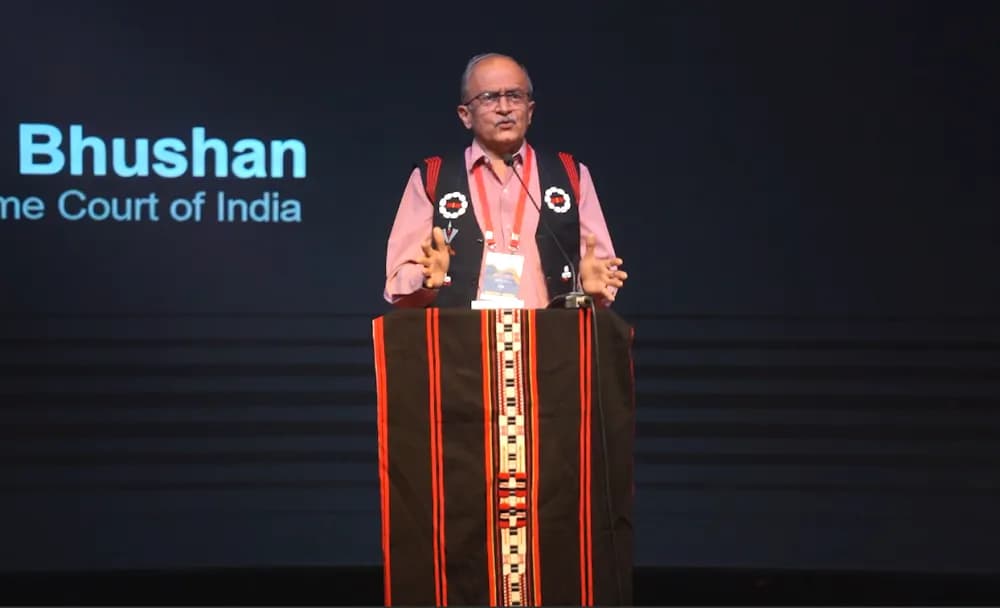
He said Nagaland’s rich tribal cultures, languages, cuisine and traditions should be preserved and celebrated. However, he argued that cultural preservation should not mean isolating from other communities.
A strong culture has nothing to fear from interaction with other cultures and can instead influence and enrich others, said the advocate.
He said cultural identities are threatened not simply by the presence of outsiders but when outsiders acquire political power and use it to suppress indigenous cultural or religious practices. Such actions, he said, are contrary to constitutional principles.
In an era of rapid communication and movement, complete isolation is impossible, he argued, adding that physical restrictions cannot prevent the exchange of ideas, cultures and information through modern technology.
Referring to the Nagas living across international borders, particularly in Myanmar, he said restrictions on movement create difficulties for communities that share families, livelihoods and social ties across borders.
Similarly, he questioned excessive barriers to movement between Indian states and across neighbouring countries, arguing that greater people-to-people interaction could reduce misunderstandings and conflicts.
On the constitutional aspect, Bhushan said Article 29 guarantees communities the right to preserve their language, script and culture, while Article 19 provides citizens the right to move freely throughout India and practice a profession. He questioned whether the Inner Line Permit system, which restricts entry into Nagaland and other northeastern states, is consistent with these fundamental rights.
He also questioned the argument that ILP is necessary for the security of visitors, saying citizens ordinarily have the right to travel freely across the country.
On land protection, Bhushan acknowledged the concern that economically stronger outsiders could exploit indigenous communities by purchasing large amounts of land. However, he suggested that this could be addressed through reasonable restrictions on the quantity of land outsiders may purchase rather than broad restrictions on movement and economic activity.
He said a limited land-purchase restriction, such as prescribing a maximum area that an outsider could acquire, could protect indigenous landowners while allowing greater interaction and economic participation.
Bhushan maintained that Nagaland should protect its culture and indigenous rights while remaining open to interaction, economic integration and the free exchange of people and ideas.
Mizoram’s ILP success story
Presenting the topic “Enforcement of the BEFR 1873 in Mizoram as a Success Story”, issued by Professor Lallianchhunga of Mizoram University, Dr. Sentikumla, Assistant Professor (Law) at Nagaland University, Lumami, said the success of the ILP system in Mizoram was largely due to strong government enforcement, active civil society participation and public support.
Mizoram Government, irrespective of the political party in power, has maintained a consistent approach towards ILP enforcement, with police conducting regular checks against violators. Civil society organisations, particularly the Young Mizo Association (YMA) and Mizo Zirlai Pawl (MZP), have also played a key role through ILP verification drives and reporting violations to the authorities, the gathering was told.
However, the opening of Sairang railway station in September 2025 is said to have created new challenges.
Dr. Sentikumla said Mizoram has also simplified the ILP process through an online system, helping facilitate tourism, business and investment while retaining the regulatory purpose of the permit.
The Mizoram experience demonstrates that effective ILP enforcement requires coordination among the government, civil society and the public, while balancing indigenous protection with economic development.
Representation to CM
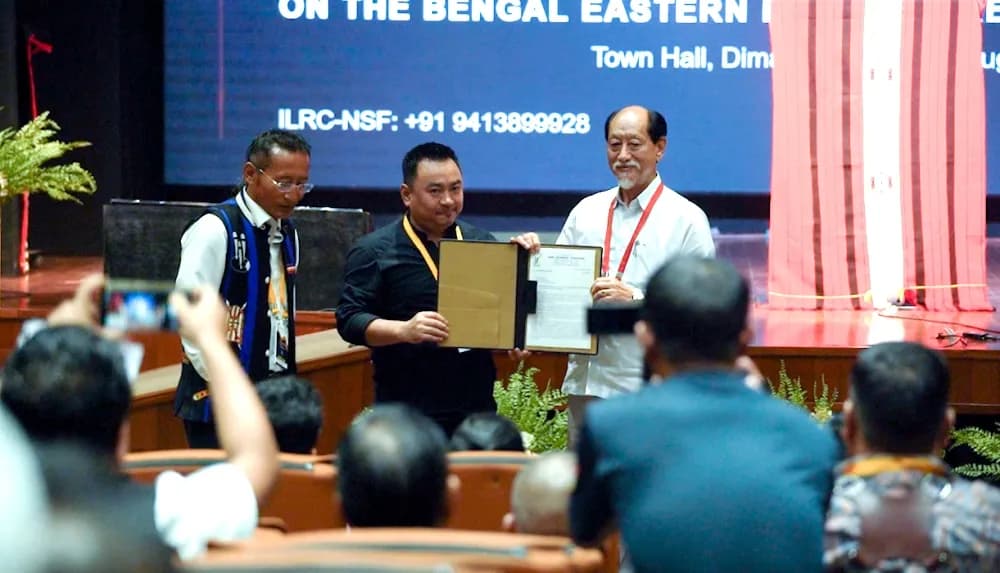
During the seminary, the NSF submitted a representation to Chief Minister of Nagaland, seeking to constitute an autonomous Nagaland Inner Line Regulation Commission, vested with full powers to formulate rules and regulations to ensure stringent enforcement of BEFR.
It stated that the Inner Line system requires a dedicated and accountable authority with a robust mechanism, but no single body is currently responsible for its implementation.