


Senior Advocate Shomona Khanna defended the BEFR, 1873, saying Nagaland’s ILP is a reasonable restriction under Article 19(5), read with Article 371A.
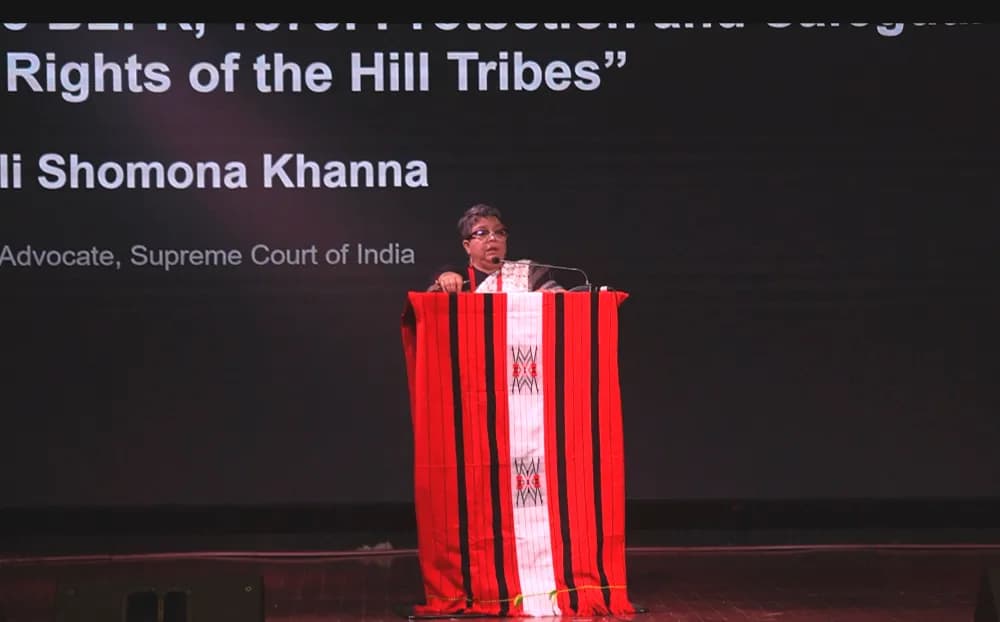
DIMAPUR — Senior Advocate of the Supreme Court of India, Shomona Khanna, has defended the Bengal Eastern Frontier Regulation (BEFR), 1873, saying the Inner Line Permit (ILP) regime in Nagaland is a reasonable restriction under Article 19(5) of the Constitution, read with Article 371A.
Speaking on “The BEFR, 1873: Protection and Safeguarding the Rights of the Hill Tribes” at the two-day national seminar on BEFR, 1873, organised by the Naga Students’ Federation (NSF) and Inner Line Regulation Commission (ILRC) at Town Hall, Dimapur, on August 29, Khanna said the regulation should be understood as a constitutional safeguard rather than merely a colonial-era administrative measure.
She said colonial records often portrayed the hill tribes of Nagaland through a paternalistic lens, while counter-narratives described Nagas as warlike tribes who entered the plains with traditional weapons.
To minimise conflict, the British created the Inner Line, restricting the entry of non-Nagas without permission.
According to Khanna, the continuation of the BEFR was explicitly recognised in the 16-Point Agreement of 1960 as an assertion of the autonomy of the people of Nagaland.
She highlighted provisions including Section 3, which provides the legal basis for the Inner Line; Section 5, which provides for confiscation of certain materials and forest produce from violators; and Section 7, which restricts non-natives from acquiring interests in land and its produce without government sanction.
Also read: ‘BEFR aimed to control British trade in tribal areas’
On the constitutional framework, Khanna said India adopted an asymmetrical federal structure to accommodate the distinct identities and circumstances of tribal and frontier regions.
She noted that Article 371A gives Nagaland special constitutional protection, including over Naga religious and social practices, customary law, administration of justice based on customary law, and ownership and transfer of land and its resources.
On challenges to the ILP, Khanna acknowledged arguments that it infringes the rights to freedom of movement and residence under Articles 19(1)(d) and 19(1)(e).
However, she pointed out that Article 19(5) permits reasonable restrictions for the protection of Scheduled Tribes. Referring to the Gauhati High Court's June 2026 ruling in Kiron Paira vs. Union of India, she said the court rejected a challenge to the extension of the ILP to Dimapur, holding the restriction to be reasonable under Article 19(5), read with Article 371A.
Khanna, however, raised concerns over executive actions relating to the definition of indigenous inhabitants. She pointed to the use of the Indigenous Inhabitant Certificate (IIC) and noted that while the Constitution (Nagaland Scheduled Tribes) Order, 1970 recognises five tribes, a 2009 Home Department notification expanded the list to 15 tribes.
She also expressed concern over the application of central laws affecting land and forests in Nagaland.
She noted that only 3.46% of the state's forests are government-owned, while 96.54% are community or privately owned.
She questioned the application of the Mines and Minerals (Development and Regulation) Act without an Assembly resolution, citing a 1984 opinion of then Attorney General K Parasaran.
Calling for solidarity, Khanna said defending the ILP for demographic stability should not promote xenophobia.
She urged Nagaland to build alliances with tribal and Adivasi communities, labour groups and civil society organisations defending customary rights, constitutional morality and democratic pluralism.
BEFR an asset for plural India: Prof. Chakravarty
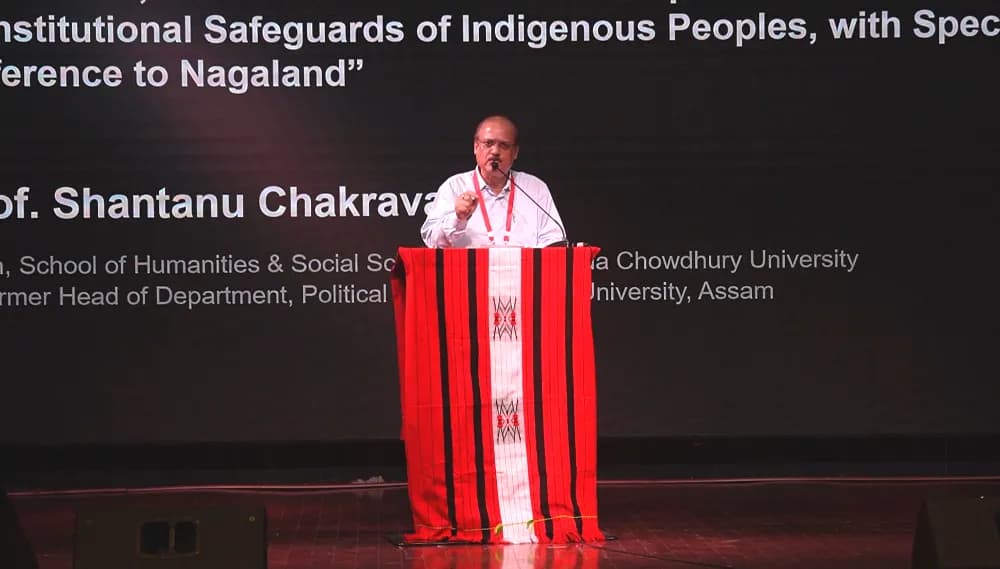
Prof. Shantanu Chakravarty of Girijananda Chowdhury University, Assam, said the BEFR should be viewed as a constitutional asset that preserves India's federal and plural character, rather than as an isolationist barrier.
Speaking on “A Mainland Indian Perspective on Constitutional Safeguards of Indigenous Peoples, with Special Reference to Nagaland”, Chakravarty said mainland opinion on the ILP was divided between an integrationist view, which sees it as restricting fundamental rights, and a protective view, which argues that unrestricted migration and land acquisition can undermine indigenous rights and demographic stability.
He said Article 19(5) permits reasonable restrictions for the protection of Scheduled Tribes and that the ILP is a regulatory mechanism rather than an outright ban on movement.
Proposing a three-pillar model for Inner Line states, he called for protection of indigenous land, identity and demographic stability; a simple and transparent permit system for tourists and businesses; and accountability through judicial oversight.
In his valedictory address, ILRC-NSF member secretary Seve R Vadeo said the BEFR is “not merely a paper pass” but a regulatory institution that has survived for more than 150 years. Its future, he said, depends on effective implementation.
He said the seminar examined the BEFR as a historical, constitutional, legal, administrative and social reality of Nagaland and stressed that stronger laws become ineffective if poorly administered.
Vadeo said the deliberations should mark the beginning of more rigorous engagement rather than the end of the discussion. He informed that the seminar proceedings and recommendations would be placed before the government.