


Nagaland Pollution Control Board (NPCB) study finds air quality at Kisama exceeded permissible limits during Hornbill Festival due to dust, traffic and firewood smoke.
Share


-1766231456137.jpg&w=1200&q=75)
KOHIMA — Air quality at Kisama during Hornbill Festival was not within safe limits on most days, with pollutant levels exceeding prescribed standards, a study by the Nagaland Pollution Control Board (NPCB) has revealed.
The NPCB conducted ambient air quality monitoring during Hornbill Festival 2025 to assess the status and trends in air quality and determine compliance with the National Ambient Air Quality Standards (NAAQS).
The study was carried out at two locations—the entrance of the Handloom & Craft Pavilion (earlier Bamboo Pavilion) at Kisama, and Kigwema village.
Monitoring focused on two pollutants: Respirable Suspended Particulate Matter (PM10) and Fine Particulate Matter (PM2.5).
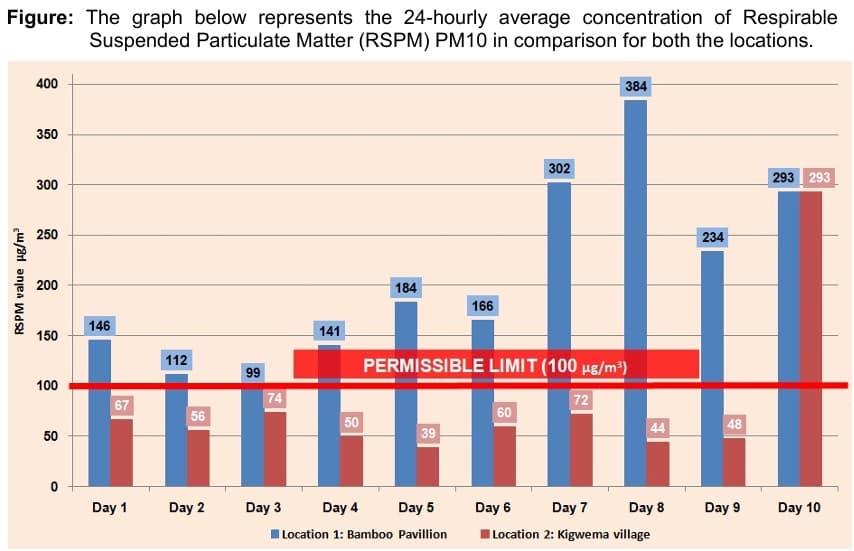
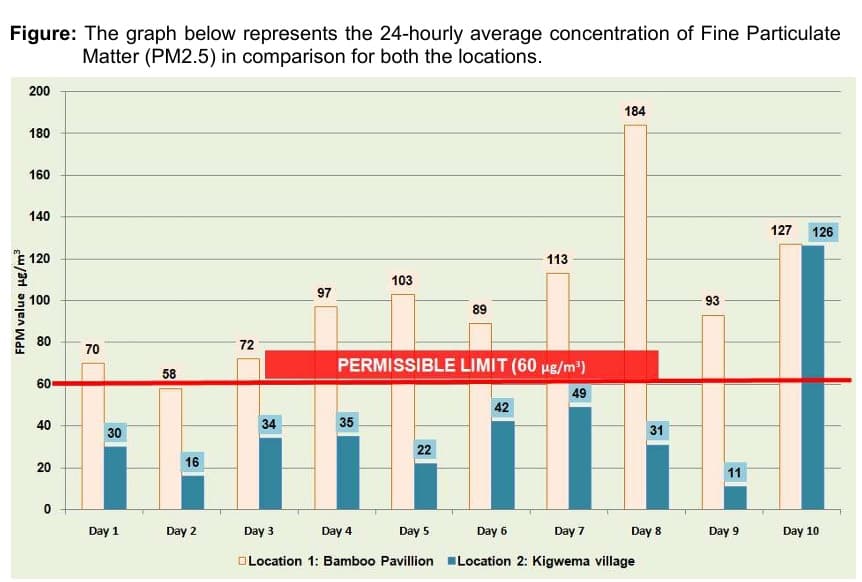
According to the findings, particulate matter concentrations for both PM10 and PM2.5 at the Handloom & Craft Pavilion entrance exceeded permissible limits on most days between December 1 and 10.
Monitoring conducted between 2 pm and 10 pm recorded the highest concentrations, which the board attributed to heavy visitor footfall, multiple activities, and increased vehicular movement in and around the festival venue.
Also read: Wildlife violations surface at Hornbill Festival
In Kigwema village, ambient air quality remained within permissible limits on all days except December 10 between 2 pm and 10 pm, when pollution levels spiked due to burning of garden leaves near the monitoring site, the report said.
The NPCB also referred to air quality monitoring conducted during Hornbill Festival 2023, presenting a comparative assessment of particulate matter levels for both years.
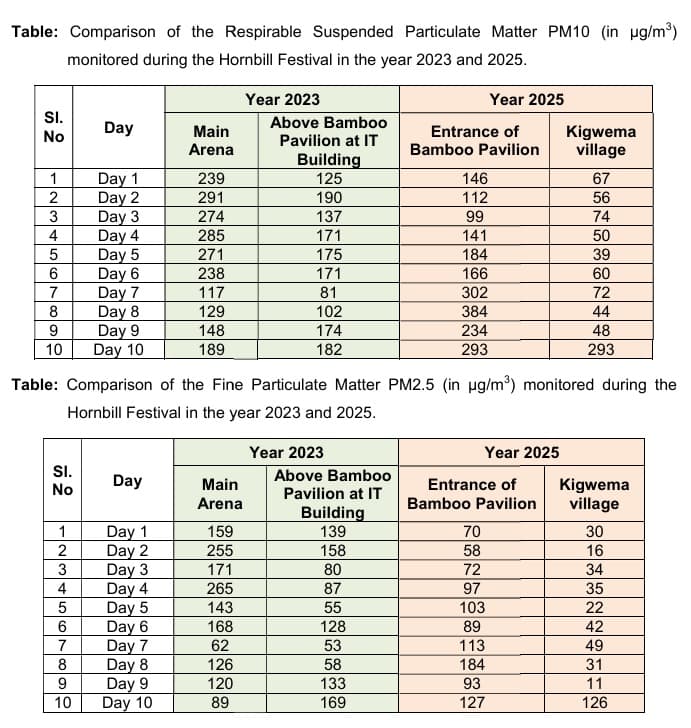
For PM10, data showed that during the first six days (December 1–6), pollution levels were comparatively higher in 2023 than in 2025. However, during the last four days (December 7–10), PM10 concentrations were higher in 2025.
With regard to PM2.5, fine particulate matter concentrations were higher in 2023 on most of the ten days, except on Day 8 and Day 10, when levels were higher in 2025.
The board attributed elevated pollution levels primarily to smoke from firewood used at tribal morungs and stalls, unpaved surfaces at venue and parking areas, and traffic congestion leading to increased vehicular emissions.
It also observed that accumulated road dust, largely due to construction activities in the main arena and festival areas, emerged as a major contributor to air pollution.
While water sprinkling was carried out during the initial days of the festival to suppress dust, the NPCB pointed out that the activity was discontinued in the later stages, contributing to worsening air quality.
To mitigate pollution, the board recommended measures including regular road and pavement cleaning, continued water sprinkling on unpaved areas, improved traffic management, installation of mist sprinklers at pollution hotspots, paving of parking areas, and awareness campaigns promoting clean air practices among stakeholders and visitors.
The NPCB, however, noted positive changes in 2025, particularly in waste management. Compared to 2023, there was less littering, improved waste collection, and no noticeable burning of waste, leading to reduced pollution from waste-related sources.