


Reports of bush-meat sales and illegal wildlife items at Hornbill Festival prompt enforcement action, with four cases recorded.
KISAMA — Celebrations at the Naga Heritage Village, Kisama, for the 26th edition of Hornbill Festival has been marred by reports and eyewitness accounts of illicit wildlife-related offences, prompting enforcement teams to step up inspections to curb illegal activities.
Independent findings by Eastern Mirror conformed that some vendors at tribal morungs discreetly offered exotic bush meat alongside their regular menu. While serving bush meat to guests has traditionally been a prized custom in Naga society, unconfirmed reports indicated that certain morungs had served items such as snake meat.
A menu from one stall featuring venison, porcupine and game birds surfaced on social media after a foreign tourist posted it online, drawing widespread attention.
Till December 9, some stalls were not openly displaying bush-meat menus but continued to serve such items quietly. One stall worker told this newspaper that deer, wild boar and bear meat were being sold at INR 500 per serving, claiming the meat was sourced from within Kohima district.
Also read: Hornbill Festival 2025 concludes with new global and regional partnerships
Vendors from some morungs also said bush meat had been brought in from Manipur through Mao Gate. While a few admitted that they had stopped serving it after learning of enforcement measures, sources suggested that the meat remained available through certain channels.
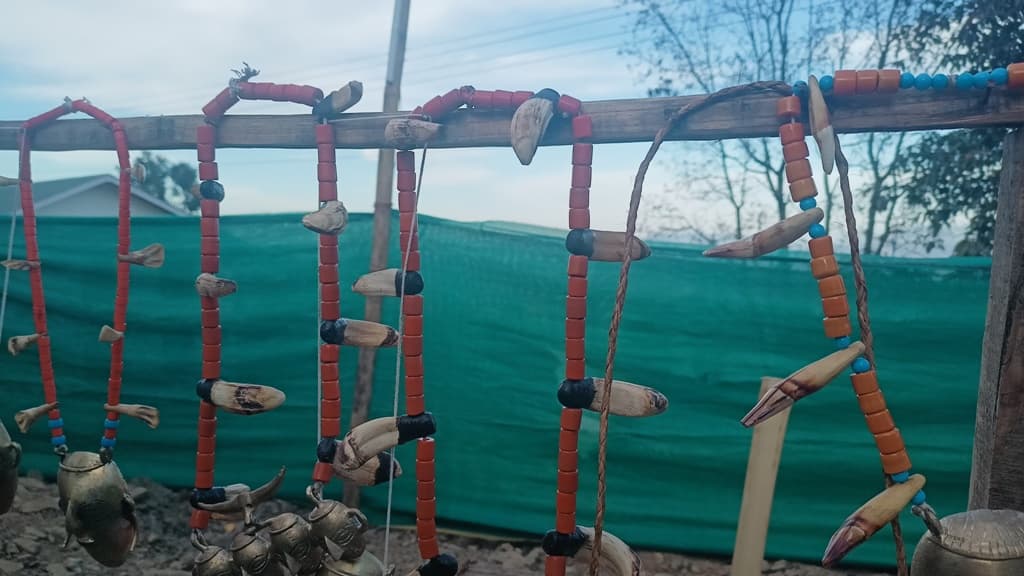
In earlier times, animal tusks and bird feathers were considered as hunting trophies in Naga society and the practice continues even today, especially as decorative elements in cultural attire.
However, it was surprising to note that many of these tusks and feathers were reportedly sourced across international borders.
An entrepreneur from Longwa village in Mon district, running a stall at Kisama, said that he had sourced wild boar tusks from Myanmar, sold at INR 3,000-5,000 per dozen, to make necklaces.
Four cases reported
Wildlife Warden of Dimapur, Tokaho Kinimi, told this newspaper that the department has been monitoring multiple locations ahead the festival.
Teams were deployed at Naga heritage Village, Kisama, where cases were detected, and another incident was reported from High School Junction, Kohima, which was verified by staff.
He added that monitoring extends to digital platforms, where posts on hunting, trapping and cooking of wild animals circulate throughout the year. The Kohima Forest Division has also deputed a special team for patrol duties during the festival period.
According to Kinimi, four cases were recorded by the afternoon of December 10. One case at High School Junction involved a lottery game where portions of wild animals were offered as prizes. Authorities intervened and shut down the stall.
However, he said that violations continue to surface despite regular monitoring, and that wild meat is often transported illegally from Assam and neighbouring states.
The officer added that while festive occasions pose challenges, the department remains committed to awareness and enforcement, stressing that all reported cases have been addressed.
Referring to the viral menu case, Kinimi said that a fine of INR 1 lakh was imposed and wild-meat items were removed from the stall.
Traditional practices and modern law
Kinimi noted that while traditional hunting once served as sport and sustenance, it now conflicts with the Wildlife (Protection) Act, 1972. With abundant alternatives such as poultry and pork, he said that subsistence arguments no longer hold ground.
He expressed concern over the use of sophisticated weapons in modern hunting and warned that continued indiscriminate killing would have long-term consequences. Hunting remains banned in the state, he said, and is not under reconsideration.
The wildlife warden emphasised that the need for community-led conservation, asserting that collective responsibility is the most effective way to preserve wildlife.
He urged communities to shift from using real tusks and feathers in cultural attire to alternative materials, saying traditional practices must evolve to avoid harming wildlife. “The continued use of original animal parts comes at the cost of killing hundreds of wild animals,” he said, adding that true conservation lies in preserving tradition while remaining mindful of nature.
Kinimi said that while some communities have made progress, greater awareness and behavioural change are needed across the state. Violations come with penalties, he said, but lasting solutions lie in genuine commitment to wildlife preservation.