


Dr. Thepfusano Aonok stresses compassionate care and awareness at Kohima's Nasha Mukti Bharat Abhiyan workshop.
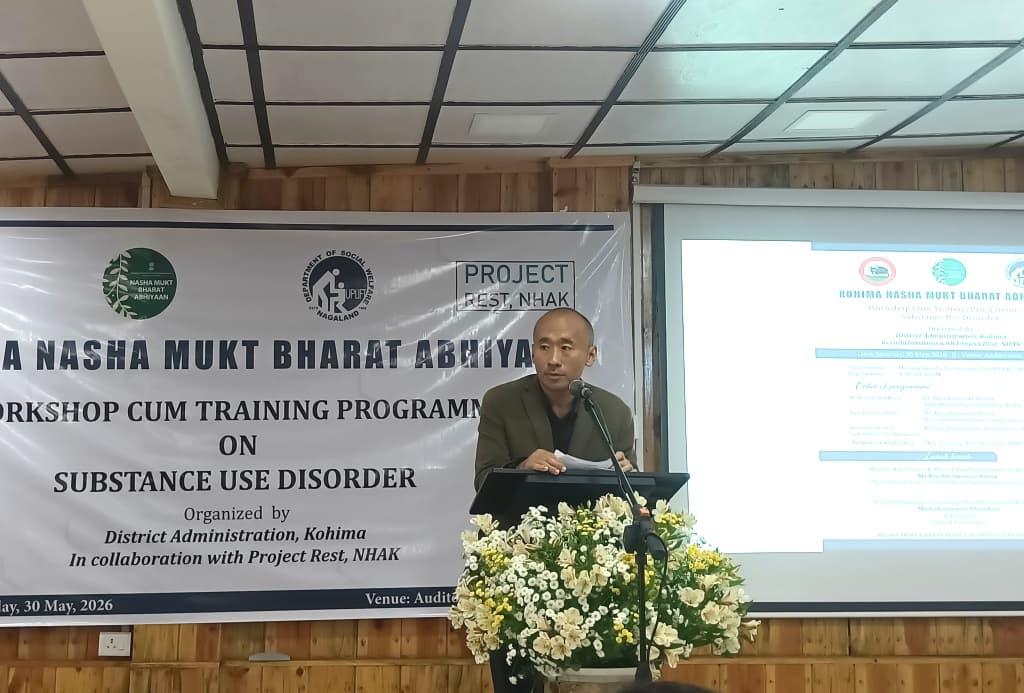
KOHIMA — Substance use disorder is often accompanied by stigma and misunderstanding, causing many affected individuals to hesitate in seeking help due to fear, shame, discrimination, and social isolation, said Dr. Thepfusano D Aonok, Additional Medical Superintendent of Naga Hospital Authority Kohima (NHAK).
Speaking at the Kohima Nasha Mukti Bharat Abhiyan workshop-cum-training programme on substance use disorder, organised by the district administration in collaboration with Project REST, NHAK, on Saturday at NHAK, Dr. Aonok stressed the need for healthcare professionals to provide compassionate and non-judgmental care.
She said that beyond treating the medical aspects of addiction, healthcare workers have a responsibility to create a safe and supportive environment where individuals are treated with dignity, compassion, and respect.
Also read: Patton condemns assault of minor in Dimapur, seeks thorough probe
“Because of this stigmatisation and misunderstanding, it is our responsibility not only to treat the medical aspects of addiction but also to provide a safe and supportive environment where individuals are treated with dignity, compassion and respect,” she said, adding that sensitisation and awareness among health professionals are as important as clinical management.
Highlighting the objectives of the Nasha Mukti Bharat Abhiyan, Dr. Aonok said the national campaign seeks to address substance abuse and strengthen support systems for affected individuals and families through sustained awareness programmes, community participation, and preventive interventions, particularly among youth, women, and educational institutions.
She noted that primary health centres and hospitals often serve as the first point of contact for individuals struggling with substance use disorders, especially during emergencies and crises.
Healthcare providers, she said, are uniquely positioned to identify vulnerable individuals early, intervene appropriately, and support recovery through evidence-based care.
Underscoring the importance of capacity building among healthcare professionals, Dr. Aonok said NHAK has remained at the forefront of addressing substance use disorders in the state through its dedicated de-addiction centre, opioid substitution therapy (OST) centre, drug treatment clinic, District Mental Health Programme, and Project REST.
She informed that Project REST is a voluntary initiative of NHAK that provides free day-care rehabilitation services for individuals recovering from substance dependence.
Maintaining that substance use disorder is a challenge that cannot be tackled by a single institution alone, Dr. Aonok called for collective efforts from all stakeholders.
Also speaking at the programme, Additional Deputy Commissioner (ADC) Kohima, Ruopfukuotuo Noudi, outlined the history and objectives of the Nasha Mukti Bharat Abhiyan campaign.
\He said the initiative seeks to address drug and substance abuse through a comprehensive framework encompassing preventive education, awareness generation, counselling, treatment, and rehabilitation.
Noudi said the central government has invested substantial resources in the campaign, reflecting its commitment to combating the menace of drug and substance abuse.
He noted that the campaign has sensitised millions of people, including healthcare providers and medical professionals, on addressing substance abuse-related issues.
According to him, the campaign focuses on three key strategies — supply control, demand reduction, and medical treatment.
He further informed that Kohima district has a dedicated committee headed by the deputy commissioner to implement the campaign and is working closely with three NGOs — the Kripa Foundation, Youth Mission, and Art Foundation.
Noudi said that most activities under the campaign focus on Information, Education and Communication (IEC) initiatives as well as rehabilitation efforts.
He emphasised that the issue of drug and substance abuse directly concerns the medical sector and that effective intervention would require active participation from healthcare professionals and service providers.
During the technical session, Dr. Sungtimen Jamir, Nodal Officer of Project REST, delivered a presentation on substance use disorder.
Dr. L Longna, Assistant Professor at NIMSR, spoke on treatment modalities, while Ruokuotuonuo Rutsa, Clinical Psychologist with the District Mental Health Programme, Kohima, discussed the harms of addiction and associated mental health challenges.
Ketousenuo Phewhuo, RCI-licensed Clinical Psychologist, presented on counselling approaches, early identification, and referral linkages.