


NSLSA conducts seminar in Wokha to strengthen access to justice, relief and legal aid for Human-Wildlife Conflict victims.
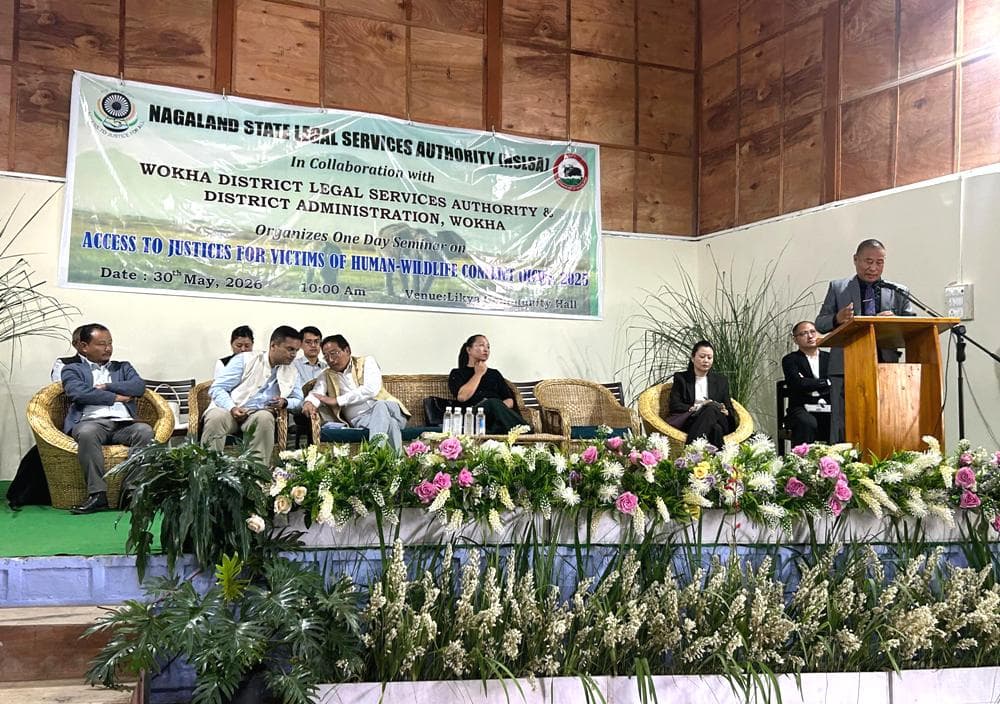
WOKHA — The Nagaland State Legal Services Authority (NSLSA), in collaboration with Wokha District Legal Services Authority (WDLSA) and Wokha district administration, organised a one-day seminar on “Access to justice for victims of human-wildlife conflict (HWC)” at Likya Community Hall, Wokha, on Saturday.
The seminar sought to raise awareness on legal rights, relief measures, compensation provisions, and access to justice for victims of human-wildlife conflict.
Deputy Commissioner Mhathung Tsanglao, delivering the special address, highlighted the growing challenge of human-elephant conflict in Wokha, with elephant presence reported in over 100 villages and nearly 60 active conflict zones.
The DC noted that such encounters have destroyed crops, plantations, and farmhouses, causing livelihood losses and fatalities—five human deaths in Wokha since 2018 and 15 elephant deaths across Nagaland.
Tsanglao stressed that blocked migratory corridors and shrinking habitats have intensified conflicts, and called for coordinated intervention.
A relief assistance distribution programme for affected victims was also held on the occasion.
Also read: MP Supongmeren Jamir flags highway safety lapses, warns of action against delayed road projects
Resource person L Jonjibemo Odyuo, Assistant Manager at NSDMA, explained relief procedures under SDRF norms, clarifying that assistance is “minimal support” rather than compensation.
He presented data showing 483 beneficiaries state-wide received INR 70.88 lakh between 2018–2026, with Wokha accounting for the highest share—256 beneficiaries and INR 49.10 lakh.
Odyuo emphasised that while relief is vital, long-term solutions require stronger coordination, awareness, and mitigation strategies.
NSLSA Member Secretary Neikho Akami introduced the “Access to Justice for Victims of Human-Wildlife Conflict 2025” scheme, assuring legal aid for victims in documentation, claims, and compensation.
He said Wokha was chosen as the venue due to its high incidence of human-elephant conflict and announced a dedicated team to assist victims.
Wildlife Warden Dr. C Zubeni Tsanglao stressed the constitutional duty of conservation, citing Articles 48A and 51A.
She noted that encroachment and blocked corridors have worsened conflicts, and urged coexistence through compassion and timely reporting.
Tsanglao added that the Doyang Wildlife Division has been established to strengthen rapid response efforts.
The programme concluded with an interactive session where victims and village councils voiced concerns and grievances, underscoring the urgent need for collective action.