


Tuensang and Longleng hold district consultative workshops on Viksit Nagaland @2047 to discuss grassroots development and strategic planning.
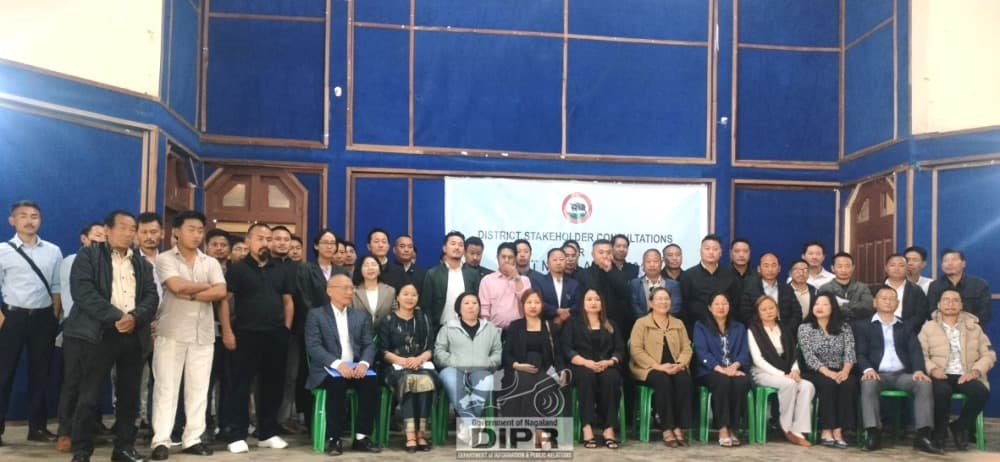
DIMAPUR — Consultative workshops on Viksit Nagaland @2047 were held in Tuensang and Longleng on April 17 to formulate a roadmap for the state's development.
Tuensang: A one-day workshop for the Tuensang district, organised by the Department of Planning and Transformation, was held at the Town Hall.
Lithrongla Tongpi Rutsa, Deputy Commissioner (DC) of Tuensang, stated that Viksit Nagaland @2047 is a roadmap of the state government aimed at formulating a vision for the grassroots development of the state and the inclusive growth of the country.
According to a DIPR report, she added that it serves as a platform for stakeholders to study past shortcomings, identify challenges, and make suggestions that will benefit the people of the district.
The DC noted that the workshop provides an opportunity to address loopholes in implementing inclusive growth, diagnose systemic gaps, and set visionary targets for 2030, 2038, and 2047.
During the workshop, participants were divided into five thematic Sectoral Working Group pillars to discuss and present key challenges.
Strategies were put forward under economic development, social development, environmental sustainability, infrastructure development, and governance.
The workshop was attended by heads of departments, non-governmental organisations, and civil society organisations.
Longleng: In Longleng, the district consultative workshop was held at the DPDB hall with heads of offices, stakeholders, and civil society organisations. The programme was organised by the state government and the district administration.
W Manpai Phom, DC Longleng, gave an overview of the vision and noted that while the central and state governments design schemes and projects, implementation takes place at the grassroots level. He observed that schemes often prove ineffective locally because local perspectives and requirements are not incorporated during planning.
Members were urged to actively deliberate on the specific needs of the district, as the consultation seeks to collect ideas and inputs so that state and national plans reflect district-specific priorities.
Central experts present at the workshop clarified that their role was to facilitate discussions and compile inputs in a structured format. Participants from departments and civil society organisations were encouraged to share sectoral issues, requirements, and suggestions openly.
The consultation was structured around five pillars for discussion: economic development, social development, environmental sustainability, infrastructure development, and institutional handling. Departments were also asked to provide relevant data and field-level information.
The district line departments presented the five pillars of the vision. Presentations were delivered by Assistant Horticulture Officer Y Angngoi Buchem, District Sports Officer Angoto Thokhwe, Assistant Conservator of Forests Ailong Phom, District Soil Conservation Officer Angnyin Konyak, Sub-Divisional Officer of Power Moiching Phom, Lipoksangla Chang from the Public Health Engineering Department, and Superintendent of Police Yanger Jamir.