


Visually impaired residents flag unsafe roads, obstructed footpaths and careless driving in Dimapur, calling for safer mobility and greater awareness
DIMAPUR — A car’s side mirror struck him as he walked with his white cane, the driver did not stop to apologise. On another occasion, a vehicle ran over a woman’s cane, bending it so badly that she could no longer use it.
For visually impaired residents of Dimapur, such encounters are part of the struggle to move around a city where, they say, vehicles, obstructed footpaths and public unawareness make even a short journey hazardous.
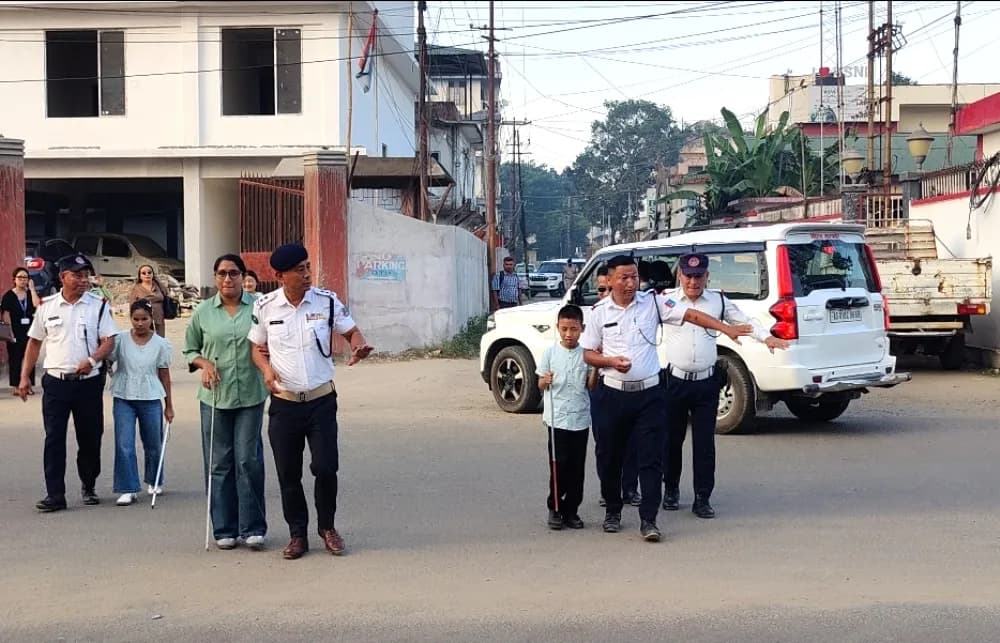
Their experiences came to light on Thursday at the first White Cane Safety Day observance in Nagaland, organised by Prodigals’ Home in collaboration with Tikvah Training Centre and Sign Reach Bilingual Ministry at the Traffic Control Office in Dimapur.
Chingdang, a student with visual impairment, shared that motorists often failed to respect the white cane, which signals that a pedestrian has limited or no sight.
“How many times will they take advantage of us? Knowing that we have disabilities, they take advantage,” he said, appealing to the traffic police to issue safety guidelines for persons with disabilities.
Also read: Biometric barriers: How Nagaland’s PwDs are getting stuck in the Aadhaar maze
Recounting the incident involving the car’s side mirror, Chingdang said the vehicle came close to him and hit him, but the driver neither rolled down the window nor apologised before driving away.
He said markets in Dimapur remained difficult to navigate, with obstacles, wrongly parked vehicles and cars occupying footpaths leaving little room for pedestrians.
“If non-disabled people also face such traffic obstacles, then how much more will it be for persons with disabilities,” he asked, urging the traffic police to enforce rules more strictly.
Initoli, a computer instructor at Prodigals’ Home and Tikvah Centre who is herself visually impaired, said public awareness could make a substantial difference to the independence and safety of cane users.
She recalled walking with six or seven other people with white canes when a car approached without warning and ran over her cane, bending it badly. The driver slowed down but drove away without apologising, she said.
Comparing her experiences in Delhi, Pune and Bengaluru with life in Dimapur, Initoli said Dimapur remained difficult to navigate because motorists and the public were insufficiently aware of the needs of visually impaired people.
She shared that vehicles sometimes passed close by without warning, leaving pedestrians unable to anticipate danger.
Prodigals’ Home director K Ela said poor road conditions and traffic posed major obstacles to people with visual impairment, even when they used white canes.
She called for collective efforts to make Dimapur safer, urging the government to improve roads and asking the traffic police to sensitise personnel to the needs of visually impaired pedestrians.
Ela also called for awareness programmes involving the Nagaland State Transport, taxi and auto-rickshaw associations, suggesting that transport associations/groups prepare guidelines for their members.
Assistant Commissioner of Police (Traffic), Dimapur, Zubenthung Lotha said road safety was not merely about regulating vehicles but ensuring that everyone could move safely and independently.
He urged motorists to slow down, respect pedestrian crossings, obey traffic signals, keep footpaths clear of obstructions and remain alert near schools and busy crossings. Anyone offering assistance to a visually impaired person, he said, should ask politely first and respect the person’s choice.
Mhasivino Khale, a special educator with Sign Reach Bilingual Ministry, said the white cane was a personal mobility aid and should not be touched without permission. She described it as “the eye on the ground” for its role in helping users detect obstacles and potholes.
Khale also urged the public to keep footpaths clear, offer assistance only after asking and communicate directly with visually impaired people rather than assuming what they need.