


At the fifth Mokokchung District Village Development Boards Association general conference, Mokokchung DC Ajit Kumar Verma stressed self-reliance.
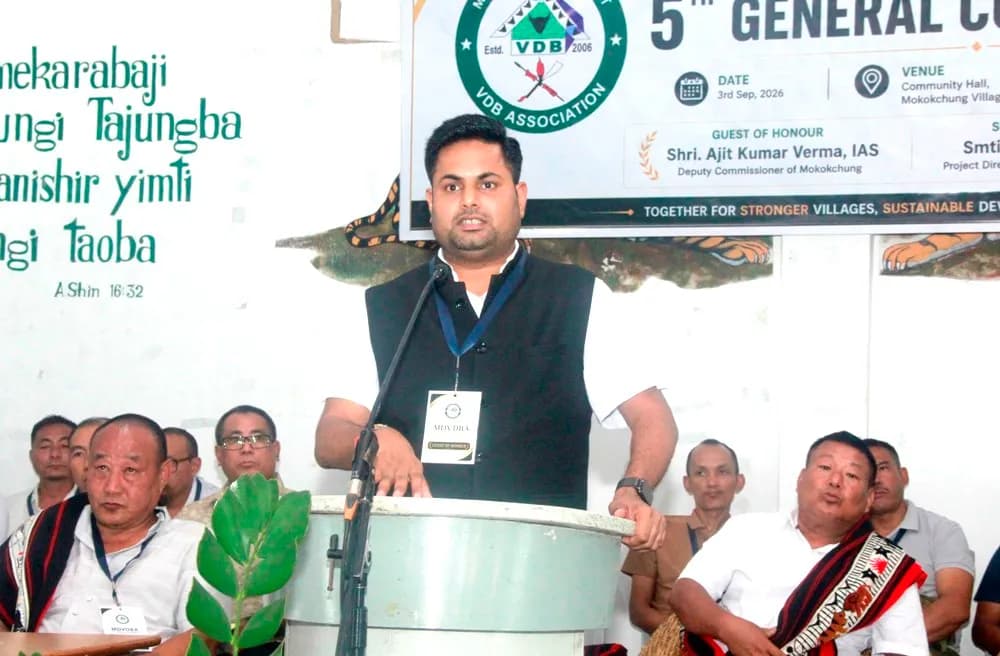
MOKOKCHUNG — The Mokokchung District Village Development Boards Association (MDVDBA) held its fifth general conference in Mokokchung village on Thursday.
Deputy Commissioner (DC) of Mokokchung Ajit Kumar Verma attended as the guest of honour, while Imtiyapangla, Project Director of the District Rural Development Agency (DRDA), was the special guest.
Representatives from 88 villages, including two Sumi villages drawn from nine RD blocks under Mokokchung district, participated in the conference.
Addressing the gathering, the DC described village development boards (VDBs) as a hybrid governance model unique to Nagaland. He said the institution serves as an interface between customary bodies and modern development schemes while working in consensus with village councils.
Verma recalled that the VDB system was established in June 1976 and is now completing 50 years of service to the state’s rural development, particularly at the village level. He noted that VDBs have played a key role in creating community assets and driving progress in rural Nagaland.
Highlighting present challenges, the DC pointed to policy-level gaps, the need for improved departmental coordination, and the necessity of revising and detailing the VDB model rules. He observed that ambiguity over the roles of basti (village) members and secretaries has led to complaints and court cases.
Verma stated that VDBs must function as inclusive bodies rather than the preserve of any particular group. He called for greater participation of women and youth in development discussions and decision-making.
Looking ahead, he urged the association to formulate a clear future vision and strategic plan. The goal, he said, should be village-level self-reliance through local entrepreneurship—identifying and focusing on one crop or product per village, establishing processing units with a 10- to 20-year horizon, and generating employment within villages to curb out-migration.
He also stressed the importance of strengthening the VDB institution itself, not merely individual or short-term benefits, and adapting to modern systems to retain relevance and integrity. Verma suggested that VDBs prioritise investment in schools, Anganwadi centres, and health centres, with the aim of creating at least one remarkable and inspiring asset in every village.
On institutional reform, he asserted that the association should revise the rules framed in 1980 and 1987 to make them more comprehensive and to clearly define each function. "The association needs to strengthen the legal framework and frame operational guidelines for VDBs, incorporating best practices," he said.
Project Director Imtiyapangla spoke on the topic "Rural Development programmes and the role of VDBs in transforming our villages". She informed the gathering that VDBs implement development programmes across nine RD blocks covering the district’s 88 recognised villages.
She outlined key schemes, including the state-sponsored Rural Development Grant-in-Aid (GIA), MGNREGA, VB-G RAM-G, PMAY-G, and the Nagaland State Rural Livelihoods Mission (NSRLM). She urged VDBs to work diligently in accordance with departmental guidelines so that all development funds meant for rural areas can be fully utilised.
She further requested village councils to extend full support to VDB Management Committees during the execution of works and to ensure that the public clearly understands the programmes and their benefits.
The project director also instructed VDBs to submit instance reports in cases where job-card holders are not cooperating during e-KYC and NMM exercises.
Meanwhile, the new office-bearers of the Mokokchung District Village Development Boards Association were announced: Bendang Walling (president), Imtiyanger (vice-president), Obangonen (general secretary), Imchayanger (assistant general secretary), Imtimar (finance secretary), and Wati Kichu (treasurer).