


All India Network Project on Jute & Allied Fibres organises training programme on improved cultivation of jute.
Share


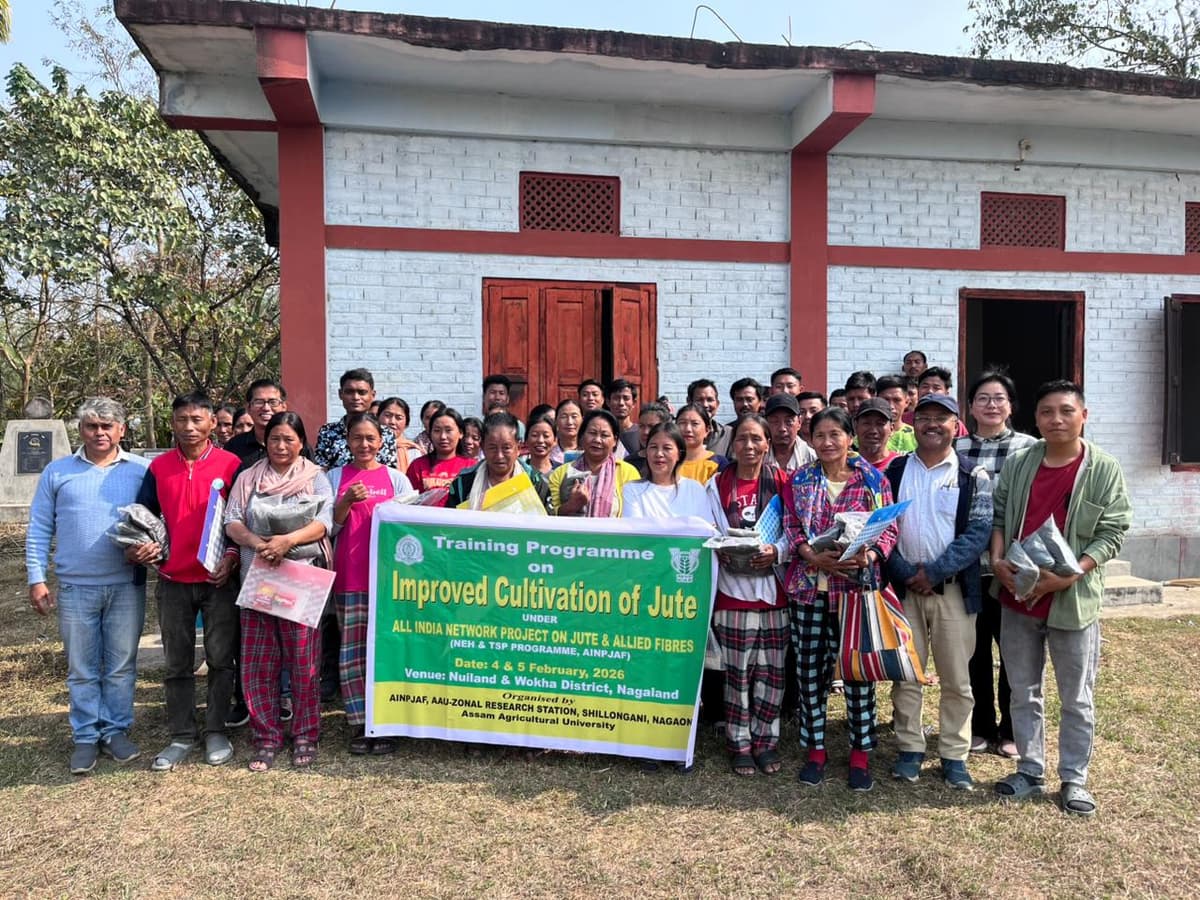
DIMAPUR — Training on ‘Improved cultivation of jute’ under the All India Network Project on Jute & Allied Fibres (AINPJAF) was conducted on February 4 and the 5th at Yeveto village, Niuland district and Old Ralan village, Wokha district, respectively.
The training programme was organised by the AINPJAF, Zonal Research Station, Nagaon, Assam Agricultural University (AAU), in collaboration with AICRP on Kharif Pulses, AICRP on Linseed, Nagaland University, SAS, Medziphema Campus, at ATMA Niuland block, and Old Ralan block in Wokha district.
The training programmes witnessed the presence of village leaders and extension officials, including village chairmen, Block Technology Manager (BTM) Demalu Hasnusa, Niuland block, and BTM Chophabeni Kikon, Old Ralan block, Wokha district, along with farmer friends.
Also read: Peren DPDB meeting discusses development plans
The training received encouraging and positive response from both farmers and village chairmen.
Dr. Arup Kumar Sarma, In-charge, All India Network Project on Jute & Allied Fibres, highlighted the importance, potential, and prospects of jute as a cash crop and its value added products in Nagaland.
He also addressed farmers’ queries, particularly clarifying doubts related to retting methods and fibre extraction techniques, which are crucial components of quality jute production.
Dr. Nabajyoti Bhuyan, Principal Investigator, AICRP on Rabi Pulses, Zonal Research Station, Nagaon, Assam Agricultural University, elaborated on the scope of rabi pulse crops in Nagaland, emphasising their role in crop diversification in Jute-Pulse crop sequence and income enhancement for farmers.
In the technical session, Dr. Lowrence Kithan, Scientist (Agronomy), AICRP on Kharif Pulses, provided insights into the potential of pulses and Dr. Virosanuo Solo, Junior Agronomist, AICRP on Linseed, highlighted the importance of vermicomposting and explained key aspects of its production and management technology.
As a part of the programme, essential agricultural inputs were distributed to the participating farmers, including jute seeds (Tarun variety), black gram seed (Variety: SBC 40), and vermicompost, to encourage adoption of improved cultivation practices.
The training programme was sponsored by the All India Network Project on Jute & Allied Fibres, AAU-ZRS, Nagaon and a total of 90 farmers actively participated from the two villages.