


Three satellite-tagged Amur falcons from Tamenglong district have reached Africa after a 20,000-km migration, the Wildlife Institute of India confirmed.
Share


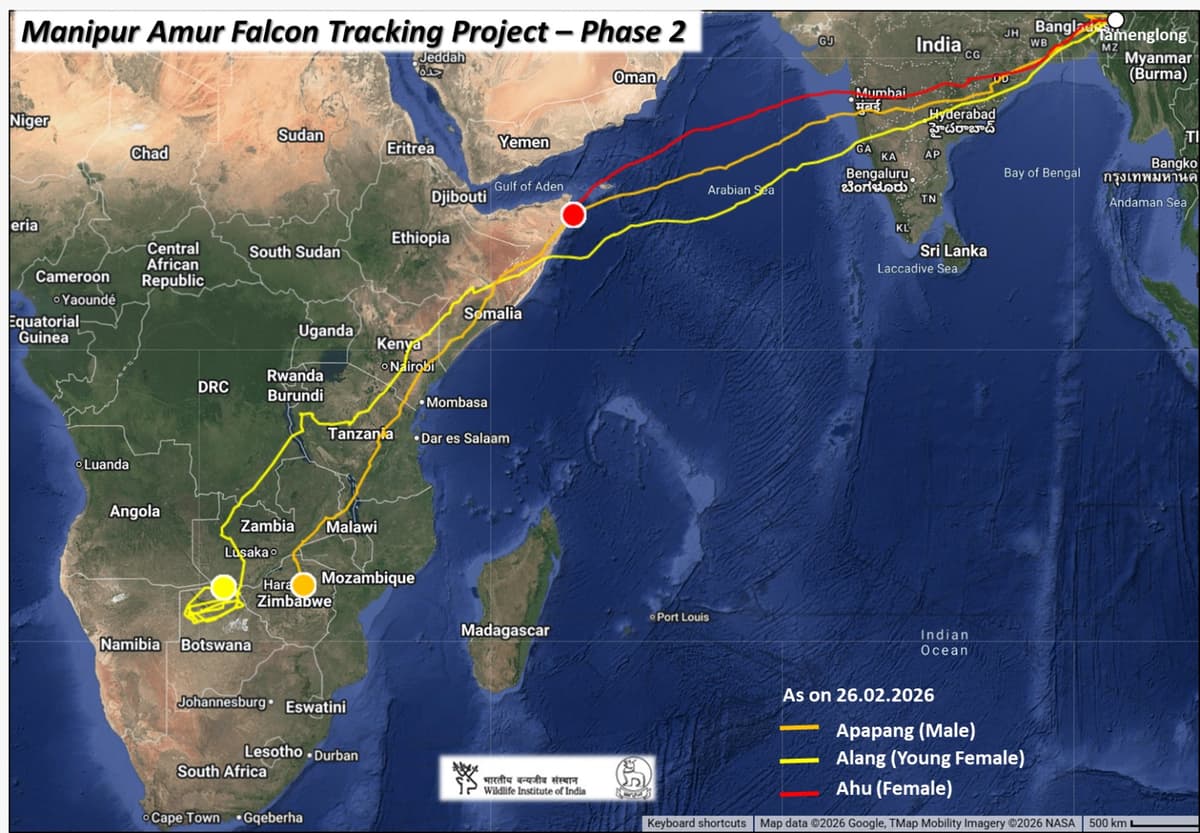
IMPHAL — Three satellite-tagged Amur falcons released from Manipur’s Tamenglong district in November last year have successfully completed their transcontinental migration and are currently wintering in different parts of Africa, according to the latest update from the Wildlife Institute of India (WII), Dehradun.
The birds — named ‘Apapang’, ‘Ahu’ and ‘Alang’ after a roosting site and the Barak and Irang rivers in Tamenglong district — are part of the Phase II satellite transmitter tagging programme taken up by the Manipur Forest Department in collaboration with WII.
Apapang is an adult male falcon, while Ahu and Alang are females.
Divisional Forest Officer, Tamenglong Forest Division, Kh Hitler Singh said that as of January 1, 2026, Apapang was in Zimbabwe and Alang in Botswana. He added that the birds remain active, except Ahu.
Also read: Union Minister reviews Central schemes in Noney, visits infra projects
The tagging exercise is being carried out under the supervision of senior scientist Dr Suresh Kumar of WII, who is responsible for the capture, fixing and monitoring of the satellite transmitters.
The Amur falcon, known locally as Akhuaipuina or Taomuanpui in the Rongmei dialect, is protected under the Wildlife Protection Act, 1972. The radio-tagging programme was first initiated in Tamenglong district in November 2018 as part of conservation efforts.
Under the mandate of the Convention on Migratory Species of Wild Animals signed at Bonn, Germany, member countries including India undertake conservation measures for migratory species such as the Amur falcon.
The Tamenglong Forest Division has been promoting protection and conservation of both residential and migratory wildlife species in the biodiversity-rich district.
Amur falcons undertake an annual migration of about 20,000 km, travelling from their breeding grounds in East Asia to wintering grounds in southern Africa. They arrive in large numbers during October in Nagaland, Manipur and other parts of northeast India before continuing their journey.