


Süngratsü village in Mokokchung earns an estimated INR 1.5 crore annually from traditional Nüoshi (Anishi) production
Nüoshi festival highlights a traditional delicacy worth INR 1.5 crore annually
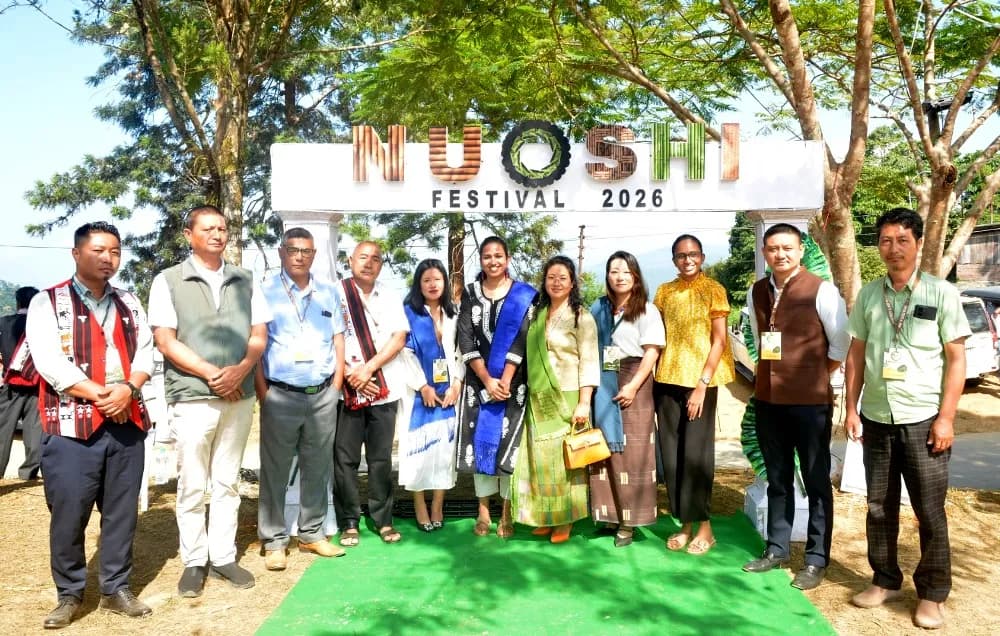
Süngratsü — A traditional Ao delicacy prepared from fermented taro leaves has emerged as a cornerstone of Süngratsü’s farming economy, with the village estimating the annual market value of its Nüoshi production at around INR 1.5 crore.
Nüoshi, also known as Anishi, is made from the leaves of taro (Colocasia esculenta). Once an ancestral practice handed down through generations, its preparation has become a vital livelihood for the people of Süngratsü in Mokokchung district.
Many farmers have shifted from paddy cultivation to taro farming, drawn by better economic returns.
According to Süngratsü Village Council chairman S Bendang Aier, the village produces an estimated 25,000 to 30,000 kg of Nüoshi each year, of which about 20,000 kg reaches the market.
With the village council fixing the price at INR 600 per kg, the annual market value stands at approximately INR 1.5 crore.
To celebrate this heritage and encourage its preservation, the Süngratsü Students’ Union organised the Nüoshi festival at the Süngratsü Village Gate on Saturday.
Also read: Nagaland: After 196 years, Tsiepama and Nerhema choose peace
The event paid tribute to the “wisdom of the ancestors” and their art of preparing the traditional food.
Aier traced Nüoshi’s origins to the Ao community’s oral account of the “Tar era” (pre-historic period), when the deity Lijaba Tsüngrem is said to have given the food to the Aos.
The first attempt to eat it caused an itchy sensation in the throat. Believing a deity would not bestow anything harmful, the people cooked it longer over embers until the irritation subsided. “We do not claim we discovered it. It is our heritage,” Aier said.
Taro has long featured in Ao cuisine, with its roots, leaves and stems used in curries and soups. Its economic role in Sungratsu village, however, has transformed.
Until about a decade ago, jhum cultivation and paddy farming dominated.
Villagers have since moved decisively towards taro fields, which they regard as more profitable. The village no longer has rice mills, a clear sign of the shift in agricultural practice.
Aier attributed the suitability of taro to the area’s rainfall and moderate climate, though this observation remains to be independently verified.
Prof. Chitta Ranjan Deb, senior professor in the Department of Botany at Nagaland University, Lumami, who has studied Nüoshi, highlighted its nutritional profile, traditional processing methods and market potential.
Research found that Anishi contains 34.19 g of protein and 12.26 g of crude fibre per 100 g, along with high antioxidant activity.
Deb suggested the traditional food could serve as a meat alternative, particularly for those following a vegan diet.
He explained that traditional processing removes the substances responsible for throat irritation. The food is also smoke-dried, allowing it to be stored for months and, under suitable conditions, for up to two years without chemical additives.
Deb stressed that any expansion of the market must prioritise food safety and hygiene.
He recommended washing leaves with clean, potable water, ensuring workers wear gloves and maintain proper hygiene, and exploring improved drying methods such as hygienic solar dryers.
The festival also outlined a broader vision: transforming an established food tradition into a platform for economic opportunity, tourism and cultural preservation.
Amongla C, Deputy Director in the Department of Agriculture, proposed positioning Süngratsü village and the Asetkong range as destinations for sustainable tourism, ecotourism, agro-enterprise and cultural immersion.
The plan includes seeking a Geographical Indication (GI) tag for Süngratsü Nüoshi, improving hygienic packaging and shelf life, and developing culinary tourism through tasting trails and master classes.
It also seeks to strengthen livelihoods, promote agro-tourism and document the stories and practices linked to the food.
Amongla called for collaboration among government departments, development agencies, corporate social responsibility initiatives, researchers, scholars and private partners to realise these goals.
Dr. Lanunochetla, District Agriculture Officer, Mokokchung, emphasised that success would depend on sustained community-level effort rather than external support.
She identified marketing, labelling, storage, packaging and pricing as key areas needing attention.
SDO (Civil) Mokokchung Temsuchuba also spoke of Nüoshi’s potential as a pathway to sustainable development.