


Hornbill Gold 308 records 5.4 tonnes per hectare in a Nagaland field trial, showcasing its potential for natural farming
ICAR-developed rice variety demonstrates high yield potential during a field trial in Chümoukedima, with seven new varieties showing promise for Nagaland farmers
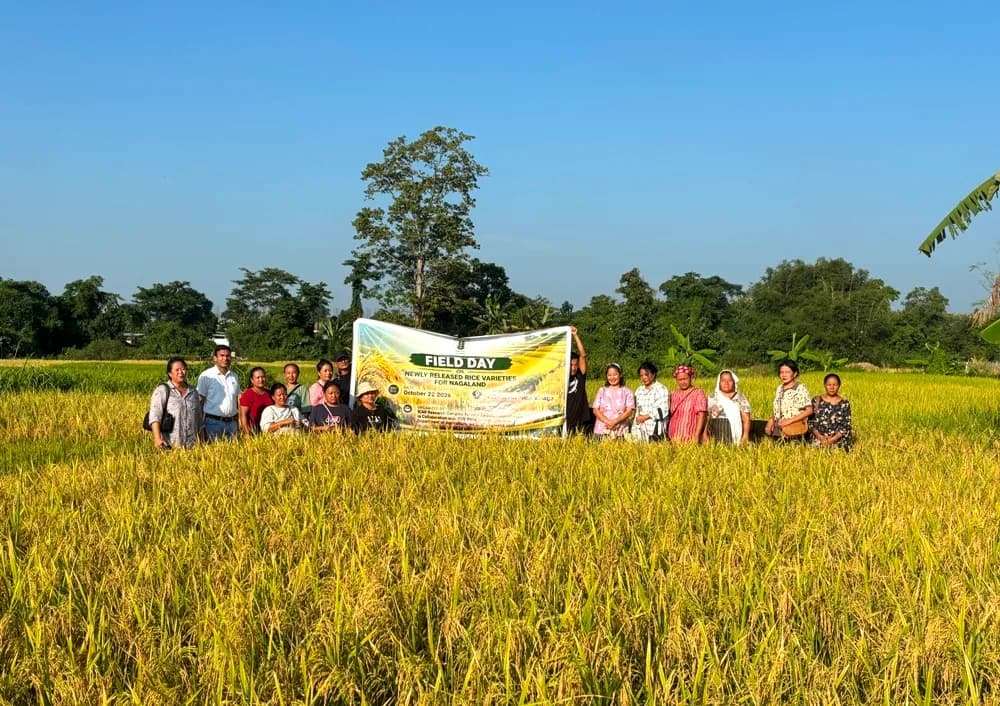
DIMAPUR — Hornbill Gold 308, a newly released rice variety developed by the ICAR Research Complex for the NEH Region, Nagaland Centre, recorded a grain yield of 5.4 tonnes per hectare under natural farming conditions during a field demonstration at Chümoukedima village on Thursday.
According to an update, the field day was organised by ICAR Research Complex for the NEH Region, Nagaland Centre, in collaboration with Krishi Vigyan Kendra (KVK), Dimapur, and the state Department of Agriculture to showcase seven newly released high-yielding rice varieties and promote increased rice productivity and crop intensification across Nagaland.
Developed after extensive multi-location trials, Hornbill Gold 308 has a maturity period of 115–120 days, high tolerance to paddy blast disease and resilience to moisture stress.
Its high yield potential under low-input, natural farming conditions makes it suitable for the hill agro-ecosystems of Nagaland.
The other varieties demonstrated were Patkai Pearl 131, Sekrenyi Lha 138, Tokhvu Tssok 171, Moatsu Tsuk 189, Ahuna Khi 395 and Aoleang Tahwan 295.
According to experts, the seven varieties showed encouraging performance compared with traditional local cultivars, with a potential yield advantage of around 35% to 45%.
Read more local news: Hornbill Festival: Tribal hohos seek clarity on Kisama PPP plan
Dr. Harendra Verma, scientist at ICAR Nagaland Centre, said the varieties’ short maturity duration, high yield potential and preferred grain quality offered considerable scope for improving cropping intensity and farm profitability.
He noted that early-maturing varieties such as Hornbill Gold 308 could provide farmers with a wider window to prepare fields and sow subsequent rabi crops, including potato, onion, toria and field pea.
Dr. Verma advised farmers to transplant young seedlings aged 18–22 days and adopt integrated crop management practices, including the use of organic manures, biofertilisers and micronutrients, along with the inclusion of pulse crops in crop rotation.
District Agriculture Officer (DAO), Chümoukedima, Moainla Pongen, also praised the performance of the new varieties and encouraged farmers to consider adopting them.
She stressed the importance of shifting towards high-yielding, early-maturing and disease-tolerant varieties to improve agricultural productivity.
Pongen further encouraged farmers to undertake community-level seed multiplication of promising varieties, particularly Hornbill Gold 308, and share seeds with neighbouring farmers to facilitate wider adoption in the upcoming cropping season.
A total of 30 farmers from Chümoukedima village attended the programme and expressed interest in adopting the new varieties. The field day provided an opportunity for farmers, scientists and agricultural officials to assess crop performance under actual field conditions and discuss strategies for improving rice production in the state.