


Nagaland begins Census 2027 preparations with self-enumeration from June 16 and trainer programmes in Dimapur and Phek.
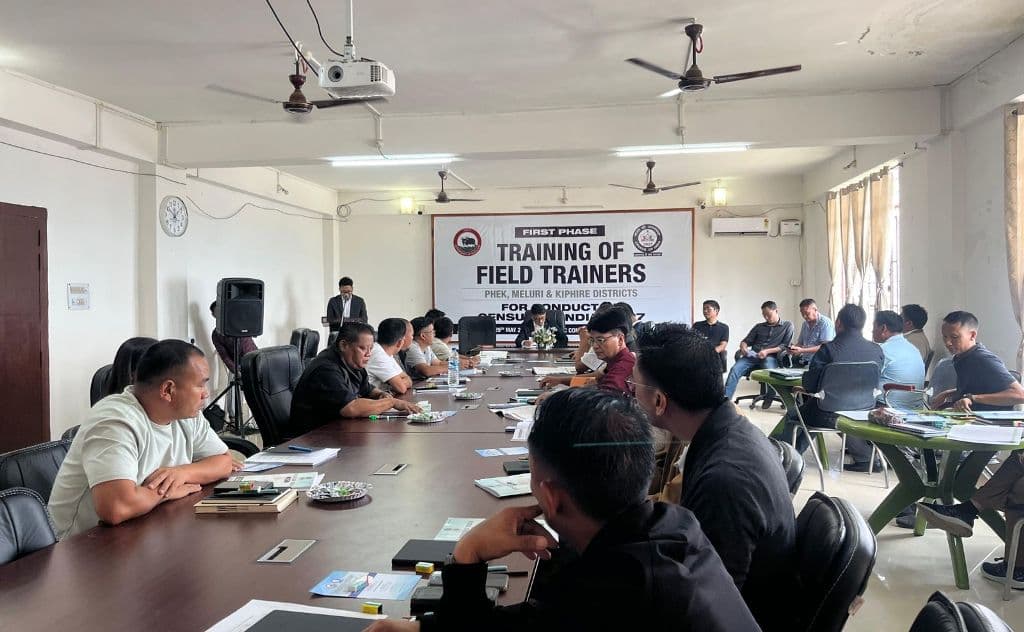
Training programmes underway in Dimapur, Phek
DIMAPUR — Preparations for Census 2027 have begun in Nagaland, with the Home department issuing directives for self-enumeration during Phase I of Census 2027, while training programmes for field trainers commenced in Dimapur and Phek on Wednesday.
Self-enumeration directives
According to a DIPR report, the Home department issued directives regarding the step-by-step user guide for self-enumeration for Phase I of Census 2027 to be held from June 16 to the 30th.
All officials of various departments and the public have been encouraged to undertake self-enumeration accurately during the notified 15-day period.
Self-enumeration (SE) is a process in which residents fill and submit their household data online. The SE portal will remain open for 15 days prior to the start of house-to-house houselisting operations (HLO) by the enumerator. The process may take approximately 15-20 minutes, and after successful submission, a unique self-enumeration ID (SE ID) will be generated.
Also read: NLA Committee on Environment and Climate Change inspects Pfutsero
Residents can access the portal at se.census.gov.in. Users are required to select Nagaland from the dropdown and enter the captcha to proceed. The department recommended the use of a laptop or desktop for better visibility while marking houses on the digital map.
For household registration, users are required to enter the name of the head of household, which cannot be changed once registered. A mobile number of any household member has to be entered, and only one mobile number can be used per household. Users may also provide an email address to receive the SE ID.
Applicants are required to select their preferred language before OTP verification. The selected language cannot be changed afterwards. OTP verification is to be completed through the registered mobile number.
For location details, users have to select their district and enter village or town, locality and nearby landmark details. A digital map with a red marker will appear for identifying the exact residential location. This process will help in assigning SE data to specific houselisting blocks for confirmation by the enumerator during the house-to-house visit.
Residents are then required to fill in the houselisting and housing census questionnaire. Guidance notes, tooltips and FAQs are available for assistance. The questionnaire is identical to the one used by enumerators, although details such as building number, census house number, use of census house and household number will be recorded separately by the enumerator during field visits.
Users can review the entered data through a preview screen and save the information as a draft before final submission. Once “Final Submit” is clicked, no further changes can be made except by the enumerator.
Upon successful submission, a unique 11-digit SE ID prefixed with “H” will be generated and sent through SMS and email. Users have been advised to save the ID for future reference. A provision to retrieve the SE ID later through the registered mobile number is also available.
During the field validation stage, residents will have to share the SE ID with the census enumerator during the household visit. If the SE ID matches the records in the enumerator’s mobile application, the self-enumeration data will be confirmed and accepted. Otherwise, the enumerator will collect the household data afresh.
Census training begins in Dimapur, Phek
Meanwhile, the Office of the Deputy Commissioner (DC) and Principal Census Officer (PCO), Dimapur, commenced a three-day field trainers training programme for officials from Dimapur, Niuland, Chümoukedima, Peren and Mon districts at Circuit House, Dimapur, on Wednesday.
The training programme, organised under directives issued by the Directorate of Census Operations, Nagaland, will continue till May 29 and aims to equip field trainers with legal understanding, technical expertise, operational knowledge and practical exposure for the smooth conduct of Census 2027.
Addressing the inaugural session, Dr. Tinojongshi Chang, DC and PCO Dimapur, stressed the importance of preparedness, coordination and accuracy in carrying out census-related responsibilities.
Dr. Chang noted that population census operations have been conducted every ten years since 1872, with the last census completed in 2011. He stated that Census 2027 would mark a major transition with the adoption of digital tools and modern technology for data collection and monitoring. The upcoming Census will be conducted through digital platforms and mobile applications supported by real-time monitoring systems. New features, including digital house listing, digital data collection and the use of artificial intelligence (AI) for enumeration and monitoring, are also being introduced.
Dr. Chang informed that the first phase of the Census 2027, namely the House Listing of Housing Census, is scheduled from July 1 to the 30th, while the self-enumeration facility will remain available from June 15 to the 30th. The Population Enumeration phase is scheduled for February 2027.
In Phek, a three-day training programme for field trainers of Phek, Meluri and Kiphire districts commenced at DC’s conference hall.
According to a DIPR report, Rhosietho Nguori, DC and PCO Phek, in his keynote address, stressed the importance of professionalism and strict adherence to SOPs and protocols during data collection.
Teisovil Neikha, Assistant Professor, Kohima Science College, Jotsoma, and Solo Lorin, Assistant Professor, Phek Government College, were the master trainers.