


The second round of National Deworming Day was observed across Kohima, Mokokchung, Phek, and Tuensang to target children aged 1-19 years.
DIMAPUR — The second round of National Deworming Day (NDD) was observed across Nagaland, with launching programmes held in Kohima, Mokokchung, Phek, and Tuensang districts on Monday, targeting children and adolescents aged between 1 and 19 years to reduce the harm caused by soil-transmitted helminths.
Kohima: In Kohima, the Office of the Chief Medical Officer, under the aegis of the National Health Mission (NHM), held the NDD programme at Government High School, Pezoucha, New Secretariat.
According to an update, the programme was launched by Dr. Khrievilhou Nakhro, District Programme Officer (Reproductive, Maternal, Newborn, Child, Adolescent Health and Nutrition), and chaired by Dr. Katila Longchar, Medical Officer (Rashtriya Bal Swasthya Karyakram). A keynote address was delivered by a teacher of the school.
Speaking at the launch, Dr. Nakhro stated that children suffer from several harmful health issues because of worm infections, such as anaemia, nutritional impairment, loss of appetite, weakness and anxiety, stomach ache, nausea, vomiting, diarrhoea, and blood in the stool.
He informed that deworming tablets are provided free of cost at schools and Anganwadi centres. He highlighted that the direct benefits of deworming control anaemia and improve nutritional uptake, while the indirect benefits include improved immunity, concentration, capacity to learn, work potential, and livelihood opportunities, which help break the transmission cycle.
He also administered Albendazole tablets to the students.
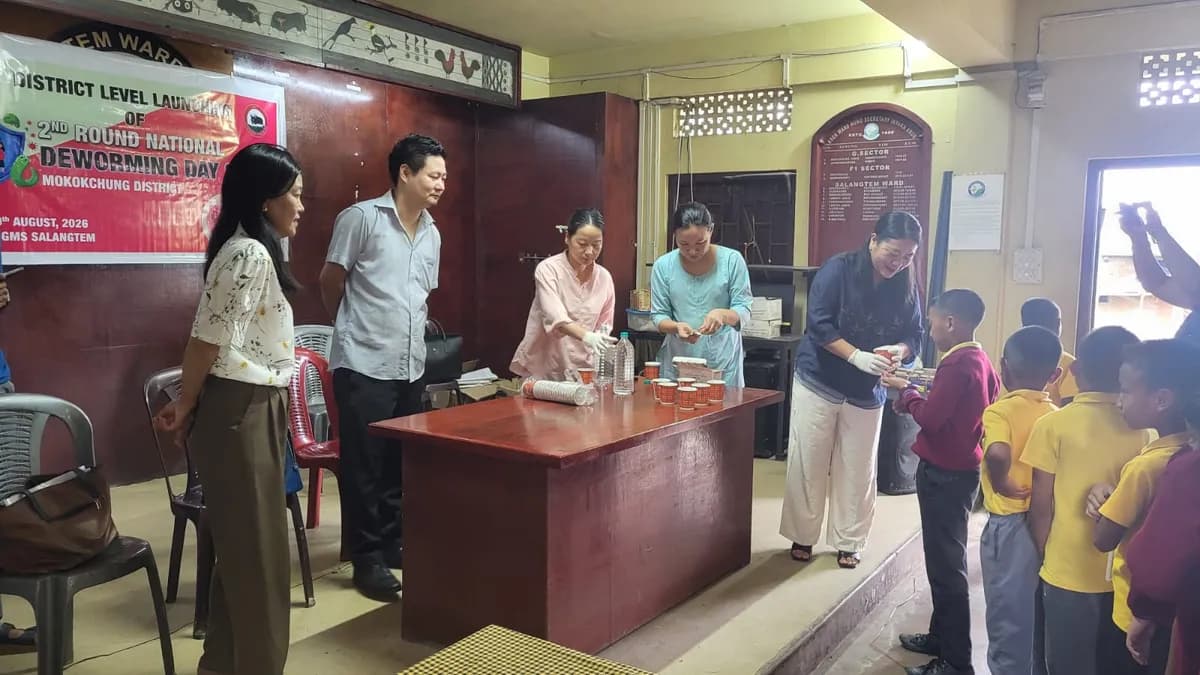
Mokokchung: In Mokokchung, the district-level launching of the programme was held at Government Middle School, Salangtem.
During a brief launching programme, Dr. Limanaro, District Programme Officer (Universal Immunisation Programme and Reproductive and Child Health), administered the first Albendazole tablet and sensitised the students on the objectives of the day, stating that it aims to improve children's overall health, nutritional status, access to education, and quality of life.
She stated that children can be at risk due to playing barefoot, open defecation, dirty hands, unclean food, and dirty water. She highlighted common types of worms, signs of infection, and preventive measures, stressing that cleanliness must be maintained to protect children from soil-transmitted helminths.
The launch was followed by a health check-up conducted by the Rashtriya Bal Swasthya Karyakram team of Mokokchung.
Phek: In Phek, the second round of NDD was launched at Government High School, Phek village, with a fixed-day approach through schools and Anganwadi platforms, while the mop-up round is scheduled for August 17.
The mass deworming programme was planned in collaboration with the departments of School Education and Social Welfare.
At the launching programme, Dr. Khriekuolie Liezietsu, District Programme Officer (Reproductive, Maternal, Newborn, Child, Adolescent Health and Nutrition), highlighted that Albendazole is an antiparasitic tablet commonly used worldwide to treat intestinal worm and tissue parasite infections and relieve symptoms like stomach pain, diarrhoea, and itching.
He urged students to practise good hygiene, including washing hands with soap before eating and after using the toilet, keeping nails short and clean, wearing shoes when playing outside, drinking clean water, and eating washed fruits and vegetables.
Tuensang: In Tuensang, the second round of NDD was observed in various health units. In the district headquarters, the launching programme was held at Wela Foundation School, where the first dose was administered by Dr. Shongmo, Medical Officer of Urban Primary Health Centre, Tuensang.
Dr. Shongmo sensitised the students on the objectives of NDD, how worm infections affect the body, and the prevention and benefits of deworming. The programme was attended by the Rashtriya Bal Swasthya Karyakram team, teachers, and more than 800 students.