


Former Nagaland Chief Minister SC Jamir met with the Rashtriya Swayamsevak Sangh (RSS) chief Mohan Bhagwat to clear confusion surrounding the RSS, BJP and the Naga political issue.
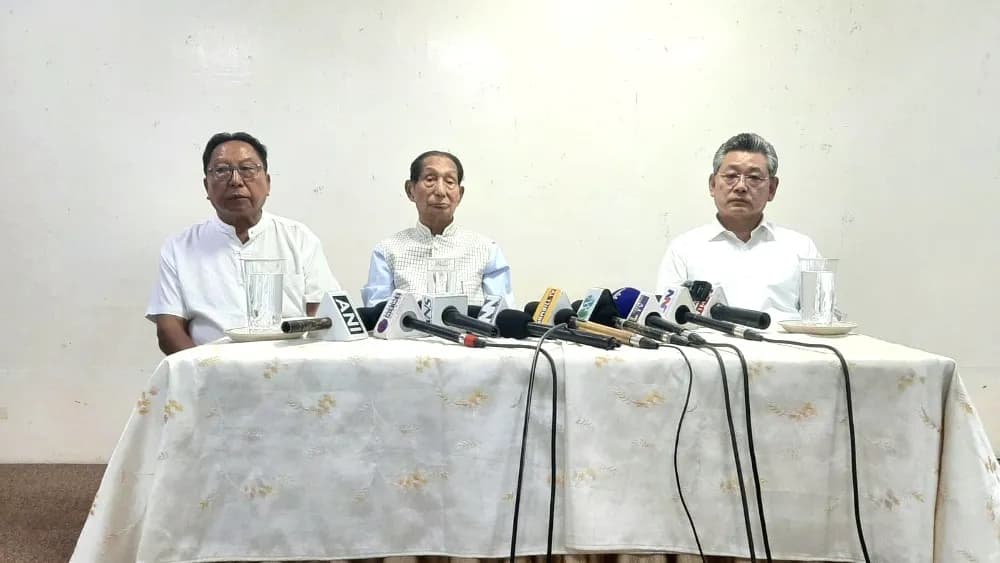
DIMAPUR—Former Nagaland Chief Minister SC Jamir on Saturday said that he met with the Rashtriya Swayamsevak Sangh (RSS) chief Mohan Bhagwat at the organisation’s headquarters in New Delhi on September 10 to clear the “confusion” surrounding the RSS, BJP and the Naga political issue, while urging the organisation to impress upon the Government of India to bring about an early settlement to the decades-old issue.
Addressing a press conference at Hotel Saramati, Dimapur on Saturday, Jamir said the meeting was aimed at going to the “roots” of the issues and explaining the Naga perspective on India, secularism, Article 371A and the unresolved Naga political issue.
He said that discussion with the RSS chief centred on India’s strength-- “oneness” rooted in “unity in diversity”—which he maintained should provide the foundation for building a united India while allowing different communities to retain their distinct identities.
He also told the RSS leadership that changing times required changing mindsets.
Referring to the RSS, he said its philosophy had also evolved since the pre-Independence period.
Naga political issue
Jamir said he had explained to the RSS chief that the Northeast had historically remained outside the mainstream during British rule, with several areas classified as partially or fully excluded.
“For us, we are newcomers to this country,” he said, recalling how people from the Northeast were stereotyped in mainland India because of their appearance.
“Even in the past, when our people went to Delhi, they used to call us ‘Yeh Cheeni bhai hai’ and then ‘Gorkha hai’,” he recalled.
“According to us, when Nagaland State was created and formally inaugurated on December 1, 1963, from that day, we became part and parcel of the Indian family,” Jamir said, adding, “If this is so, how long are you going to allow our people to suffer?”
While recalling that there was only one Naga National Council (NNC) in the past, before numerous factions emerged following the ceasefire, he also criticised the emergence of several organizations functioning according to the “whims and fancies” of such factions.
“What is their modus operandi? Only extortion,” he said, adding that the situation had placed an enormous burden on ordinary Nagas.
He further alleged that the proliferation of authorities has weakened the State government.
Call for early settlement
Referring to the prolonged Naga peace negotiations, Jamir said the Naga groups had earlier insisted that talks be held only in foreign countries in the presence of a third country, but ‘it has come down to Chümoukedima Police complex today’.
On the 2015 Framework Agreement, he maintained that it is by its very nature, a framework with no mention of “sovereignty” or “integration”.
Asserting that the Naga people wanted an early settlement, he said told the RSS chief that helping address the Naga issue could become a milestone for the organisation.
He said the people’s “hope against hope” in the Government of India was waning and the relevance of the issue was also fading amid the multiplication of factions.
“Before it is totally lost, I think the Government of India should now say, ‘Okay, this is final. That’s what we want’,” he said.
Responding to why he approached a religious organisation for a political issue, Jamir said the BJP-led government at the Centre takes cues from the RSS.
“If the BJP government is not listening to us despite raising our voice, why not ask the RSS to also raise its voice so that the BJP government at the Centre will listen?” he asked, adding that all possible avenues should be explored to ensure an early settlement.
On the presence of Apok Jamir, working president of the Nagaland Pradesh Congress Committee, at the meeting, he said the meeting with the RSS was not undertaken along party lines, but in the interest of the Naga people.
He said meeting the RSS did not mean that he had compromised his identity or affiliations.
Asked about social media speculation that his meetings with BJP leaders and the RSS chief indicated that he was leaning towards the BJP, Jamir said his position was clear and that he had no obligation to any party or organization, other than to the Naga people and God.
Stating that the BJP and RSS are not “devils”, he said the Naga issue needed to be explained to all sections of society.
He said Bhagwat had informed him that he would most probably travel to Delhi after a week to meet the concerned authorities.
Growing public frustration
Claiming that the attitude of the present government to continue to stay in power by extending the talks at political level is being opposed at all level but yet to gain momentum, he urged the RSS to take immediate stock of the situation before the situation develops into unwanted consequences with global implication.
He added that ‘there should be total overhauling of the entire system of governance and this could be possible only when the state is brought under president rule for a spell of one or two years’.
“The GoI should avail this opportunity and help restore the normal health of the governance in Nagaland under a President Rule,” he stated.
Opposition to FCRA Amendment Bill
When asked about the Foreign Contribution (Regulation) Amendment Bill, 2026, Jamir said he was “totally against” it and suggested that states such as Nagaland and Meghalaya pass resolutions against it as a representation of the people’s voice.
On the issue of persecution of Christian minorities, Jamir said he had told Bhagwat that Nagaland is a Christian State and ‘being Christian doesn’t mean that we are not Indians’.
Article 371A and Christian identity
Jamir said he had told Bhagwat that secularism is the epitome of “unity in diversity”, where all sections of society could live freely and harmoniously as members of one family.
“During Durga Puja, Nagas take as much, if not more, interest than Hindus. Likewise, during Christmas, people from Hindu, Muslim and other communities also participate. The same spirit is seen during Muslim festivals. In Nagaland, we do not differentiate between Hindus, Muslims and Christians,” he said.
He recalled that RSS members had earlier sought his views on Article 371A, particularly its provisions relating to the social and religious practices of Nagas.
“As far as Nagaland is concerned, when we talk about social and religious practices, religious practices mean Christianity,” he said.
He added the protection of religious practices under Article 371A, in the context of Nagaland, should therefore be understood as including Christian practices.
ALSO READ