


Rev. Dr. Wati Aier urges reimagining Naga sovereignty, emphasising unity, dialogue and collective future at Patkai lecture in Chümoukedima.
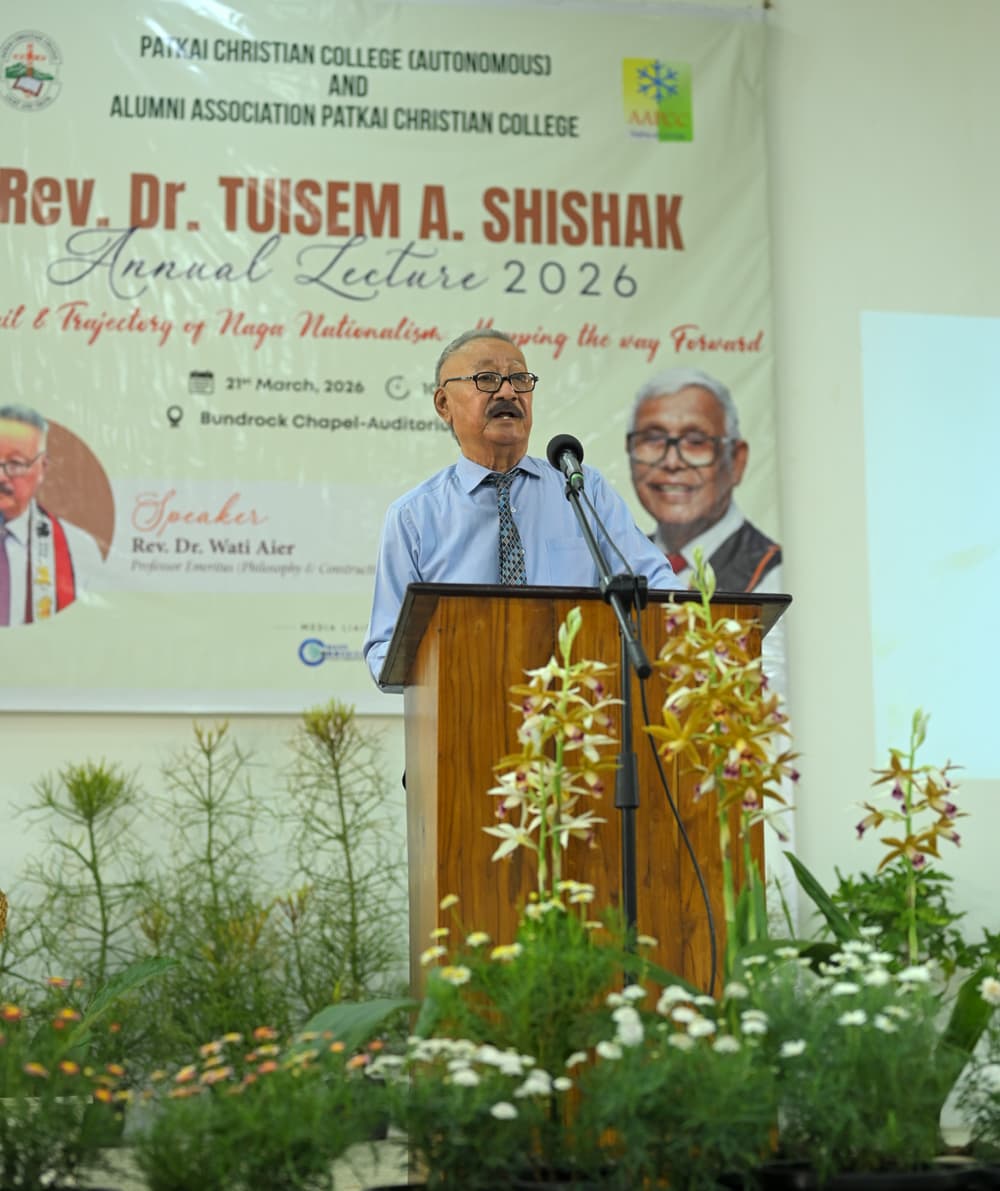
DIMAPUR — At a time when the Naga political discourse appears caught between hardened positions and prolonged negotiations, a fresh call to rethink the very idea of sovereignty is gaining ground—one that seeks to move beyond binaries of independence and integration, and towards a more nuanced, collective future.
Delivering the Rev. Dr. Tuisem A Shishak Annual Lecture at Patkai Christian College in Chümoukedima on Saturday, leading Naga peace advocate Rev. Dr. Wati Aier urged people to “reimagine sovereignty” beyond rigid political definitions while remaining rooted in historical rights, according to a press release.
At the heart of Aier’s argument was a stark reality: the trajectories of Naga nationalism, shaped by decades of resistance, internal divisions and shifting geopolitical realities, have reached a critical juncture.
While the historical assertion of Naga identity—anchored in milestones such as the 1929 memorandum to the Simon Commission, the 1947 declaration, and the 1951 plebiscite—remains central, the path forward, he suggested, must adapt to the changing realities.
Also read: The long walk to oneness: FNR calls 2025 a turning point, backs Naga Machang framework
‘The trajectories point toward convergence, but the path is fraught with challenges,’ Aier said, underlining that divisions within the movement—fuelled by leadership conflicts, competing narratives and external pressures—have weakened the collective cause over time.
Yet, in what he described as a hopeful shift, recent developments among Naga political groups indicate a gradual movement towards unity.
The formation of the Council of Naga Cooperation and Relationship (CNCR) in 2025—following multiple rounds of dialogue—was highlighted as a significant step. Aier likened it to a ‘Naga Machang’, a shared platform where dignity, dialogue and mutual respect can shape a common voice.
‘The Machang is not about dominance but dignity,’ he said, framing it as a metaphor for what he termed “relational sovereignty”—a form of political imagination that prioritises shared identity, cultural continuity and collective responsibility over rigid territorial definitions.
In rethinking sovereignty, Aier challenged both extremes that have long defined the discourse. On one hand lies the Westphalian model of absolute territorial sovereignty—central to modern nation-states like India.
On the other is an indigenous conception of autonomy rooted in culture, customary practices and lived experience.
The Naga struggle, he observed, exists at the intersection of these two frameworks—seeking recognition within a global system that privileges territorial states, while also asserting a distinct identity grounded in indigeneity.
To navigate this tension, Aier proposed three possible pathways. The first is the idea of hybrid sovereignty—arrangements where indigenous political authority coexists with state structures, drawing parallels with regions like Greenland and Nunavut.
The second puts emphasis on plural recognition, where language, culture, and customary laws are acknowledged as legitimate forms of sovereignty.
The third calls for geopolitical realism—accepting the present contours of the Indian state while negotiating safeguards that protect Naga distinctiveness.
“These are not compromises of principle, but creative rearticulations of sovereignty in a plural world,” he asserted.
At the same time, Aier cautioned against romanticising isolation. While historical resistance remains a source of pride, he reminded that “romantic statelessness” cannot sustain political viability in an increasingly interconnected world.
Equally, he cautioned that uncritical assimilation risks eroding the very identity that defines the Naga people.
According to him, the challenge lies in a “dialectical approach”—bringing together differing visions of the future, including complete sovereignty, existing agreements, and ongoing negotiations, into a meaningful dialogue.
A key concern raised during the lecture was the growing disconnect between the Naga movement and its younger generation. Responding to questions, Aier acknowledged that this stems from a deeper crisis of identity and a failure of leadership to present a clear, unified vision.
“The crisis of relevance is rooted in a crisis of identity,” he said, urging both leaders and society to move beyond rhetoric and foster genuine engagement.
He also called on the academic and intellectual community to critically examine the narratives that have shaped Naga nationalism. While such narratives have inspired generations, he added, they have also contributed to division when turned into rigid dogmas.
“A critical engagement is necessary—not to dismiss these narratives, but to reinterpret them in ways that foster unity and authenticity,” he said.