


PIB Kohima organises a discourse on the Viksit Bharat rural development mission with Kohima Press Club members.
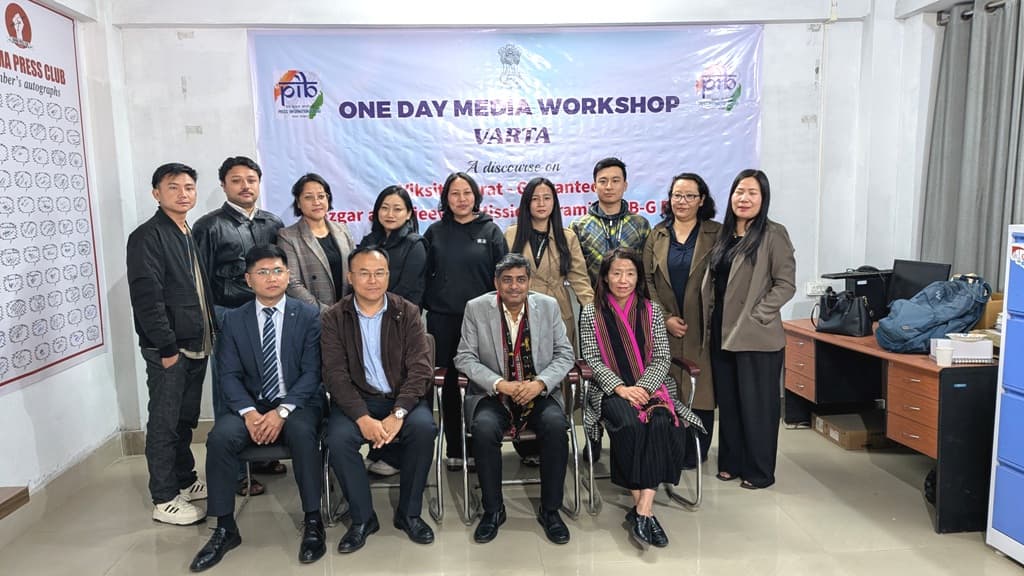
KOHIMA — The Press Information Bureau (PIB) Kohima, under the Ministry of Information and Broadcasting, organised a discourse (varta) on the Viksit Bharat Guarantee for Rozgar and Ajeevika Mission, Gramin (VB-G RAM G) with members of the Kohima Press Club (KPC) in Kohima on Wednesday.
VB-G RAM G, a renamed version of Mahatma Gandhi NREGA, was recently rolled out under the Ministry of Rural Development and is yet to commence.
Jayanta Choudhury, Head of the Department of Rural Development and Planning at Nagaland University, was the resource speaker. He highlighted key structural changes and the implications of the new programme on the rural community, particularly in the northeastern region.
He noted that VB-G RAM G aims to enhance rural employment but introduces structural changes that diverge from MGNREGA's demand-driven principles. Its success will depend on careful implementation, monitoring, and state-level capacity to manage allocations while ensuring fair wages and technological accessibility.
Also read: Assam Rifles organises free medical camps in Mokokchung and Shamator
While the scheme promises more employment days, actual benefits may be limited due to allocation restrictions, supply-driven planning, and peak-season work hours, he observed.
The speaker explained that VB-G RAM G introduces a guaranteed 125 employment days but does not specify inflation-linked wage revision or address long-standing wage stagnation. He further noted that past MGNREGA wage adjustments, which lagged behind agricultural wages, remain an unresolved concern.
The burden of financing is shifted more towards states except for special regions, while earlier MGNREGA had broader central funding. This may strain state budgets, particularly in high-migrant or economically weaker states.
The new scheme will be implemented as a centrally sponsored scheme with central and state governments sharing a 90:10 ratio for Northeastern states, Himalayan states (Uttarakhand and Himachal Pradesh), and the union territory of Jammu and Kashmir. A share of 60:40 will apply for all other states and union territories with a legislature, and 100 per cent central funding will be provided for UTs without a legislature.
He further observed that unreliable digital infrastructure and poor network connectivity in rural areas, particularly in northeastern regions, could cause delays for biometric attendance, which is a mandatory feature in the new scheme.
He said that rural development is the centre of development, noting that achieving the SDG goals depends on how to better rural development. It is a holistic development. Earlier it was manpower planning and sectoral planning, but now it is holistic planning as it converges and creates more job opportunities.
He also added that it would create meaningful participation of women in the scheme. The new initiative should address disparity and inequality among the rural poor.
Moderating the session, Andrew Lalchhandama, Media and Communication Officer of PIB Kohima, remarked that any government schemes must be people-centric and should benefit and uplift the community.