


A workshop on the One District One Product initiative was held in Mokokchung to promote local coffee branding and marketing.
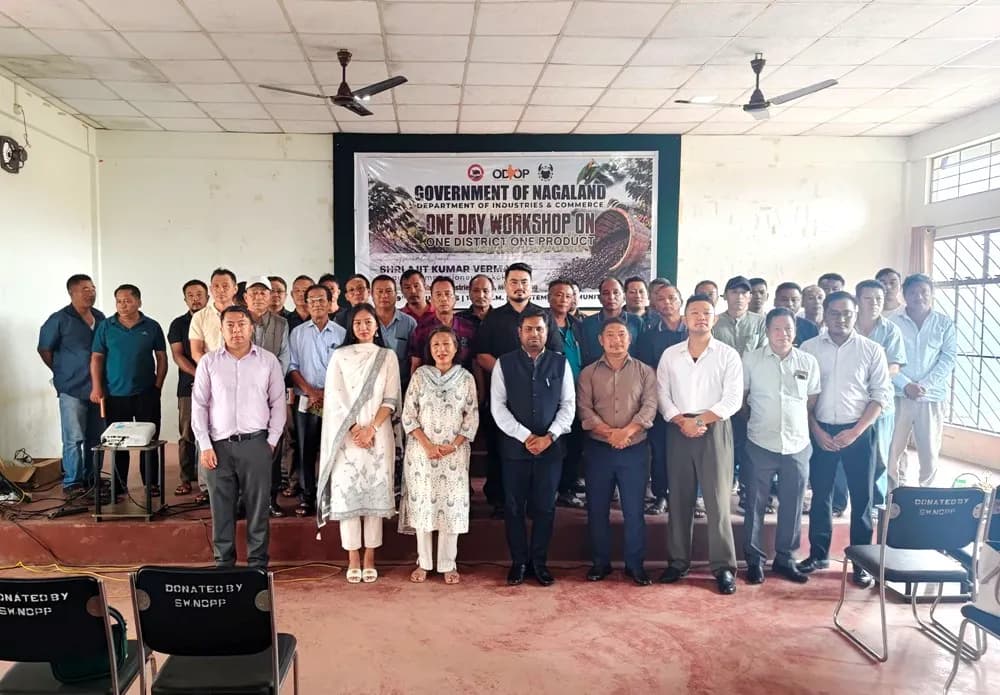
MOKOKCHUNG — A workshop on the One District, One Product (ODOP) initiative for coffee on the theme “Branding - packaging - marketing” was organised by the District Industries Centre (DIC), Mokokchung, at Sangtemla Community Hall on Wednesday.
The programme focused on strengthening coffee production in Nagaland, particularly in the Mokokchung district. More than 40 coffee farmers from Warumong, Mongsenyimti, Longsa, Chuchuyimpang, Khensa, Ungma, Mangmetong, and Mokokchung attended the workshop.
Deputy Commissioner (DC) of Mokokchung Ajit Kumar Verma attended the event as the special guest.
In his address, Verma described the workshop as significant, noting that the ODOP initiative was conceived by the Ministry of Commerce and Industry, to encourage every district to identify its most important product and promote it through stakeholder convergence.
“ODOP is not a funding scheme. It is a convergence initiative in which government departments and private stakeholders come together to utilise available resources and promote the identified product,” Verma said.
He observed that the Department of Land Resources has undertaken several activities for coffee cultivation, resulting in modest growth in production across Nagaland.
The general manager of DIC Mokokchung stated that the district currently produces about 40 to 50 metric tonnes of coffee annually, a figure expected to rise as more farmers become motivated.
Verma pointed out that government departments can organise training, provide infrastructure, and offer support for planting, skilling, processing, and marketing. However, the real drivers of growth remain the farmers and entrepreneurs working on the ground.
“Production is the primary step. It must be sufficient in scale and quality to be marketable. The second step is creating demand, which is possible only through processing. The Department of Industries is therefore focusing on food processing to add value and ensure better prices for producers,” he said.
He noted that Mokokchung already has outlets for coffee consumption and some processing units supported by the Department of Land Resources, which have supplied machines for roasting and packaging.
Verma called upon coffee growers, processors, café owners, and marketers to function as a cohesive ecosystem covering the entire value chain, from production to marketing.
“Only then can we increase production from 40 metric tonnes to 80 metric tonnes or more, given the available cultivable area,” he added.
Referring to the recent announcement by the Government of Nagaland of two coffee clusters in Kohima and Niuland, Verma expressed hope that a similar cluster would soon be established in Mokokchung in view of the district’s potential.
He highlighted the need to maintain the originality, purity, and quality of Mokokchung coffee through proper seed certification and consistent standards.
Without quality control, the local brand cannot expand nationally or globally, he cautioned, adding that certification is also essential for export markets.
Verma urged stakeholders to prepare long-term plans spanning 10, 20, or even 30 years rather than focusing only on immediate gains. He suggested that growers and entrepreneurs form groups or teams to coordinate production, processing, branding, and packaging while safeguarding quality.
The technical session featured resource persons T Imlisunep Ao, Principal of GITI Mokokchung, who spoke on marketing opportunities and channels; Atipong Aier, CEO of Aier Bakery and co-owner of Body Balance, who addressed branding and packaging in general; and Alimoa S Longkumer, proprietor of Mascot Store & Café, who focused on branding and packaging specific to coffee. The session concluded with an interactive question-and-answer round.