


Mahila Jan Sunwai held in Kohima highlights need for forensic lab and stronger safety measures for women in Nagaland.
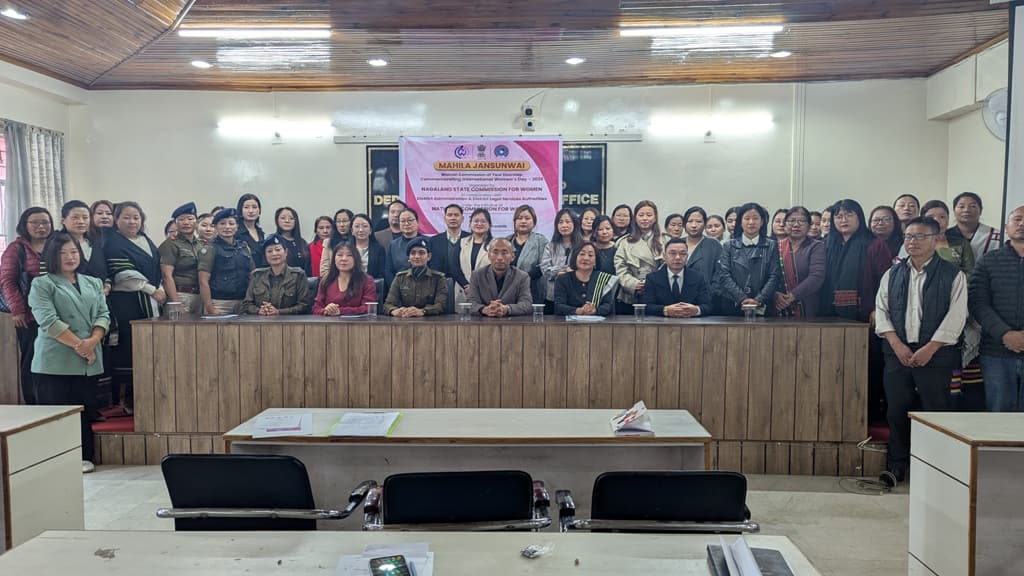
KOHIMA — The Nagaland State Commission for Women’s (NSCW) Mahila Jan Sunwai (women’s public hearing) in Kohima has called upon the state government to step up for the safety and security of women.
An initiative of National Commission for Women (NCW), the programme is being held across 12 districts in commemoration of International Women’s Day and is organised by the NSCW in collaboration with the district administration, district legal services authority and Department of Social Welfare.
The programme was held at the DC Office, Kohima, on Friday.
Speaking at the event, Additional Deputy Commissioner of Kohima Ruopfukuotuo Noudi said that the public hearing aims to provide a platform for redressal of any pending complaints.
Also read: Cluster-level natural farming training held across Nagaland
Its purpose is to address longstanding complaints by bypassing administrative delays and for the swift disposal of any grievances that women may have. When it comes to the judiciary system, he said, long delay is involved in settlement of cases.
The platform will address issues of such delays to ensure that swift justice is delivered. With increasing instances of crime against women and workplace-related sexual offences, he said the platform will generate awareness for women to know their rights and fight for their rights.
Kekhrienuo Meyase, NSCW member, said it is about time that the government steps up and provides a good forensic laboratory if they are concerned about the safety of women. In the absence of a forensic laboratory, many women are denied timely justice.
“Rape is always seemed to be followed by murder. Most reviews that the commission received from the police is lack of forensic lab. Without evidence police cannot proceed the investigation,” she said
Evidences collected are compelled to send outside the state in the absence of a forensic laboratory in the state. In the process, the evidence gets tampered or destroyed, denying timely justice delivery, she added.
She also maintained that Nagaland is placed as the state with the least crime against women in the country but that this is because of less reporting.
Meyase called for collective effort in ensuring safety of women and urged CSOs to assist and extend help to the police wherever required.
UBSI Vikuobinuo presented the role of the police, particularly the Women Police Station, in addressing crimes against women and children and outlined the types of crimes registered in women police stations.
She stated that they primarily deal with offences against women and children such as rape and sexual assault, molesting and outraging a woman's modesty, domestic violence and physical abuse, sexual harassment and stalking, domestic-related harassment and cruelty, cyber harassment and online exploitation, child abuse, and offences against minors.
Vikuobinuo stated that complaints from women in distress are handled with sensitivity, confidentiality, and professionalism, with priority given to the victim’s dignity, safety, and psychological well-being.
She emphasised that public cooperation is vital in preserving evidence. Citizens should avoid touching or disturbing objects at the crime scene, prevent crowding, inform the police immediately, and provide accurate information or eyewitness details.
They should also help ensure the victim’s basic safety and medical assistance.
The first responder—whether police or a responsible citizen—should secure the victim and others, call the police and emergency medical services, preserve the crime scene, and provide first aid without disturbing evidence. Noting details such as time, location, and suspicious individuals can help strengthen investigation and prosecution.
She further stressed the need to encourage early reporting of crimes without fear or stigma, while strengthening community policing, helplines, and coordination among police, the judiciary, social services, and civil society.
Meanwhile, Vimenu Richa, Centre Administrator of SAKHI One Stop Centre Kohima, said the centre has registered 192 cases in the district since 2016, with domestic violence and distress cases forming the majority. She added that counselling is the first step in handling cases, while legal services are pursued when counselling fails.
A representative from the Kohima District Legal Services Authority informed that a total of 36 cases have been disposed of through mediation in 2025.
Many of these cases were family disputes. Most of the people come for legal assistance only at the last stage when things cannot be reconciled.
The advocate noted that they are trained to mediate but when they come at the last stage they help.
He called for CSOs particularly women organisations and churches to create platform where women can share their experience.