


Search operations continued in Nepal on Saturday, more than two weeks after devastating flash floods, with teams continuing efforts to trace more than 5,000 people still missing.
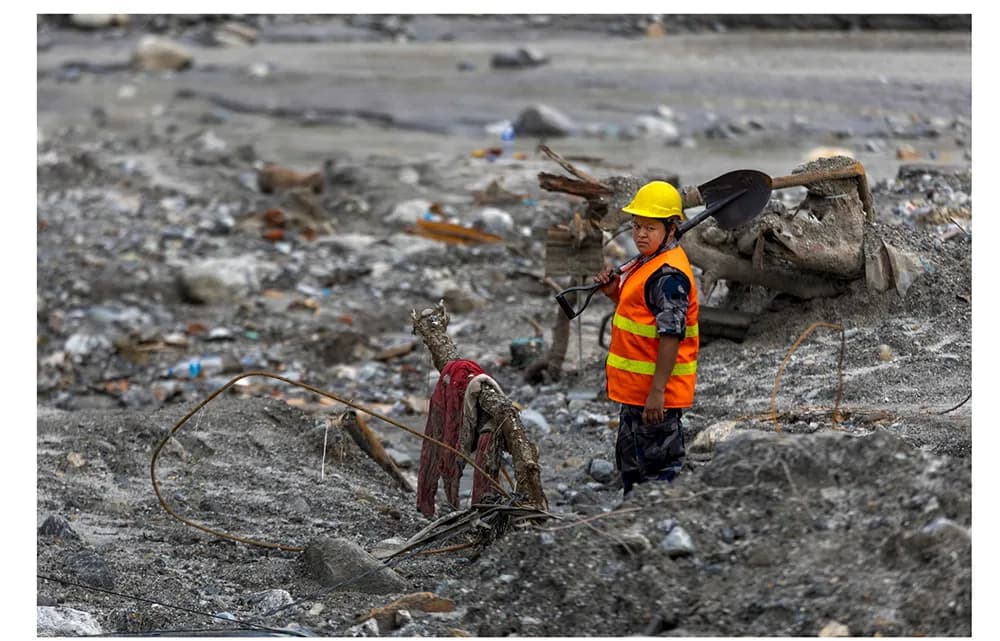
KATHMANDU — Search operations continued in Nepal on Saturday, more than two weeks after devastating flash floods, with teams continuing efforts to trace more than 5,000 people still missing.
Nearly 1,400 people have been killed, while 13,676 people have been rescued so far, according to Nepal’s National Disaster Risk Reduction and Management Authority (NDRRMA).
At least 5,130 people, including 589 foreign nationals from around 30 countries, remain missing, authorities said.
Flash floods, triggered by an ice-rock avalanche near the Nepal-Tibet border on August 26, devastated towns and villages in northern and central Nepal. The Bhotekoshi River, which flows south from the Himalayan border region, carried the floodwaters downstream, sweeping away homes, vehicles, roads and bridges and damaging hydropower projects.
The floods also killed 43 people on the Chinese side, where more than 500 remain missing, according to Chinese media.
In Nepal, 364 bodies were recovered in Chitwan district alone, the highest among all districts, followed by Nawalparasi East, Nawalparasi West. The rest were from Nuwakot, Rasuwa, Gorkha, Dhading and Tanahun districts, according to NDRRMA.
Search teams have been deployed at several hydropower projects in the flood-hit Rasuwa and Nuwakot districts, where large numbers of workers remain unaccounted for.
The operations involve the Nepal Army, Armed Police Force, project personnel and foreign technicians.
At the Chilime Hydropower Project, teams have entered the tunnel and advanced about 115 metres while clearing mud, rocks and other debris.
At the Upper Trishuli-1 project, a joint team including foreign technicians has entered about 400 metres into the main access tunnel to search for missing workers, according to the Nepal Army.
Search operations are also continuing at the Rasuwagadhi, Rasuwa Bhotekoshi, Langtang, Trishuli-3A and Upper Trishuli-3B hydropower projects.
The search operations have been complicated by buried structures, mud and debris inside tunnels and difficult terrain.
Identifying the dead has emerged as a major challenge. Of the total bodies recovered, only around 100 have been handed over to families so far after, authorities said.
Bodies recovered after being swept downstream have often been severely damaged, decomposed or recovered only in parts, making identification by face, clothing or personal belongings difficult, officials said.
Prolonged immersion in water and exposure to mud and debris can destroy identifiable features, while some remains have been fragmented or mixed with other remains. Forensic experts say DNA testing has therefore become crucial, but it is a time-consuming process requiring samples from the remains and biological relatives for comparison.