


Senior journalist Vishal Arora tells North East Christian University students that narrative journalism helps uncover truth beyond simple reporting.
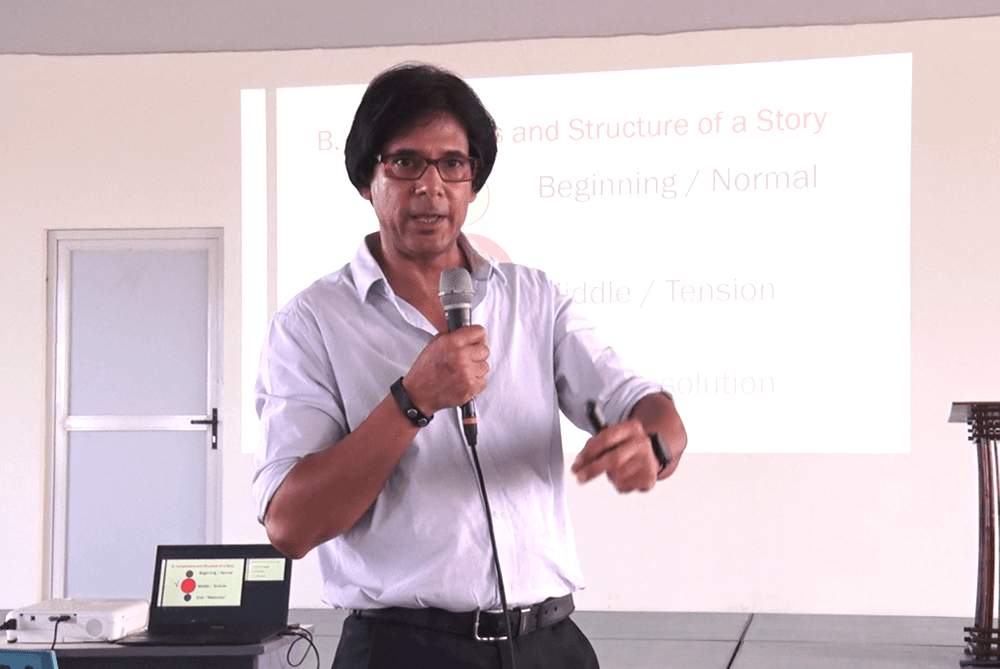
DIMAPUR — Simply reporting facts is no longer enough, as audiences today expect journalists to investigate, uncover truth and present meaningful narratives, said Vishal Arora, a senior journalist and founding Editor of Storytelling at Newsreel Asia, during an interaction with students of North East Christian University (NECU) in Dimapur on Saturday.
Speaking on the topic ‘The Power of Narrative Journalism,’ Arora said that journalists must begin with objectivity but can take a stand once the truth is established.
“Simply reporting is not enough. Readers expect you to investigate and uncover the truth. Once you find the truth, it is okay to be biased towards it,” he said.
Arora said that narrative journalism has long been debated for its relationship with objectivity. Traditional journalism emphasises neutrality and detachment, but narrative journalism focuses on storytelling to convey deeper truths.
Also read: North East Japan Caravan kicks 2025-26 off in Kohima
He added that narrative journalism is often wrongly linked to fake news and propaganda, especially in today's polarised media environment.
“Fake news is usually not narrative journalism at all. Many outlets spreading misinformation are not using narrative techniques,” he said.
According to Arora, the misuse of journalism is not tied to any particular genre, as misinformation can occur in any form of reporting. However, narrative journalism seeks to convey truth through powerful storytelling.
He said that the debate over whether narrative journalism can be objective has largely settled, with the format now recognised as one of the most respected forms of journalism.
“Many Pulitzer Prize-winning stories are narrative journalism,” he said.
Arora also observed that top global organisations such as BBC, CNN and Al Jazeera attempt narrative journalism but often struggle to implement it effectively because it requires journalists to unlearn traditional newsroom practices.
Disproportionate focus
Questioning the relevance of contemporary news coverage, Arora claimed that much of the media focuses disproportionately on governments, party politics and elite personalities.
Citing a study conducted by Newsreel Asia, he claimed that only about 1% of news coverage focuses on governance and basic needs such as electricity, water, roads, economy and livelihoods, while the majority highlights political elites and celebrities.
According to him, this pattern dates back to an earlier era when media served as the primary bridge between the public and powerful institutions such as Parliament, Bollywood and political leaders.
“Today things have changed. Elites have direct communication channels through social media, yet media still prioritises elite news,” he said.
Arora further observed that the relationship between journalists and political leaders has also shifted. Referring to Prime Minister Narendra Modi, he remarked that journalists often struggle to access leaders directly, with communication increasingly routed through social media posts and official statements.
Arora argued that traditional journalism assumes people lack information and therefore focuses on delivering facts. However, he said that the real challenge lies in how audiences interpret and emotionally respond to information.
“Knowing the facts does not necessarily change behaviour. People often make decisions based on experiences and emotions,” he said.
He explained that confirmation bias leads individuals to seek information that validates their existing beliefs rather than challenge them.
Narrative journalism, he said, addresses this by connecting with audiences emotionally through storytelling.
“When people feel connected to a story, they are more likely to reflect on their own lives and attitudes. That is the power of narrative journalism,” he said.
Arora also spoke about ‘narrative transportation’, describing it as a process where audiences become immersed in a story and emotionally identify with its characters.
This emotional engagement, he said, can influence perspectives and inspire change.
According to Arora, narrative journalism ultimately focuses on humanitarian concerns and the everyday experiences of people rather than just political developments.
“It is about telling stories that reflect universal values such as peace, equality, inclusion, democracy and human dignity,” he said.