


World Veterinary Day marked in Kohima as Nagaland veterinarians were urged to evolve, learn skills and serve beyond duty.
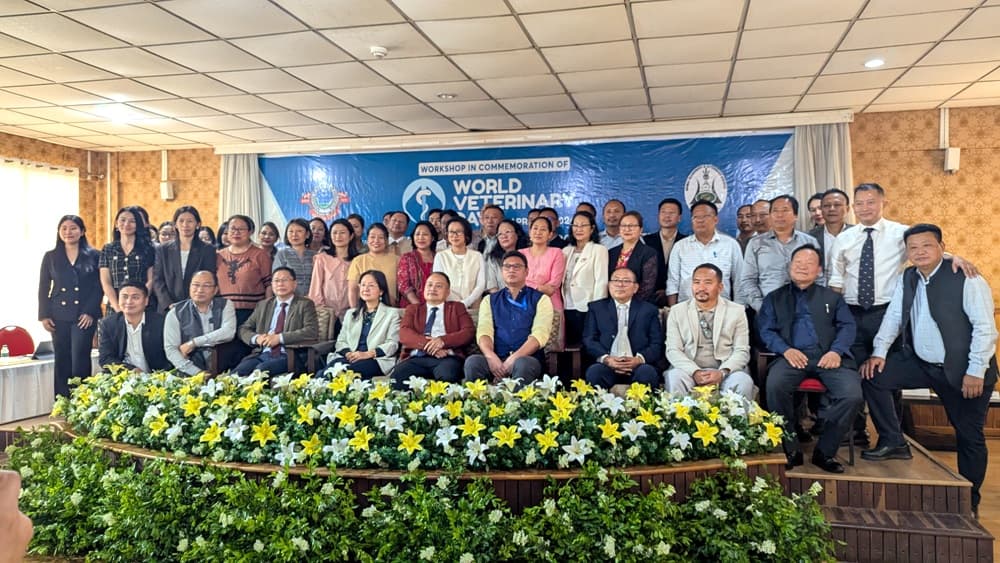
KOHIMA — Celebrating World Veterinary Day, veterinarians in Nagaland were called upon to constantly evolve, learn new skills and work beyond their profession during a workshop in commemoration of the occasion in Kohima on Saturday.
The occasion was celebrated on the theme ‘Veterinarians: Guardians of food and health’ and was organised by Nagaland Veterinarians’ Association and sponsored by the department of Animal Husbandry & Veterinary Services.
In her speech, Angelina Tajen, Secretary of Animal Husbandry & Veterinary Services and Tribal Affairs, noted that the next decade will test veterinarians as climate change shifts disease patterns and consumers will demand safer food.
Towards addressing this, she challenged them to evolve, learn the new skill, and adopt the new technology but also keep the old compassion.
She reminded that the farmer does not care about degree but cares that they picked up his desperate call.
She also said that government's commitment under NLM and the state’s own schemes must be matched by timely resources and training because Nagaland needs a future-ready veterinary service.
Acknowledging the veterinarians, the secretary said because of them, a child drinks safe milk today, a family income survived and the word ‘epidemic’ is contained.
To recognise their excellence, she suggested that a veterinarian award be instituted.
Also read: Nagaland inks pact to improve maternal, child services in eastern districts
Dr. Zaseikuolie Chusi, Commissioner and Secretary, Department of Land Revenue, Tourism and Director of Census Operation, called upon the veterinarians to ponder upon the per capita conjunction in terms of Nagaland state.
He said the state's dairy product requirement is 150 grams per capita, while availability is about 67 grams. For eggs, the requirement is 110 per capita, while availability is around 34 to 40 eggs.
He said the gap between demand and supply is huge.
Chusi also disclosed that pork consumption in the state is more than one-fifth of the total production in the country, which is high.
On pork production, he said there are many diseases which cause economic losses. While veterinarians are taking precautionary measures and are ready for post-effective measures, he challenged them to go beyond their services.
Citing that veterinarians are among the most highly paid salary groups in the country, he questioned whether they are doing justice to their profession and service.
He said the rural economy depends on animal husbandry, which is directly related to veterinarians, and that the community needs veterinary services.
Dr. Kuokehebi Gwirie, Director of AH&VS, spoke on the importance of retrospection of the activities on a real time basis.
He further noted the need of the hour is to have realistic target, upgrade disease diagnostic facilities and quality checking facilities.
He said the department’s DPRs are designed to be environment friendly and meeting the SDG indexes but there is a need to ensure availability of chemical free feed and fodder.
Dr. KN Zubemo Humtsoe, president of Nagaland Veterinarians' Association, noted that veterinarians often work under challenging conditions, especially in remote and underserved areas.
They must be supported through better infrastructure, access to modern technology, continuous training, and fair opportunities, he said.
He called for recognising the importance of responsible animal ownership, ethical farming practices, and awareness about animal welfare.
“Investment must be made in veterinary education and research to prepare future generations for emerging challenges. Innovations in science and technology, including diagnostics, vaccines, and digital tools, must be made accessible to veterinary professionals. Strengthening veterinary systems will not only benefit animals but also ensure food safety and public health at large,” he added.
Dr. Simon Ao, president, NSVC, said the state stands at a critical intersection of animal welfare, food safety and disease prevention.
On the standard of safety and status of public health, he suggested that veterinarians can design and develop a strong and regulated system with the support of the state machinery.
Dr. Raghubir Singh, Assistant professor, Department of Veterinary Public Health & Epidemiology, College of Veterinary Science and AH, Jalukie, was the theme speaker for the workshop.