


Nagaland urged to create a legally robust child protection model aligned with Naga customs and realities.
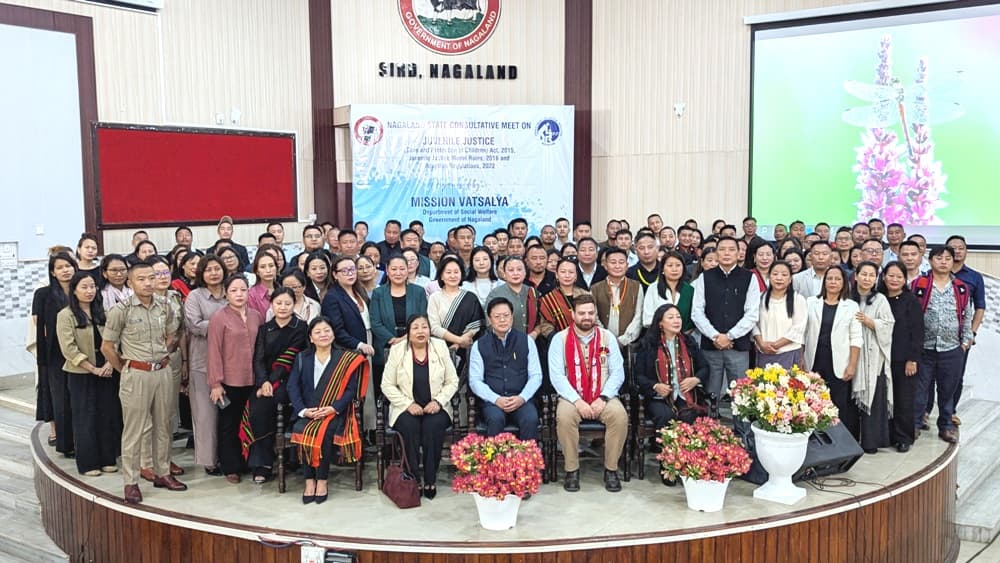
KOHIMA — Nagaland was on Tuesday urged to develop a child protection framework that is legally robust while remaining sensitive to Naga customary practices and local realities, during a state-level consultative meeting on child welfare laws held in Kohima.
The call came during the one-day Nagaland State Consultative meeting on the Juvenile Justice (Care and Protection of Children) Act, 2015, Juvenile Justice Model Rules, 2016, and Adoption Regulations, 2022, organised by Mission Vatsalya under the department of Social Welfare at the SIRD Auditorium.
Addressing the programme, Secretary of the Social Welfare department and Mission Director of Mission Vatsalya, Limawabang Jamir, said Nagaland’s constitutional protections under Article 371A of the Constitution of India make the state’s child protection challenges distinct from those in other parts of the country.
He said customary forms of adoption rooted in clan and village traditions, though carried out with good intentions, are increasingly leaving children legally vulnerable in matters relating to identity, inheritance, education, welfare entitlements, and long-term security.
“Our reality includes customary forms of adoption deeply rooted in clan and village traditions—done with good intentions, but increasingly leaving children legally vulnerable in a modern world,” he said.
Also read: 'Wait and see' approach delaying help for children with disabilities — Experts
Jamir also pointed to the “deep digital divides” in newly created and remote districts, saying the reliance on centralised online systems was creating practical difficulties in implementing child protection mechanisms.
He noted that Nagaland has historically depended on community-based systems of care through families, clans, village councils, churches, and tribal institutions, which have protected vulnerable children for generations. However, he said such systems now need to be reinforced through proper legal safeguards provided under the Juvenile Justice Act and Adoption Regulations.
“The task is not to dilute the law, nor to disregard the customs, but to implement these provisions in a manner that is practical, culturally sensitive, and responsive to the realities of Nagaland,” he said.
WATCH MORE:
Calling for coordination among all stakeholders, he urged the Social Welfare department, judiciary, police, medical fraternity, district administrations, and tribal institutions to work together instead of functioning in silos.
“We do not need to rewrite the federal law to suit Nagaland, nor do we need to abandon Naga culture to suit the law,” he added, while calling for a child protection model that is “legally airtight, yet distinctively Naga”.
Director of Social Welfare and Member Secretary of Mission Vatsalya, Tosheli Zhimomi, said the Juvenile Justice Act, Juvenile Justice Model Rules, and Adoption Regulations together form the backbone of the country’s child protection and adoption framework.
She informed that the Juvenile Justice (Care and Protection of Children) Act, 2015, was notified in Nagaland on March 22, 2018, while the Nagaland Juvenile Justice (Care and Protection of Children) Rules, 2024, were drafted and notified on December 2, 2025.
According to her, the consultation was intended to assess implementation mechanisms, identify gaps and challenges, and strengthen coordination among departments and stakeholders.
“Most importantly, it gives an opportunity to reaffirm that the best interests of the child must remain at the centre of every decision made,” she said.
She added that orphaned, abandoned, and vulnerable children depend greatly on the effectiveness and accountability of child protection systems, and called for strengthening institutional support systems and inter-departmental convergence.
Senior Consultant at the Ministry of Women and Child Development, Junaid Ul Islam, said national child protection laws and regulations would continue to evolve based on inputs received from states and the public.
He observed that the 10 years since the enactment of the Juvenile Justice Act, 2015, had exposed institutional gaps, changing crime patterns, and areas requiring legislative review.
Citing NCRB 2024 data, he said around 35,000 crimes were committed by children in conflict with law.
Islam urged Nagaland to submit practical recommendations during the consultation process, adding that suggestions gathered from states across the country would later be opened for public consideration.
Earlier, Programme Manager of the State Child Protection Society, Raitale Zeliang, said the consultative meeting was organised to hear directly from field-level functionaries.
The meeting was attended by representatives from Child Welfare Committees, Juvenile Justice Boards, Child Care Institutions, police, State Legal Services Authority, Nagaland State Commission for Protection of Child Rights, district administrations, and the medical department.