


Nagaland University organises a programme on saving water and energy, highlighting environmental justice and sustainable living.
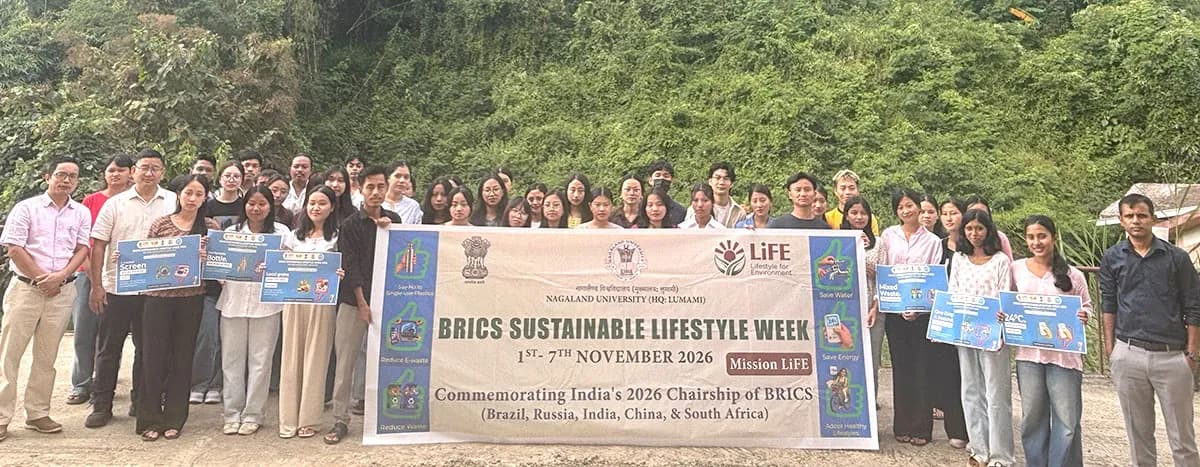
DIMAPUR — The Department of Sociology, Nagaland University, organised an awareness programme on “Save Water and Energy” on Friday, featuring a keynote lecture by Dr. Sandeep Gupta, Associate Professor in the department, followed by a student slogan competition aimed at promoting environmental awareness and active participation.
Speaking on the sociological dimensions of resource access, Dr. Gupta highlighted that essential resources such as water and energy are not merely natural assets but are closely linked to social power, infrastructure and institutional frameworks.
He pointed out that unequal access to these resources creates disparities between rural and urban populations, as well as affluent neighbourhoods and informal settlements, the university stated in an update.
Citing acute water scarcity in certain cities, he observed that institutional deficiencies often compel residents to depend on private groundwater extraction, an option available primarily to those with sufficient financial resources.
Dr. Gupta further explained that consumption patterns are shaped by structural class differences rather than individual preferences alone.
Higher-income households, he noted, tend to consume disproportionately more energy through air conditioning, multiple electronic devices and extensive lighting.
He also highlighted the gender dimensions of resource scarcity, stating that in traditional patriarchal settings, women disproportionately bear the burden of sourcing and managing water, often travelling long distances to meet household needs.
Drawing attention to global environmental inequalities, Dr. Gupta observed that developed Western countries have historically recorded significantly higher per-capita carbon emissions but often shift the responsibility for conservation towards developing nations.
On disaster vulnerability and environmental justice, he contrasted advanced mitigation measures, such as Japan's seismic-resistant architectural technologies, with the high casualties witnessed during floods in countries like India, where inadequate protective infrastructure leaves vulnerable communities exposed to greater risks.
He noted that the environmental costs of consumption by wealthier sections of society are often transferred to lower-income and marginalised communities, which lack the financial resources and infrastructure to protect themselves from environmental degradation.
The conveniences enjoyed by privileged groups, he added, often conceal the burdens borne by vulnerable populations and unpaid household labour.
In contrast to capitalist models that associate prosperity with continuous resource exploitation, Dr. Gupta highlighted indigenous practices as examples of sustainable living.
He cited seasonal hunting restrictions in Nagaland during animal breeding periods as an illustration of need-based resource use and coexistence with nature.
Emphasising that sustainability must be viewed through the lens of environmental justice, he urged sociology students to develop structural empathy and recognise their shared responsibility towards marginalised communities and future generations.
He stressed that conservation should go beyond reducing individual utility bills and be guided by intergenerational equity and collective responsibility.
The programme was organised under the “BRICS Sustainable Lifestyle Week” initiative as part of the broader national events commemorating India's 2026 Chairship of BRICS, comprising Brazil, Russia, India, China and South Africa.
The programme was attended by Prof. Athungo Ovung, faculty members, officers, staff, research scholars and students of the university.
Winners of the slogan competition on the theme “Save Water and Energy” will be announced at a later date, the update stated.