


Nagaland University Lumami hosts national conference on biodiversity conservation and climate resilience.
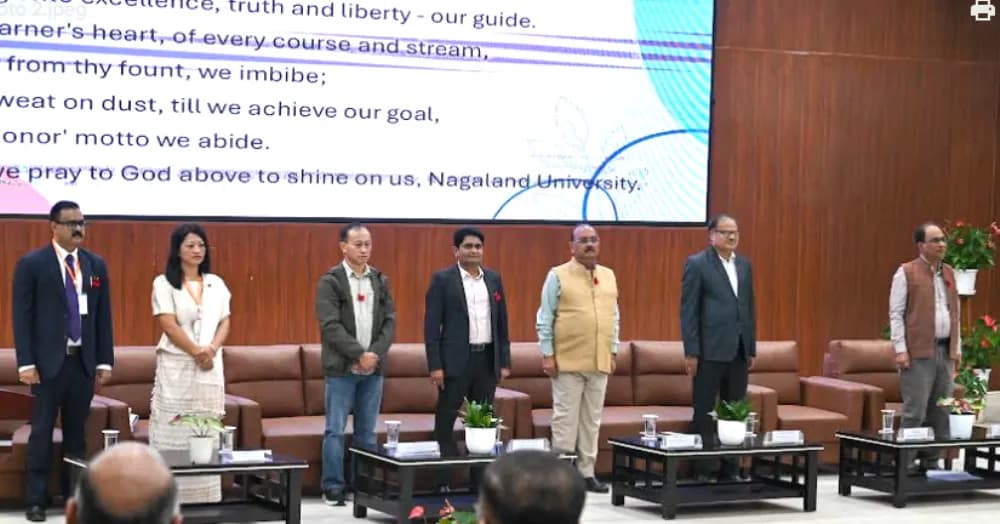
DIMAPUR — The inaugural session of the National Conference on Biodiversity Conservation and Climate Resilience (NCBCCR) in North East India 2026 commenced at the I Ihoshe Kinimi Hall, Nagaland University, Lumami, on October 6.
Conference Convener Ashutosh Tripathi outlined the core theme and objectives of the conference, highlighting the rich forest cover, diverse ecosystems, and traditional indigenous knowledge of Northeast India.
According to an update, he pointed out that rising climate risks and biodiversity loss necessitate an integrated, multidisciplinary platform connecting science, policy, and practice to promote community-centred and culturally grounded conservation strategies.
Chief guest PK Mishra, Professor of Chemical Engineering at IIT (BHU) Varanasi and former Vice-Chancellor of AKTU and JTU, officially opened the conference. He warned of the risks posed to human survival by continuing ecological degradation.
While acknowledging the rich natural heritage of Nagaland, he highlighted the growing impact of human activities on local landscapes and urged a return to sustainable, eco-friendly practices in harmony with nature to address environmental challenges.
Also read: NSRLM and BRAC International sign MoU on social inclusion, livelihoods
Chozuba Village Fair pushes farm enterprise
He noted that the traditional conservation ethos has been strained by modern development, while pointing out the role of Government of India initiatives, such as local biodiversity management committees, in empowering communities to safeguard natural resources.
Chief patron and Nagaland University Vice-Chancellor JK Patnaik observed that although Nagaland has historically preserved its forests, recent development and modernisation have coincided with an increase in natural disruptions, including frequent landslides and cloudbursts. He urged researchers to document fine-scale environmental changes to guide broader conservation efforts.
School of Sciences Dean and co-patron Santosh Kumar Singh highlighted the intersection of science and tradition, describing climate change as an immediate threat to the region. He noted that combining long-standing indigenous knowledge with modern scientific research is essential to bridge ecological sustainability with ongoing development.
The session registered 91 participants, comprising 14 resource persons, 67 registered delegates, and 10 faculty members of Nagaland University.