


The Village Fair in Chozuba promotes rural enterprise, local products and livelihood opportunities for farmers and entrepreneurs.
Agriculture Advisor Yanthan urges shift from subsistence farming to market-oriented enterprise
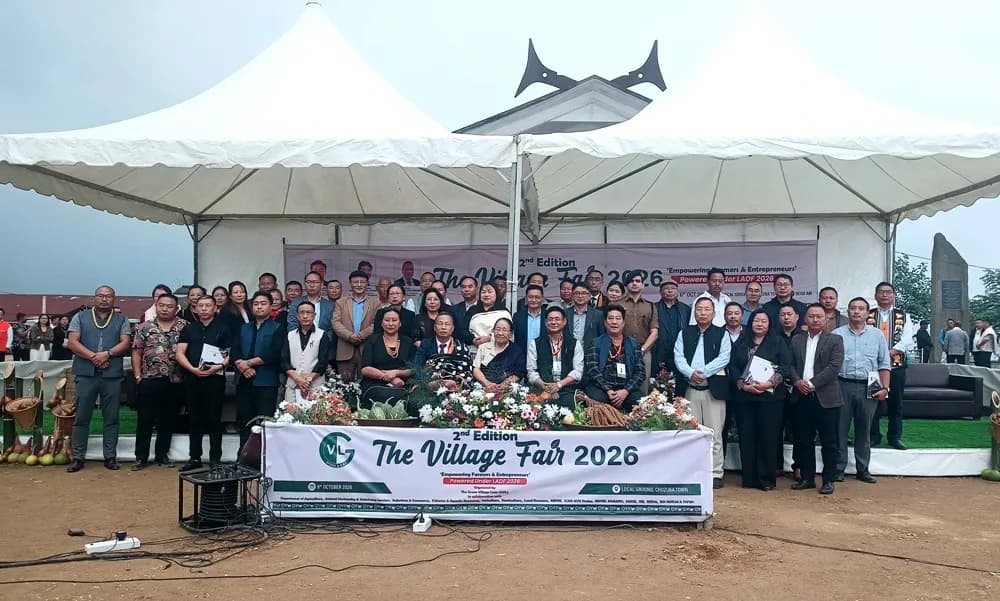
CHOZUBA — The second edition of The Village Fair was held at Chozuba town, Phek district, on Tuesday under the Local Area Development Fund (LADF) 2026, bringing together farmers, entrepreneurs, self-help groups (SHGs), government departments and institutions to promote rural enterprise and livelihood opportunities.
Organised by The Green Village Link (GVL) in collaboration with government departments, ICAR-KVK Porba, State Bank of India (SBI) and Chakhesang Women Welfare Society (CWWS), the fair featured more than 90 stalls showcasing locally produced goods and services.
Medical camps and cooking and baking competitions were also held as part of the event.
Speaking as the special guest, Advisor for Agriculture Mhathung Yanthan said the fair had created a platform for farmers, government departments, institutions and other stakeholders to come together and work towards advancing the farming community.
He said Nagaland had fertile soil, a conducive environment and traditional knowledge and skills, along with a hardworking and resilient population.
However, he stressed the need to shift from traditional farming practices towards modern, technology-driven agriculture and urged farmers to view agriculture as a business.
“Farming has to be taken as a business,” Yanthan said, calling for a shift from subsistence to enterprise, production to value addition and individual effort to collective economic strength.
He stressed the importance of aggregation, institutional support, market linkages and remunerative prices, while urging farmers to adopt new technologies and understand the economic value of their produce.
Yanthan also highlighted agriculture and allied sectors as a major opportunity for the youth. He said opportunities extended beyond cultivation to processing, packaging, logistics, farm machinery, digital services, agritourism, marketing and other allied activities. Young people, he said, could start small with vision, discipline and a clear understanding of the market.
He called for greater convergence among government departments and institutions, stating that transformation could not be achieved by one department working in isolation. He urged that the village fair should develop into a continuing movement rather than remain an annual event, with its success measured through tangible outcomes such as new markets for farmers, institutional support for entrepreneurs, sustainable SHG enterprises and local products reaching markets beyond Chozuba.
Yanthan further identified Chozuba's scenic landscape and agricultural potential, particularly its production of kiwi, persimmon and honey.
He encouraged mechanisation, crop diversification and scientific farming practices suited to different topographies and changing climatic conditions.
Emphasising the need for a change in mindset, he said villages should not be viewed merely as beneficiaries of government schemes but as partners in building Nagaland's economy.
Young people, he added, should be encouraged to become job creators and entrepreneurs rather than only job seekers.
“Our villages must become engines of development,” Yanthan said, calling for a rural economy that was productive, market-oriented, innovative and dignified.
Guest of honour and Advisor for Airways and Railways A Pongshi Phom called for a return to the land and greater utilisation of the State's natural resources.
He observed that many people had moved towards towns and urban areas while continuing to depend on others for essential goods, resulting in a decline in the number of producers.
Phom urged people to utilise available resources through scientific approaches, including natural and organic farming, and called for efforts to preserve Naga traditions, culture and heritage. He also highlighted the contribution of the Chozuba Assembly Constituency in producing leaders in public life and organisations.
Host and Advisor Kudecho Khamo said the fair was aimed at encouraging farmers and entrepreneurs and empowering them with opportunities.
He called on the Chakhesang community to develop a strong work culture and make effective use of available resources.
Khamo highlighted the “One Family, One Project”, “One Family, One Entrepreneur” and “One Family, One Prayer Time” initiatives launched last year, saying they were helping create a movement among the people.
He noted that buyers were increasingly seeking locally produced goods and encouraged producers to build relationships with banks, financial institutions and marketing agencies.
Stressing that government employment could not accommodate everyone, Khamo urged greater emphasis on business and entrepreneurship. “Thinking is capital, enterprise is the way,” he said.
Earlier, Chakhesang Public Organisation (CPO) president Vezuhu Keyho expressed appreciation that people were choosing livelihood over politics and encouraged farmers to adopt organic and natural farming practices for sustainable livelihoods.