


Nagaland University's School of Agricultural Sciences held a workshop on statistical methods.
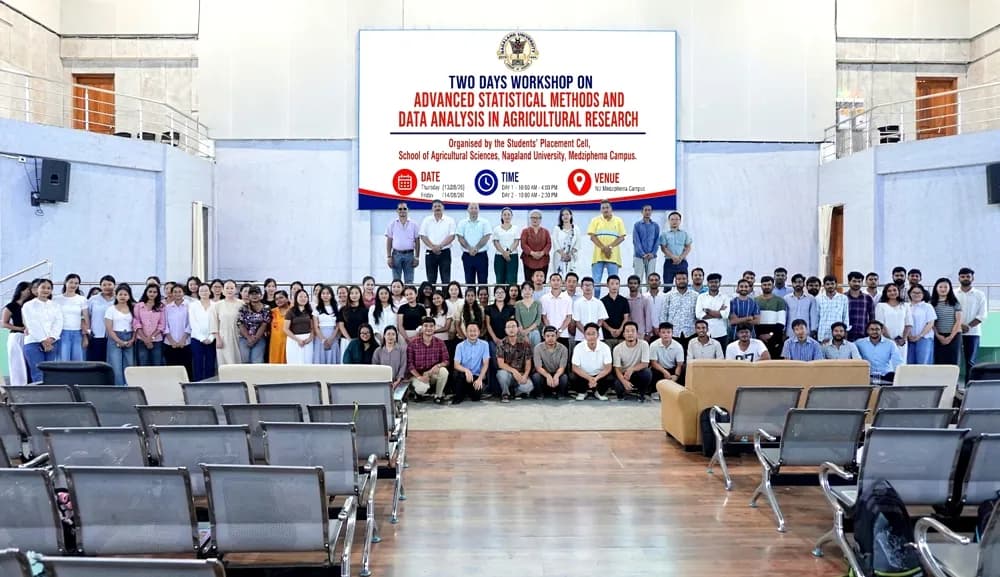
DIMAPUR — A two-day workshop on "Advanced statistical methods and data analysis in agricultural research" was organised by the Students’ Placement Cell, School of Agricultural Sciences, Nagaland University (SAS, NU), Medziphema Campus, on August 13 and 14.
The workshop, supported by the PhD Scholars Forum and NUSU, Medziphema Campus, brought together 110 postgraduate students and research scholars from 11 departments of the School of Agricultural Sciences.
The programme was designed to address statistical challenges encountered by students and scholars in their ongoing research. A preliminary survey was conducted to identify areas requiring greater understanding and practical guidance, with sessions structured around these needs.
A major feature of the workshop was its focus on practical application and research problem-solving. Rather than focusing solely on theoretical aspects, the sessions provided participants with opportunities to work with data, understand appropriate analytical approaches, and discuss specific research problems with resource persons.
Read more local news: Missing data drags Nagaland’s SDG performance, officials say
Exam preparation book by Avinu Kennao launched in Kohima
Participants were grouped according to their research areas, allowing technical sessions to address the diverse statistical requirements of agricultural research. The programme included sessions on the importance of statistics in agricultural research, data analysis, and practical applications using statistical tools.
The technical sessions were conducted by Dr. Sh. Herojit Singh, Assistant Professor in the Department of Agricultural Economics, SAS, NU, and Dr. Damitre Lytan, guest faculty in the Department of Entomology, SAS, NU.
Pro Vice-Chancellor of Nagaland University, Medziphema Campus, Dipak Sinha, advised the participants to look beyond the workshop certificate and recognise that advanced statistical knowledge would provide an important advantage in their research careers.
Indian Council of Agricultural Research Nodal Officer KK Jha encouraged participants to develop critical thinking and explore how the knowledge gained could be applied to their actual research problems.