


Nagaland University organises a programme on single-use plastics during BRICS Sustainable Lifestyle Week
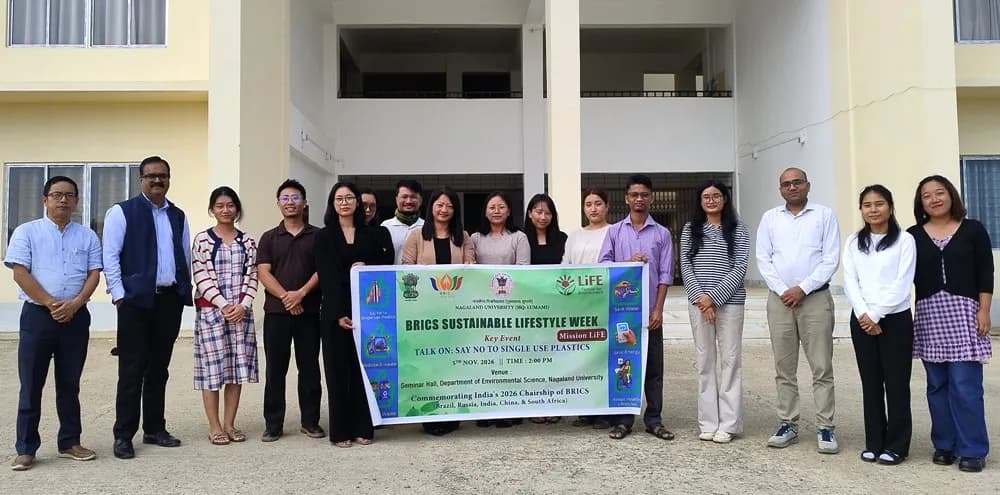
DIMAPUR — As part of the BRICS Sustainable Lifestyle Week being observed from November 1 to the 7th, a programme titled "Say No to Single-Use Plastics" was organised on Thursday at Nagaland University, Lumami.
Head of the Department of Environmental Science and member of the Committee for Mission LiFE, Dr. Latonglila Jamir, on the occasion explained that the practice of using items once without the burden of cleaning, storing, or maintaining creates a severe ecological imbalance.
She noted that plastic usage surged in the early 1950s and matured through the 1990s. Although environmental awareness emerged in the 1960s and 1970s, leading to extensive research into the 2010s, effective bans only gained momentum after 2018. Today, these materials are classified into seven main categories: PET, HDPE, PVC, LDPE, PP, PS, and "Others".
Illustrating the scale of the crisis, Dr. Jamir highlighted global and national statistics. Globally, approximately 400 million metric tons of plastic waste are generated annually, half of which consists of single-use items, while the global recycling rate sits at a 9 percent.
Citing 2019 data for India, she shared that the nation generates 9.5 million tons of plastic waste annually, 43 per cent of which are single-use items like packaging, straws, and cutlery, leaving at least 10,000 tons of waste uncollected daily.
Also read: Nagaland University observes BRICS Sustainable Lifestyle Week
While India ranks as the third-largest plastic polluter overall, its per-capita single-use plastic generation remains significantly lower than top producers like Singapore (76 kg per capita). Currently, India processes roughly 30 per cent of its plastic waste, and despite introducing a national ban, practical enforcement remains an ongoing challenge.
Addressing why recycling rates remain low, Dr. Jamir identified several operational and chemical barriers. Operationally, multilayered materials combining plastics with paper or cardboard complicate separation, while virgin plastic production from raw petrochemicals remains far cheaper than recycling. Additionally, food contamination hampers recycling efforts unless consumers thoroughly clean containers prior to disposal. Chemically, reprocessing synthetic polymers causes chain degradation and loss of structural integrity, making high-quality recycling technically difficult.
Despite these challenges, Dr. Jamir presented global success stories to demonstrate that effective policies drive real progress. Germany achieves a 65 per cent recycling rate for plastic waste and a 98 per cent return rate for drink containers through its Pfanddeposit-refund scheme. South Korea recycles roughly 58 per cent of its plastic waste via a mandatory Pay-As-You-Throw model coupled with strict sorting guidelines. Sweden diverts 99 per cent of household waste from landfills using advanced waste-to-energy facilities, even importing waste to power them. Meanwhile, Rwanda enforces a strict nationwide ban on non-biodegradable bags backed by border inspections, and the United States relies on extended producer responsibility mandates.
Dr. Jamir outlined actionable solutions and core principles for sustainable living. She called for adopting eco-friendly alternatives, such as cotton, jute, glass, stainless steel, bamboo, and paper, and embedding the 4 R Framework (Refuse, Reduce, Reuse, Recycle) into daily habits.
However, she noted that individual responsibility must be supported by policy interventions and industrial innovation. Drawing from green chemistry principles, she left the audience with a foundational takeaway: it is always far easier to prevent waste generation at the source than to clean up after waste has already been created.
The formal lecture programme was followed by a practical plastic collection drive conducted in and around the Department of Environmental Science.