


Nagaland University hosts a programme on sustainable food systems and composting as part of BRICS Sustainable Lifestyle Week
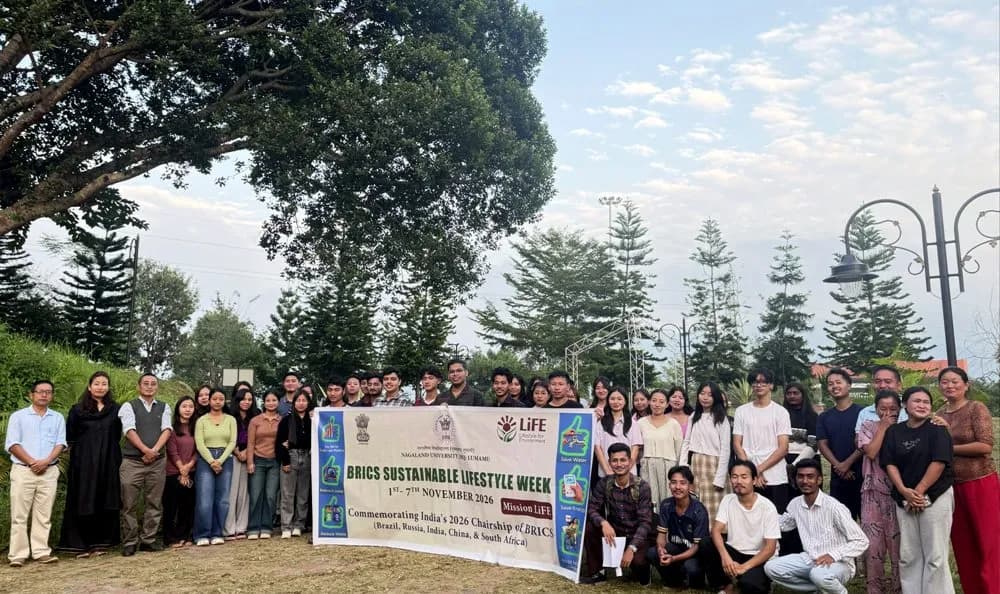
DIMAPUR — Nagaland University organised a programme on the theme "Adopt Sustainable Food Systems" at Rajiv Gandhi Park, Lumami, on Wednesday, as part of the BRICS Sustainable Lifestyle Week being observed from November 1 to the 7th.
Serving as the resource person, Dr. Lirikum from the Department of Zoology, Multidisciplinary Research Centre (MDRC), Nagaland University, presented composting as an accessible, kitchen-based solution that transforms daily organic waste into high-quality soil while advancing environmental sustainability.
According to an update, he explained that rather than purchasing commercial fertilisers or discarding kitchen scraps, individuals, particularly hostel residents who generate large volumes of food waste, can recycle these materials to cultivate plants and vegetables. Microbes break down this organic matter into compost rich in essential macronutrients such as nitrogen, phosphorus, and potassium, creating a vibrant soil structure superior to ordinary topsoil.
Beyond soil enrichment, composting plays a crucial role in environmental protection by mitigating greenhouse gas emissions, noting that food waste decomposing in landfills releases methane, a gas 28 times more potent than carbon dioxide. Composting redirects this waste, curbing emissions, eliminating foul odours, and keeping surroundings clean.
Read more: Fazl Ali College holds lecture on Gross National Happiness
To ensure efficient composting, Dr. Lirikum outlined essential management techniques, stating that containers must have adequate aeration to prevent anaerobic conditions. He advised turning the compost pile every four to five days to maintain air circulation, shredding kitchen scraps into smaller pieces to accelerate decomposition, and monitoring acidity levels to avoid inhibiting microbial activity.
Earlier, chairing the event, Assistant Professor in the Department of Zoology, Dr. Lobeno Mozhui, highlighted the deep connections between traditional diets, agricultural health, and environmental sustainability.
She praised efforts to promote nutrient-dense local dishes like Galho, a mixture of rice and vegetables, while warning against an over-reliance on standard commercial food items. She also pointed out that everyday food scraps should be viewed not as trash, but as a valuable bio-resource capable of enriching soil and restoring local ecosystems through organic composting.
Public Relations Officer of Nagaland University, Peter Ki, introduced the programme by connecting India's 2026 BRICS chairship with the Sustainable Lifestyle Week initiative. He stated that India's chairship theme, "Building for Resilience, Innovation, Cooperation and Sustainability", places sustainability at its core, connecting it with Mission LiFE to encourage everyday practices that foster environmental resilience and collective well-being.
He also exhorted students and youth to take the Mission LiFE pledge through the dedicated online portal open from November 1 to the 7th.
The BRICS Sustainable Lifestyle Week is being observed at Nagaland University to promote environmentally responsible living through public outreach, citizen engagement, and action-orientated initiatives on the key themes of "Adopt Sustainable Food Systems", "Say No to Single-Use Plastics", and "Reduce Waste (including E-Waste)".
India holds the BRICS chairship from January 1 to December 31. BRICS, originally established as BRIC in 2001, became BRICS when South Africa joined in 2010, serving as a cooperation platform for emerging economies, with the New Development Bank financing sustainable development projects.
The programme was attended by Chairperson of Mission LiFE Dr. Tovishe Phucho, MDRC faculty members, university staff, research scholars, students, and service providers from Toti-La Cafe, established under the Women Technology Park Incubation Hub.