


The Nagaland State Legal Services Authority concluded its Summer Internship Programme 2026 in Kohima on July 31.
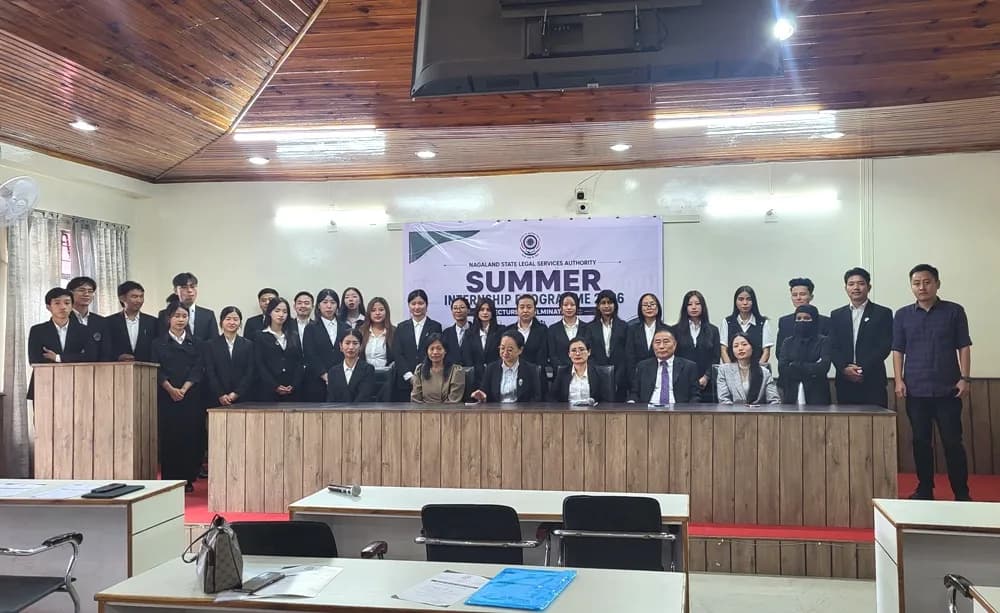
DIMAPUR — The Nagaland State Legal Services Authority (NSLSA) concluded its Summer Internship Programme 2026 with a culmination programme held at the deputy commissioner’s conference hall in Kohima on July 31.
Delivering the appraisal and keynote address, Member Secretary of NSLSA Neiko Akami described lawyers as defenders of justice and called upon the interns to become harbingers of justice by upholding the rule of law with integrity and compassion.
According to an update, he said the summer internship programme was conceived to bridge the gap between legal education and practical legal practice by exposing law students to the realities of the justice delivery system.
Beyond academic learning, Akami said the programme aimed to instil professional ethics, strengthen legal reasoning, and inspire future lawyers to use the law as an instrument for protecting the rights of the vulnerable and ensuring access to justice.
Akami stated that the consequences of alcoholism and drug abuse are a reality in Naga society, referring to how the judiciary can prove this fact.
While Nagaland may not witness the volume of crime reported in larger states, the member secretary said many incidents remain unreported or are resolved through customary institutions without entering the formal judicial system.
He cited that 766 Narcotic Drugs and Psychotropic Substances (NDPS) cases were registered in Nagaland between 2023 and June 2026. During this period, 246 female and 958 male accused were arrested, indicating the widespread reach of narcotic offences across society.
He said as per records of 11 judicial district courts, 4,627 cases remained pending till June 2026, while 639 cases had been disposed of in June alone. At the High Court, Kohima Bench, 106 cases were disposed of, and 804 cases remained pending.
Akami referred to criminal cases associated with alcoholism and abuse and the devastating consequences of substance abuse and violence.
He referenced a case in which an alcoholic and drug-dependent father was convicted of killing his three children, aged 12, 10, and 8 years, and remained incarcerated for over 17 years. In another case, a son allegedly addicted to drugs repeatedly demanded money from his mother and, upon her refusal, murdered her, ultimately receiving a sentence of life imprisonment.
He also referred to a drug trafficking case involving the smuggling of heroin from a neighbouring country, in which the accused was apprehended by the narcotics authorities and convicted to 10 years' imprisonment along with a fine of approximately INR 1 lakh.
Drawing attention to crimes against children, the Member Secretary cited a case under the Protection of Children from Sexual Offences (POCSO) Act, where an adult lured a minor girl with sweets before committing penetrative sexual assault. The accused was subsequently convicted and sentenced to 20 years' imprisonment.
Recalling the 2012 Nirbhaya case, Akami said it marked a turning point in India's criminal justice system by prompting significant legal reforms relating to sexual offences and strengthening the protection of women.
Urging the interns to carry forward the lessons gained during the programme, Akami encouraged them to uphold the highest standards of ethics and professionalism while ensuring that justice remains accessible to every individual, particularly the poor, marginalised, and vulnerable sections of society.
During the internship held in the month of July, 44 law students underwent the training.
As part of the internship programme, interns received the opportunity to visit and interact with various institutions, which included the Gauhati High Court, Kohima Bench; district courts; police stations; orphanage homes; central jail; district jail; and other institutes. The interns also participated in legal awareness activities.