


Nagaland signs an MoU with ICFRE-RFRI to promote scientific cultivation, processing and commercial utilisation of agarwood, benefiting forest-dependent communities and boosting the state's forest economy.
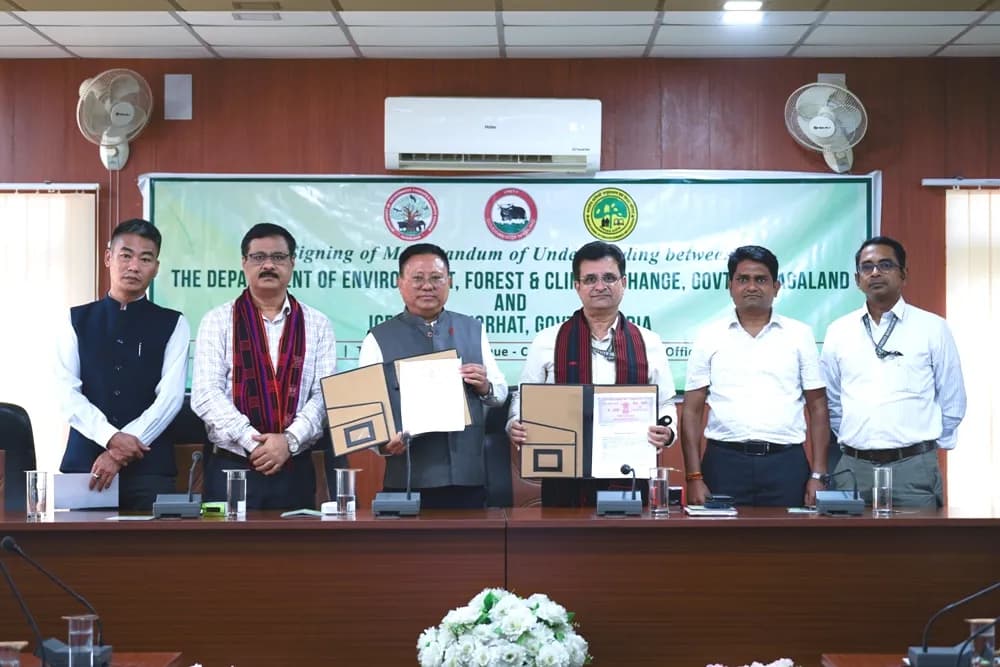
DIMAPUR — The Department of Environment, Forest and Climate Change (DEFCC) on Saturday signed a Memorandum of Understanding (MoU) with the Indian Council of Forestry Research and Education–Rain Forest Research Institute (ICFRE-RFRI), Jorhat, to promote the sustainable cultivation, processing and commercial utilisation of agarwood in the state.
The agreement was signed at the Forest Office Complex in Dimapur and aims to strengthen scientific collaboration for the economic development of forest-dependent communities while promoting sustainable management of natural resources.
Speaking at the event, ICFRE-RFRI Director Dr. Nitin Kulkarni said the partnership would help unlock the economic potential of Nagaland's natural resources, particularly agarwood, through scientific research and technical support.
He noted that while Nagaland possesses abundant natural resources, many remain under-utilised, especially by communities living in and around forest areas. Agarwood, he said, offers significant opportunities for income generation and has considerable scope for expansion in the state.
Kulkarni said the collaboration would include scientific assessment of agarwood resources by studying their distribution, quantity and quality across Nagaland.
The institute would also assist in expanding plantations and promoting agroforestry by encouraging farmers to cultivate agarwood alongside other crops rather than as a monoculture.
Also read: Nagaland launches AI-powered digital agriculture ecosystem to modernise farming
He added that scientific intervention would play a key role in improving economic returns through both natural infection and artificial inoculation of agarwood trees.
The ICFRE-RFRI would support the state in conducting surveys, identifying suitable plantation sites and providing technical expertise to maximise benefits for local communities.
Kulkarni also clarified that the MoU extends beyond agarwood and provides a framework for cooperation in the sustainable management and development of other forest-based resources.
Addressing the gathering, Principal Secretary, DEFCC, and Development Commissioner Y Kikheto Sema said agarwood has grown naturally in Nagaland for generations, but the absence of a dedicated policy on its cultivation, processing and trade had prevented the state from fully utilising its economic potential.
He said nearly 96 per cent of India's agarwood resources are found in the Northeast, with Assam and Tripura having established policies that enabled them to develop plantations and export agarwood products to international markets.
In contrast, Nagaland's lack of a policy had limited its utilisation of the national agarwood quota to around two per cent, while Assam accounts for nearly 80 per cent and Tripura around 15 per cent.
Although agarwood is naturally abundant in Nagaland's foothill areas and many trees develop valuable resin through natural infection, the state has lacked processing facilities, technical expertise and training programmes. These gaps, he said, prompted the government to formulate a dedicated agarwood policy.
Kikheto said officials visited ICFRE-RFRI, Jorhat, in March while drafting the policy and explored the possibility of collaboration.
The policy was later presented before the North Eastern Council (NEC) and NITI Aayog before being approved by the State Cabinet on May 6, which also authorised the signing of the MoU.
Under the agreement, the institute will work with the Forest department to identify suitable agarwood varieties for cultivation, conduct soil testing and recommend appropriate planting materials. It will also provide scientific and technical training on plantation management, harvesting, processing, transportation and trade.
He said the collaboration would help ensure that agarwood production and marketing are carried out in a scientific and regulated manner instead of through unorganised practices.
Kikheto also noted that while the Union Budget has sanctioned an agarwood processing unit for Golaghat in Assam, Nagaland would require similar technical support from ICFRE-RFRI to establish processing facilities in the state in the future.
Highlighting the importance of scientific innovation, he said many agarwood trees in Nagaland's foothill areas develop resin naturally, while others mature without infection.
To address this, ICFRE-RFRI has developed an artificial inoculation technology known as the "Sashi Inoculation" method, which induces resin formation by injecting a specially developed formulation into the trees.
According to Kikheto, field trials conducted by the institute have recorded a success rate of over 90 per cent. He said the technology has been incorporated into the MoU and would help reduce farmers' dependence on private operators who often charge high fees without guaranteeing results.
The government-to-government partnership, he added, would make scientifically validated inoculation technology more accessible, regulate inoculation costs and improve the value of agarwood produced by farmers, enabling them to secure better market opportunities.
While the present MoU focuses on agarwood development, Kikheto said the state government and ICFRE-RFRI are also exploring a similar collaboration for teak cultivation in Nagaland.