


Districts in Nagaland hold several workshops and distribution drives on agricultural practices, poultry farming, and piggery.
Share


DIMAPUR/WOKHA — Several agricultural, poultry, and livelihood development initiatives were conducted across multiple districts in Nagaland to promote sustainable farming, enhance rural livelihoods, and empower local communities.
Wozhuro AGM highlights growth of SHGs
In Wokha, the Liju Federation, Wozhuro Block, promoted under the Nagaland State Rural Livelihoods Mission (NSRLM), held its third annual general meeting (AGM) at the Public Ground, Wozhuro Range, on June 12.
The Assistant Registrar of Cooperative Societies (ARCS), Obendangba, commended the federation members for their dedication in strengthening self-help groups (SHGs) across the district.
He encouraged SHGs to register under Cooperative Societies through the Rural Development department. Highlighting the potential of food processing enterprises in Nagaland, Obendangba advised SHGs to adopt sustainable pricing strategies, introduce smaller packaging options, and improve shelf life through better preservation techniques.
Success stories were shared during the meeting. VF Mangasa village-level organisation (VLO) member T Kimonglo Lotha narrated how her SHG received a revolving fund of INR 17,000, enabling members to start small businesses. She now runs a ration shop supporting her family. Bank Sakhi Khomotchu of Oreno VLO shared how she borrowed from her SHG to purchase a vehicle and begin a rubber plantation venture.
Chanden SHG received the Best Performing SHG Award, Hayichan VLO was awarded Best Performing VLO, Oreno Patton received the Best VF/MBK Award, Ebibeni Lotha was honoured with the Best CSP Award, and Thungrhoni Yanthan received the Best CRP-ep Award.
Asetkong urged to become piggery farming hub
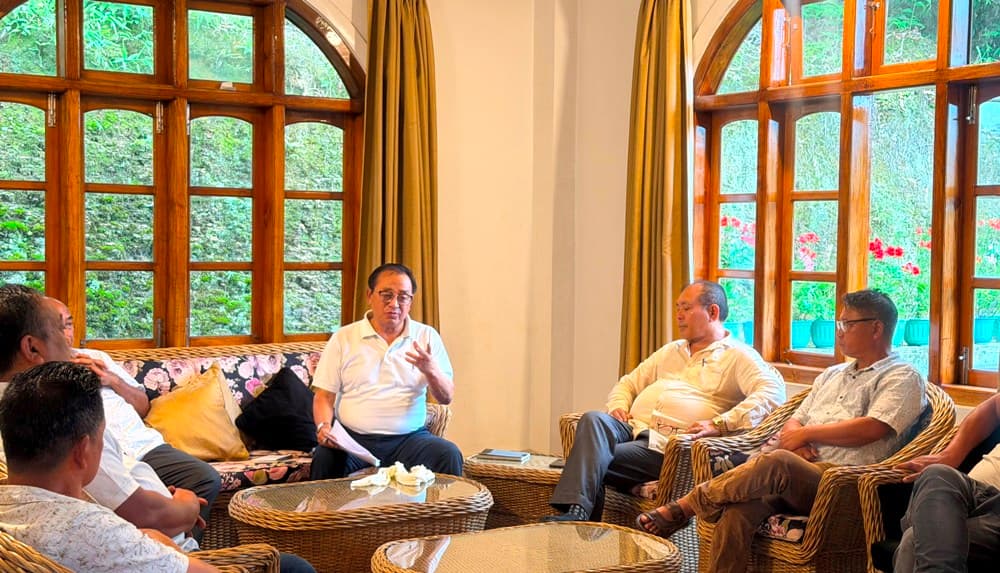
In Mokokchung, the governing body of the 23 Impur Piggery Community Project and stakeholders held a meeting at the residence of the Advisor for Law and Justice and Land Revenue TN Mannen, on June 11.
According to an update, Mannen advocated for Asetkong to become a piggery farming hub and directed departmental officials to assist the project through training and medical support. He expressed hope that future leaders and stakeholders from the Asetkong area will continue the project to meet Mokokchung district's piggery needs.
Dr. Simon, retired Additional Director of Animal Husbandry and Veterinary Services, spoke on technical matters, feed, and disease control measures.
District Chief Veterinary Officer (CVO) Dr. Tiachuba spoke on animal registration and life insurance procedures, while Dr. Sarandi from Krishi Vigyan Kendra (KVK) discussed demonstration plots and technical support.
The Impur Community Piggery Project, launched in May 2016, covers nine villages under the 23 Impur Assembly Constituency. A total of 106 beneficiaries have received piglets, feeders, and necessary equipment. Piggery Community Project Convenor Aongsen Aier presented the progress details for discussion.
ICAR holds fertiliser stakeholders meeting
In Medziphema, the Indian Council of Agricultural Research (ICAR) Research Complex for North Eastern Hill (NEH) Region, Nagaland Centre, organised a state stakeholders meeting on "Present status of fertiliser consumption and strategies to reduce its application" on June 12.
Dr. H Kalita, Head of Regional Centre, highlighted the need for Integrated Nutrient Management (INM) through the combined use of chemical fertilisers, organic manures, and biofertilisers. Director of Agriculture Sanuzo Neinu spoke on improving nutrient-use efficiency for food security and farm profitability.
Dr. Lahar J Bordoloi, Head of ICAR-KVK Kiphire, presented the Draft State Action Plan on Fertiliser Consumption and Reduction Strategies. The proposed roadmap focuses on soil test-based nutrient application, Integrated Farming Systems (IFS), and precision farming. Dr. Girish Patel and Dr. I Shakuntala Devi spoke on integrated farming approaches and livestock-based farming systems.
KVK Phek holds Sarpanch sammelan
In Phek, the ICAR-Krishi Vigyan Kendra (KVK), Phek, under ICAR-Agricultural Technology Application Research Institute (ATARI), Zone VII, Umiam, organised a “Sarpanch sammelan: Capacity building programme on Khet Bachao Abhiyan” on Saturday at its Porba campus.
Representatives from seven villages, including village council chairmen, members, head gaon buras, and community leaders, attended.
Dr. Sanjeev Kumar Singh, Senior Scientist and Head of KVK Phek, highlighted the campaign's focus on soil testing, balanced nutrient management, natural farming, pulse production, and Thu-thu cattle.
Special Guest Dr. Pritpal Kaur, Superintendent of Police, Phek, encouraged village leaders to support sustainable livelihoods and promote organic farming, digital technologies, and agro-ecotourism.
Technical sessions featured lectures by Dr. T Esther Longkumer, Chief Technical Officer (CTO) (Soil Science); Dr. Hannah K Asangla, CTO (Agronomy); Manjunath KS, SMS (Horticulture); and Keniseto Chucha, Farm Manager.
KVK Zunheboto distributes poultry inputs
In Zunheboto, KVK Zunheboto, Nagaland University, organised an input distribution programme under the National Bank for Agriculture and Rural Development (NABARD)-sponsored Farmers' Support Programme Fund (FSPF) project "Empowering rural women through Kadaknath poultry farming: A sustainable approach to livelihood and nutrition" on June 12 at VK Town, Akuluto.
Tiayanger Jamir, ADC of Akuluto, attended as the chief guest, and Poji, District Development Manager (DDM) of NABARD, attended as the special guest, stated a press release.
Dr. Rakesh Kumar Chaurasia, Principal Investigator of the project and Programme Coordinator of KVK Zunheboto, highlighted the project's goal of improving household nutrition and women's empowerment through scientific poultry practices.
GB Hekuto of Sastami village and Kheveni Aye of Ajiquami village spoke on behalf of the beneficiaries, thanking the teams for selecting Sastami, Maromi, and Ajiqami villages.
Essential poultry inputs, including Kadaknath chicks, feeds, medicines, drinkers, and feeders, were distributed to 45 selected women beneficiaries under the project. The programme concluded with a vote of thanks from Naropongla, Senior Technical Officer (Farm).