


India, Assam and Nagaland signed a historic tripartite Memorandum of Understanding to unlock border oil and gas exploration after decades of dispute.
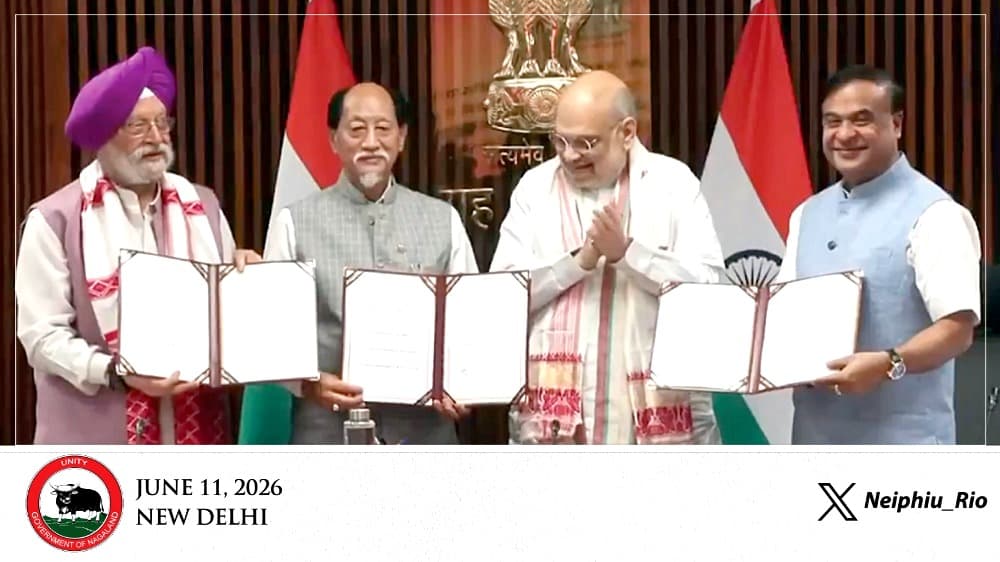
KOHIMA — In a major breakthrough after years of disputes over exploration and production of crude oil and natural gas along the Assam–Nagaland border, a tripartite Memorandum of Understanding (MoU) was signed on Thursday in New Delhi among the governments of India, Assam, and Nagaland.
The agreement was signed in the presence of Union Home Minister Amit Shah, Union Minister for Petroleum and Natural Gas Hardeep Singh Puri, Nagaland Chief Minister Neiphiu Rio, Assam Chief Minister Himanta Biswa Sarma, senior Union government officials and representatives of the two state governments.
Describing the signing as a "historic moment", Shah said that the agreement would significantly enhance prospects for oil and natural gas exploration in the region while opening up opportunities for mineral exploration across the Northeast.
Also read: Rio pitches Foothill Road, IIT, AIIMS and airport projects at NITI Aayog meet
WC-NNPG opposes oil exploration until Naga political settlement is signed
"Today, we have successfully removed a major hurdle in realising the prime minister's vision of a prosperous and developed Northeast," Shah said, adding that the agreement reflected the spirit of "Nation First."
He said that both Assam and Nagaland had agreed to a 50:50 resource-sharing arrangement in the disputed areas.
Another long pending issue of Northeast has come to an end. Speaking on the signing of the historic agreement in New Delhi. https://t.co/muwLvZkRcb
— Amit Shah (@AmitShah) June 11, 2026
"There is neither a winner nor a loser in this agreement. It is a win-win situation where India, Assam and Nagaland all emerge victorious," he said.
Shah also welcomed Nagaland's willingness to facilitate oil exploration beyond the six disputed fields covered under the agreement, stating that the state government had expressed openness to exploration activities across the state.
According to Shah, the MoU could pave the way for broader mineral extraction activities across the Northeast, a region he said possesses vast reserves of oil, natural gas and minerals that have remained underutilised because of longstanding disputes and law-and-order concerns.
Also read: Assam simplifies business registration through single-window portal — CM Himanta Biswa Sarma
He claimed that the agreement could increase oil production from the current 1,000–1,500 barrels per day to more than ten times the present level, adding that a single oilfield has the potential to generate recoveries worth over INR 15,000 crore.
"If the oil and gas reserves across Nagaland are fully tapped, India can significantly reduce its dependence on foreign sources to meet its energy requirements," Shah said.
Calling the agreement an example of cooperative federalism, the Union home minister said that it would create new avenues for economic growth and investment in both Assam and Nagaland.
A HUGE STEP IN ENHANCING BHARAT’S ENERGY SECURITY 🇮🇳Under the guidance of Hon’ble Prime Minister Shri @narendramodi Ji and in the distinguished presence of Adarniya @AmitShah Ji and the Hon’ble Chief Minister of Nagaland Shri @Neiphiu_Rio Ji along with Hon'ble Union Minister… pic.twitter.com/BANcyDAr3X
— Himanta Biswa Sarma (@himantabiswa) June 11, 2026
He also highlighted the Centre's efforts to restore peace in the Northeast since Prime Minister Narendra Modi assumed office, stating that nearly 12 peace agreements had been signed in the region since 2019, contributing to an approximately 80% decline in violence and facilitating infrastructure development, tourism growth and increased private investment.
Referring to the gradual withdrawal of the Armed Forces (Special Powers) Act (AFSPA), Shah said that over 80% of the Northeast is now free from the Act and expressed confidence that it could be withdrawn from most of the remaining areas by next year.
Linking the agreement to India's long-term energy security, Shah said that global geopolitical tensions and conflicts have underscored the importance of reducing dependence on imported energy.
"This initiative will strengthen India's self-reliance and provide significant relief whenever global energy crises arise," he said.
The signing of the MoU came a day after Chief Minister Rio, accompanied by Deputy Chief Ministers TR Zeliang and Yanthungo Patton, met Union Petroleum and Natural Gas Minister Hardeep Singh Puri in New Delhi to discuss petroleum exploration and development in Nagaland. The meeting followed earlier consultations held in February this year on the long-pending border oil exploration issue.
The agreement is expected to facilitate the resumption and expansion of hydrocarbon exploration in the disputed belt while providing a framework for cooperation between the Centre and the governments of Assam and Nagaland for exploration and production activities across more than 1,000 sq km of the border region.