


Dr. Kekhrielhoulie Yhome stresses school leadership, curriculum and administration at DSSL PLC launch in Kohima.
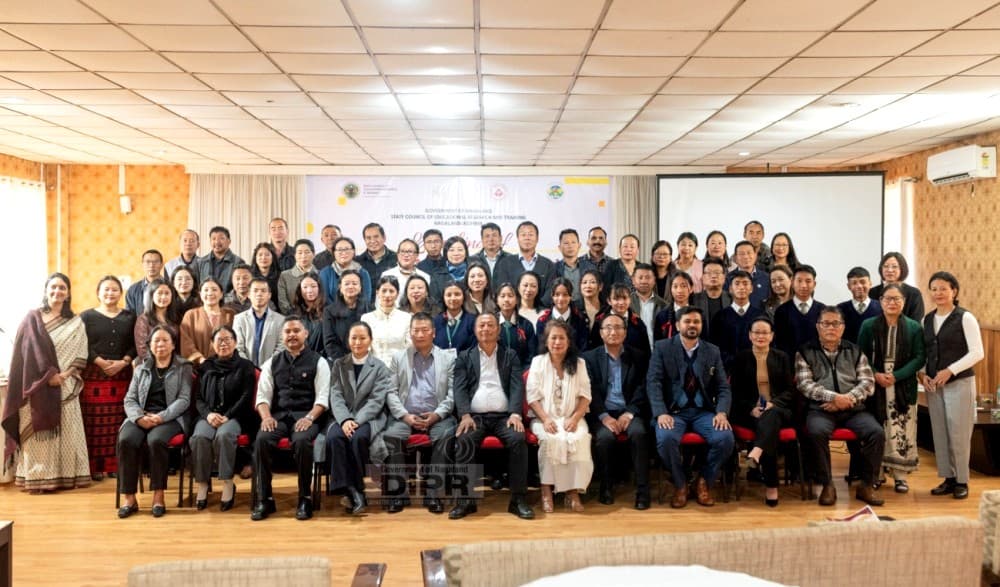
DIMAPUR — Advisor for School Education and SCERT, Dr. Kekhrielhoulie Yhome, stated that a robust education system rests on three key pillars - school leadership, curriculum, and administration.
The advisor was addressing the launching of the District School & System Leaders Professional Learning Community (DSSL PLC) at de Oriental Grand, Kohima, on Tuesday, a DIPR report stated.
Yhome stressed the need to reinforce these foundations while addressing persistent challenges such as infrastructure gaps, connectivity issues, shortage of human resources, and logistical and systemic barriers that continue to affect implementation on the ground.
The launch marks a step towards strengthening the state’s education system through collaborative leadership and institutional reforms.
Stressing on the importance of rebuilding public confidence, he emphasised that revitalising government schools remains a priority.
He expressed optimism that initiatives like the professional learning community would help restore trust in the public education system and create a more accountable and responsive framework.
The advisor also informed that a baseline survey covering 249 schools across the state has been undertaken, alongside a pilot of the School Quality Assessment and Accreditation Framework (SQAAF), to assess existing conditions and guide future interventions.
Also read: SCERT, NBSE tie up with Lend A Hand India
Aligning reforms with the National Education Policy, efforts are being made to develop a world-class curriculum tailored to the needs of the state, he added.
Yhome further stressed the importance of continuous teacher training and capacity building, noting that school leadership and systems must operate with a greater degree of personalisation and maintain close coordination with the administrative machinery.
Deputy Director of SCERT, Nagaland, Benjung Yaden highlighted the progress and impact of the School Leadership Development Programme (SLDP) during the launch of DSSL PLC.
She traced the initiative to the establishment of the National Centre for School Leadership under the National Institute of Educational Planning and Administration, which led to the creation of School Leadership Academies across states.
Yaden mentioned that the programme aims to strengthen leadership across schools to improve learning outcomes. Training initiatives include a one-month certificate course for school heads and senior teachers, along with shorter programmes for head teachers. These are supported by locally adapted modules, research activities, and documentation of best practices, she informed.
Aligned with the National Education Policy 2020, she said that the SLDP focuses on continuous professional development and leadership skills.
The one-month course is conducted in three phases, combining classroom training, school-based project work, and final assessment.
Secretary of School Education, Mhathung Tungoe, emphasised that in today’s evolving educational landscape, innovative approaches are essential to enhance student learning and strengthen school communities, noting that educational excellence is a responsibility that shapes society’s future.
He highlighted that Professional Learning Communities (PLCs) foster continuous improvement, shared expertise, and collaborative problem-solving among educators.
Recognising their importance, the School Leadership Academy, SCERT, in collaboration with the National Centre for School Leadership, NIEPA, New Delhi, and NECTAR P3 consortium, launched the DSSL PLC in Nagaland.
Describing it as a significant initiative, he said the DSSL PLC will build a strong network of educational leaders to share best practices, drive systemic change, and improve the quality of education across the state.
Principal Director of School Education, Shashank Pratap Singh, stated that nearly 385 leaders have been trained through a one-month leadership programme.
He said that the training is integral, and teachers were mandated under NEP 2020 to undergo professional development courses. Singh also said that school leadership has become increasingly important as rules have evolved.
“Schools now have a significant degree of autonomy, and what happens within a school largely depends on its teachers. However, autonomy must be exercised with accountability, and the school head bears a crucial responsibility in this regard,” the principal director said.
Assistant Professor NCSL, NIEPA, New Delhi, Dr. Yogesh Pahariya, acknowledged Nagaland as one of the best-performing states, taking a leading role in the implementation of NEP.
He highlighted that the state has institutionalised PLCs into a formal structure and mechanism.
He emphasised that a PLC is not merely a group, but a culture where educators learn, discuss, grow, and share accountability. Such a culture has the potential to build strong leadership and improve learning outcomes, he added.
“The launch of the professional learning community is expected to serve as a catalyst for reimagining school education in Nagaland, fostering collaboration among leaders and laying the groundwork for long-term, sustainable reforms,” the report stated.