


NSHRC Chairman Justice Jamir urges legal reform, digital literacy and collective action to combat stalking and cyber stalking in Nagaland
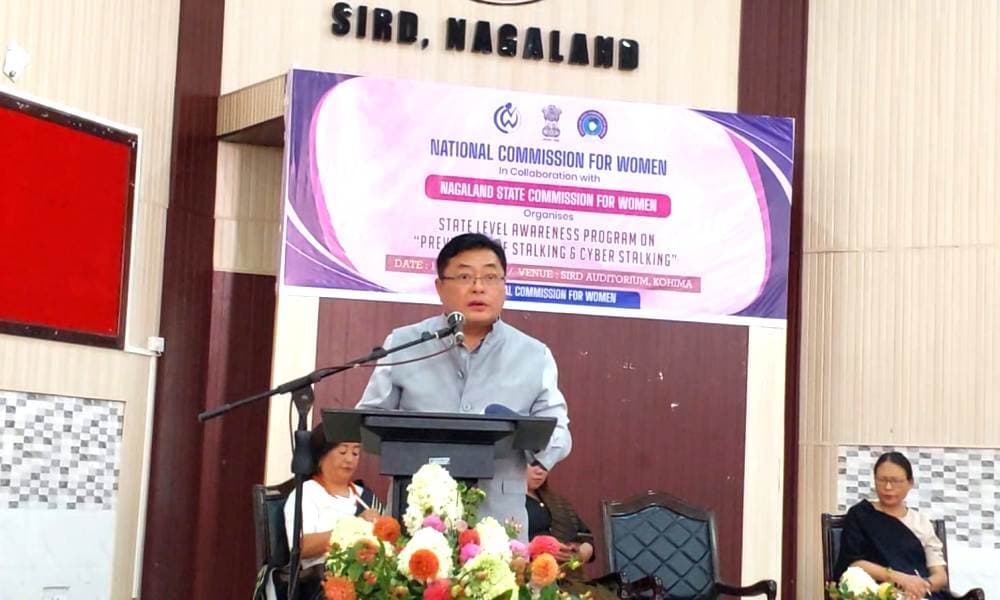
KOHIMA — Nagaland State Human Rights Commission (NSHRC) Chairman Justice Lanusungkum Jamir on Wednesday called for stronger legal safeguards, improved digital literacy and a collective societal response to combat stalking and cyber stalking, stressing that every person has the right to privacy and to live without fear, both offline and online.
Addressing the inaugural session of State Level Awareness Programme on Prevention of Stalking and Cyber Stalking, organised by National Commission for Women (NCW) in collaboration with Nagaland State Commission for Women (NSCW) in Kohima, Jamir described stalking as a pervasive yet often trivialised violation of human dignity.
He said that India now recognises stalking as a serious offence under Section 78 of the Bharatiya Nyaya Sanhita (BNS), which covers both physical and cyber stalking. However, he reminded that stalking remains a bailable offence on the first instance and pointed out that the law currently identifies the perpetrator as a man, suggesting it should evolve to provide gender-neutral protection.
Jamir maintained that preventing stalking requires more than legal action, urging society to respect personal boundaries, understand that "no means no", and reject cultural narratives that glorify persistence over consent.
Also read: Deputy CM TR Zeliang calls for safe spaces for women in politics
Highlighting the rise of cyber stalking, he said that social media, spyware and other digital tools have made it easier for offenders to monitor, intimidate and harass victims through online surveillance, fake accounts, identity theft and the non-consensual sharing of private information.
While India has strengthened its legal framework through the BNS and the Information Technology Act, 2000, he said that challenges remain due to the borderless nature of the internet, evolving technology, low digital literacy and the stigma associated with reporting online abuse.
He advised victims to preserve evidence, block offenders, report them to online platforms and approach law enforcement agencies if harassment persists or threats escalate.
WATCH MORE:
Delivering the keynote address, NSCW Chairperson W Nyingyeih Konyak said that stalking and cyber stalking have become serious threats to the freedom, dignity and safety of women and girls.
While Nagaland continues to report one of the lowest rates of crimes against women, with 56 cases recorded in the latest National Crime Records Bureau (NCRB) report, she said the state's digital spaces are becoming increasingly vulnerable to cyber offences.
Referring to a representative case study presented during the programme, Konyak said that a college student in Kohima allegedly became the target of an anonymous cyber stalker who monitored her social media activity, tracked her movements, created AI-generated morphed images and attempted to extort her, illustrating the severe psychological impact of such crimes.
She urged educational institutions to strengthen reporting mechanisms and legal awareness, and called for a state-wide campaign on digital hygiene, improved cyber forensic infrastructure under the Cyber Crime Prevention against Women and Children (CCPWC) scheme, and greater community support for survivors instead of victim-blaming.
The event included technical sessions by officials from Nagaland Police, NIELIT, mental health professionals and legal experts.