


Nagaland launches e-Challan system in Dimapur to boost transport revenue, improve road safety, and strengthen digital traffic enforcement.
DIMAPUR — Nagaland’s Motor Vehicles Department is the state’s second-largest revenue generator, having contributed approximately INR 260 crore in the last financial year towards a total state plan of about INR 1,000 crore.
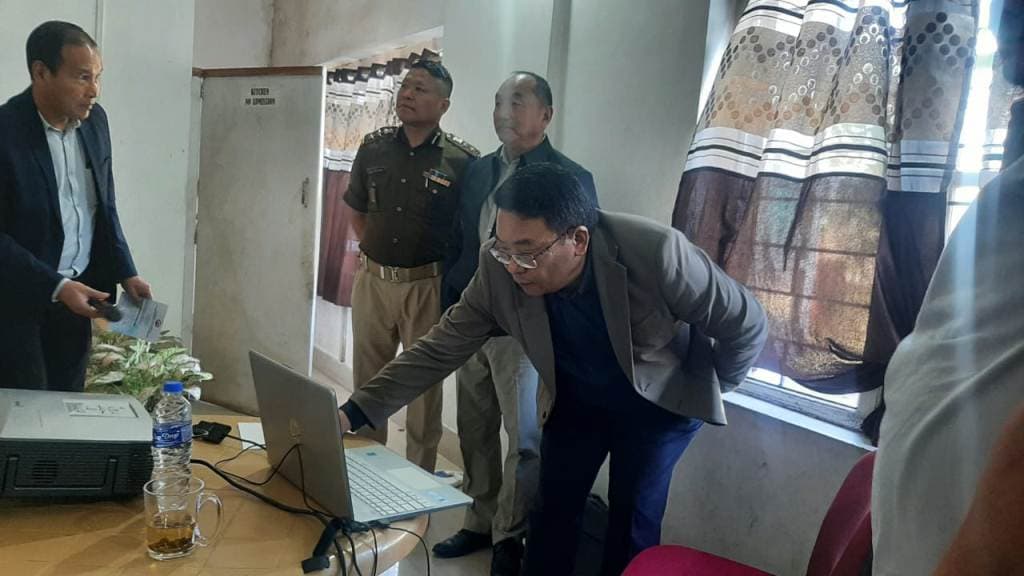
This was stated by Commissioner and Secretary for Transport department, Robert Longchari, during the launch of e-Challan service in the state, with Dimapur selected as the pilot district, on Monday at the District Transport Office (DTO), Dimapur.
With the launch, Nagaland becomes the 34th state in the country to introduce e-Challan system, marking a significant milestone in the state’s journey towards transparent, efficient and technology-driven governance.
Longchari said that strengthening enforcement in the transport sector could substantially boost the finances of the revenue-deficient state.
He felt that improving road safety and revenue collection will take time, as Nagaland continues to face challenges such as a shortage of driving schools, weak enforcement of traffic rules and a vehicle population exceeding four lakh, resulting in chronic congestion on roads.
Also read: Naga people can’t back unknown Agreement, says Niki Sumi
Referring to the national vision of Viksit Bharat and the state’s own Viksit Nagaland 2047 target, Longchari stressed the urgent need for a more dynamic and efficient transport system.
He said that Nagaland Police remains the primary enforcement agency, while the Transport department operates with a skeletal staff of around 30 traffic officers to oversee the entire state—an arrangement he described as grossly inadequate given the number of registered vehicles.
Drawing parallels, Longchari said that the situation mirrors that of the Nagaland Liquor Total Prohibition (NLTP) enforcement, where just about 300 personnel are tasked with monitoring compliance. He added that districts such as Dimapur and Kohima currently function with only eight to nine enforcement officers each.
As the new traffic enforcement initiative rolls out, he stressed that enhanced police deployment will be essential for effective implementation and to restore order on Nagaland’s congested highways.
Expressing gratitude to departmental officers, Longchari said their efforts in establishing a transparent and connected traffic system deserve recognition.
He recalled that during last year’s national transport and safety meeting in Delhi, Nagaland’s progress was often overlooked due to lack of tangible implementation, but the launch of the e-Challan system now provides the state with a concrete achievement to present to the Ministry of Road Transport and Highways.
Despite ongoing highway upgrades, Longchari said that road accidents remain high, largely due to the prevalence of self-taught drivers. He expressed optimism that the e-Challan system would significantly improve compliance and safety.
He cautioned that although major projects are planned, the Transport department continues to suffer from a shortage of skilled manpower. However, he said that the transition from manual enforcement to a digital system—supported by staff training and public awareness campaigns—would enhance efficiency and substantially improve revenue collection.
Referring to Kohima’s worsening traffic congestion amid rising vehicle registrations, Longchari sought suggestions from the media, officials and the public, while stressing that restricting vehicle ownership is not a viable solution.
Article 371 (A) relook
According to the senior bureaucrat, land acquisition remains the biggest hurdle to highway development in Nagaland, as land ownership rests with communities rather than the government. While acknowledging Article 371 (A) as a protective provision, he urged a review, stating that without addressing landownership challenges, projects such as the Trans-Highway and East Asia Highway cannot progress.
He said a fresh approach to land acquisition is essential to unlock Nagaland’s infrastructure potential.
Highlighting the benefits of the e-Challan system, Longchari said that it would eliminate cash transactions and discretionary decision-making, ensuring that all penalties are deposited directly into the government treasury.
“This transparency will build public trust by removing ambiguity, delays and negotiation. Our citizens deserve a fair and accountable system, and e-Challan is a major step towards that,” he said.
He outlined plans to roll out the system statewide, starting with Dimapur, followed by all districts, along with the installation of automatic enforcement cameras wherever feasible. He also stressed the importance of data analytics in policymaking.
“Our goal is to transform Nagaland into a model state for digital transport governance, where every service—from vehicle registration to enforcement—is transparent, efficient and citizen-centric,” he said, adding that the department welcomes public suggestions.
Meanwhile, Lanusungkum Aier, Senior Technical Director and State Informatics Officer for Transport Project, National Informatics Centre (NIC), said that implementation of the e-Challan system would be challenging as it involves strict enforcement of road rules.
He said that the e-Challan app, developed jointly by NIC and Ministry of Road Transport and Highways, complies with CMVR rules and offers a comprehensive enforcement solution for transport officials, traffic police and violators.
The system includes handheld devices for enforcement officers, a web portal, GPS-enabled geo-tagging, online payment options, and SMS alerts. While CCTV integration is not yet active in Nagaland, the platform supports red-light and speed-violation cameras used in major cities.
He urged vehicle owners to update their mobile numbers on the portal to ensure timely alerts and compliance.