


Niki Sumi questions secrecy around Framework Agreement, urges public disclosure, clarity on integration, and unified Naga stand before settlement.
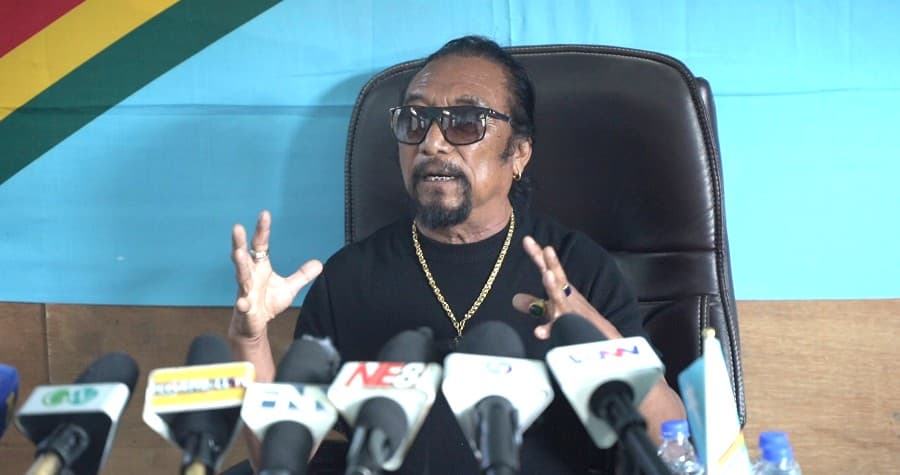
DIMAPUR — Gen. (Retd.) Niki Sumi, President of NSCN/GPRN, on Monday expressed concern over the lack of transparency surrounding the Framework Agreement, stating that Naga people cannot support any agreement—good or bad—without knowing its contents.
Addressing a press conference at the Ceasefire Supervisory Board (CFSB) office in Padumpukhuri here, Sumi said that if the agreement genuinely benefits Nagas, NSCN (IM) should make it public so that any problematic clauses can be identified and corrected.
He questioned whether Naga integration has been finalised in the agreement and whether the demand for a Naga flag and constitution applies only to Nagaland or also includes Naga-inhabited areas of Manipur, Arunachal Pradesh, and Assam.
He warned that ambiguity on these issues could lead to interstate conflict and urged clarity so that the Naga people can make an informed decision.
Stressing the importance of understanding the history of Northeast, Sumi said that indigenous Naga communities in Arunachal Pradesh have been sidelined over time, while Mizoram made significant progress after a political settlement.
Referring to Assam, he cited the history of Kamrup Kingdom, Mikir Hills, and the Assam Movement led by AASU against illegal immigration, which brought relative stability but also gave rise to ULFA.
WATCH MORE:
He said that the Bodos, one of the oldest indigenous groups in Assam, are now confined to the Bodoland Territorial Region. He added that although the British could not control the Mikir Hills, the region later received only autonomous council status.
Sumi further pointed out that Tripura has been overtaken demographically by Bengali settlers, while in Manipur, nearly 80% of the land belongs to tribal communities and remains constitutionally protected.
Comparing Nagaland with other NE states, Sumi said that despite challenges, Nagaland enjoys relatively better facilities.
He asserted that political groups existed even before statehood, and their continued presence thereafter has prevented outsiders from overtaking the Naga people. He claimed that peace and economic stability among Nagas are largely due to the existence of political groups.
Sumi went on to state that in the past many shops, contractors, and businesses were controlled by non-Nagas, but political groups restricted such dominance, enabling Nagas to gain economic opportunities.
Criticising the subcontracting system, Sumi alleged that development in Nagaland has suffered because main contractors take up to 40 percent of project funds, leaving little for actual work after commissions. He claimed that most main contractors are from mainland India and urged that central development contracts in Nagaland be awarded to Nagas to ensure better implementation.
On the Naga National Political Groups (NNPG), Sumi said that although the Agreed Position was signed by seven groups, they have since splintered into multiple factions—around 10 under Kitovi Zhimomi and seven under NN Nokpao.
He said the group must clarify which faction will carry the agreement forward and urged them to unite under one convenor, one leadership, and one taxation system before appealing to the public for unity.
Sumi further stated that blaming the state government alone for the Naga political issue is misleading, as state institutions cannot provide a political solution.
He urged political parties and civil society leaders not to disclose details of meetings with the governor, interlocutor, or Union home minister, claiming such engagements often deepen divisions among the Naga people.
Emphasising unity, Sumi said that cooperation among United Naga Council (UNC), Eastern Nagaland People’s Organisation (ENPO), and Nagaland tribal hohos is crucial.
If these bodies unite and move forward with all political groups and the people, he said, a strong collective demand can be placed before the government of India. Continued disunity, he warned, would lead to further fragmentation, autonomous councils, and the eventual erosion of Naga identity.